Join us on a literary world trip!
Add this book to bookshelf
Grey
Write a new comment Default profile 50px
Grey
Subscribe to read the full book or read the first pages for free!
All characters reduced
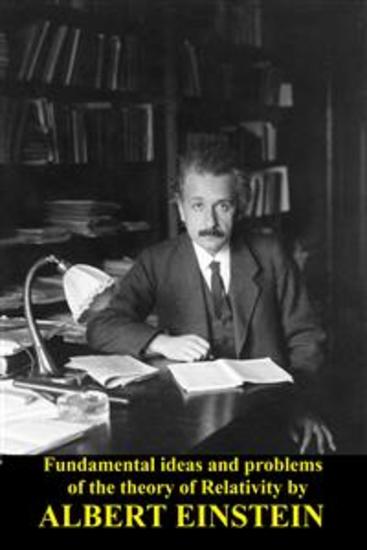
Fundamental ideas and problems of the theory of Relativity - cover

Fundamental ideas and problems of the theory of Relativity

Einstein Albert

Publisher: Balungi Francis

  • 0
  • 0
  • 0

Summary

Einstein's Theory of Special Relativity is based on two principles:

	The laws of physics are constant, even when objects move at constant speeds relative to each other.
	The speed of light is the same for everyone, regardless of how they move relative to the light source.


One fundamental problem with Einstein's theory of relativity is that relative spacetime is not true. Special relativity also challenges our intuitive understanding of simultaneity. According to the theory, two events that are simultaneous in one frame of reference may not be simultaneous in another.

Firstly we see that at any point filled with matter there exists a preferred state of motion, namely that of the substance at the point con- sidered. Our problem starts however with the question whether physically preferred states of motion exist in reference to extensive regions.

This ebook contains a Lecture delivered to the Nordic Assembly of Naturalists at Gothenburg, July 11, 1923 by A.Einstein
Available since: 01/24/2024.

Other books that might interest you

  • Ultimate Web Automation Testing with Cypress - Master End-to-End Web Application Testing Automation to Accelerate Your QA Process with Cypress - cover

    Ultimate Web Automation Testing...

    Vitaly Skadorva

    • 0
    • 0
    • 0
    Elevate Your Web Testing with Practical Insights and Advanced Techniques.
     
    Book Description
    Dive into the world of automated web testing with “Ultimate Web Automation Testing with Cypress.” From foundational concepts to advanced techniques, the book equips professionals with the skills to seamlessly integrate Cypress into their workflow. Starting with setup and basic tests, it progresses to cover end-to-end, component, API, and data-driven testing with practical examples and best practices. Further, it explores advanced topics like custom commands, plugins, Cypress Cloud, Smart Orchestration and Flaky Test Management. The book also unveils the integration with GitHub, GitLab, and Cucumber, and concludes with CI/CD implementation using Docker and Jenkins Pipelines, along with effective reporting techniques.
     
    By the end, you will have a profound understanding of Cypress, empowering you to excel in web application testing and advance your careers in the competitive software testing industry.
     
    Table of Contents
    1. Getting Started with Cypress Testing
    2. Setting Up the Development Environment
    3. Writing Your First Test
    4. End-to-End (E2E) Testing
    5. Component Testing
    6. API Testing
    7. Data-Driven Testing
    8. Advanced Cypress Techniques
    9. Cypress Cloud, Smart Orchestration, and Flaky Test Management
    10. Integrating with GitHub, GitLab, and Cucumber
    11. Continuous Integration and Continuous Deployment (CI/CD)
    12. Reporting and Test Results
    13. Conclusion
    Index
    Show book
  • Tips For Social Bookmarking - cover

    Tips For Social Bookmarking

    Larry Arnett

    • 0
    • 0
    • 0
    Tips For Social Bookmarking: Discover How Social Bookmarking Works and How It Can Help You Get the Most Out of Your Online ExperienceSocial bookmarking is not only one of the easiest ways of saving your favorite websites and bookmarks, but it is also very easy. There are many different social bookmarking sites on the web today. Social bookmarking has become such a popular way to save and share your websites with others that many companies have developed social bookmarking sites.This audiobook will teach you everything you need to know about social bookmarking. Learn tips on how it can help browsing the internet either for personal or business more fun and efficient.This audiobook will cover the following topics:- The Simplicity Of Social Bookmarking- Why People Love Social Bookmarking- Using Social Bookmarking As A Search Engine Tool- Using Tags In Social Bookmarking- Social Shopping Through Social Bookmarking- Most Popular Social Bookmarking Sites- Social Bookmarking For Educational Purposes- Quick And Easy Access To Social Bookmarking Sites- Choosing Social Bookmarking Sites- Social Bookmarking Tips- Social Bookmarking SoftwareSocial bookmarking offers internet users many options for finding things of interest quickly and easily. Rather than go through the sometimes tedious searching. If you want to learn more, scroll up and click “add to cart” now!
    Show book
  • How to Design and Simulate Stand Alone PV System using PVsyst - cover

    How to Design and Simulate Stand...

    Prasun Barua

    • 0
    • 0
    • 0
    Embark on a journey into the world of solar energy with "Solar Brilliance," an insightful and practical audiobook that unveils the secrets of designing and simulating standalone PV systems using PVsyst. Authored by experts in the field, this audiobook takes you step-by-step through the process of harnessing the power of the sun to create efficient and sustainable photovoltaic setups. Whether you're a seasoned professional or a curious enthusiast, the narrated guide provides in-depth knowledge, practical tips, and real-world examples, ensuring that you master the art of designing and simulating standalone PV systems. From understanding the fundamentals of solar energy to navigating the advanced features of PVsyst software, "Solar Brilliance" is your indispensable companion in the pursuit of clean, renewable energy solutions. Listen, learn, and empower yourself to contribute to a greener, more sustainable future.
    Show book
  • The Wireless World - Global Histories of International Radio Broadcasting - cover

    The Wireless World - Global...

    Friederike Kind-Kovacs, Andrea...

    • 0
    • 0
    • 0
    The Wireless World sets out a new research agenda for the history of international broadcasting, and for radio history more generally. It examines global and transnational histories of long-distance wireless broadcasting, combining perspectives from international history, media and cultural history, the history of technology, and sound studies. It is a cowritten book, the result of more than five years of collaboration. Bringing together their knowledge of a wide range of different countries, languages, and archives, the coauthors show how broadcasters and states deployed international broadcasting as a tool of international communication and persuasion. 


    Exploring the idea of a "wireless world," a globe connected, both in imagination and reality, by radio, The Wireless World sheds new light on the transnational connections created by international broadcasting. Bringing together all periods of international broadcasting within a single analytical frame, the study reveals key continuities and transformations. It looks at how wireless was shaped by internationalist ideas about the use of broadcasting to promote world peace and understanding, at how empires used broadcasting to perpetuate colonialism, and at how anti-colonial movements harnessed radio as a weapon of decolonization.
    Show book
  • Data-Driven AI Architectures - Building Intelligent Systems for the Future - cover

    Data-Driven AI Architectures -...

    James Ferry

    • 0
    • 0
    • 0
    In an era where data is the new oil, "Data-Driven AI Architectures: Building Intelligent Systems for the Future" serves as an essential guide for anyone looking to harness the full potential of artificial intelligence (AI) through a data-centric lens. This comprehensive book delves into the intricate relationship between data and AI, offering a deep understanding of how data shapes and drives the development of intelligent systems. 
    "Data-Driven AI Architectures: Building Intelligent Systems for the Future" is an invaluable resource for data scientists, AI practitioners, and anyone interested in the transformative power of AI. With its practical insights, detailed explanations, and forward-looking perspectives, this book equips you with the knowledge and tools to build the intelligent systems of tomorrow. Whether you're a beginner or an experienced professional, this book will guide you through the complexities of data-driven AI, helping you to create innovative solutions and stay ahead in the rapidly evolving world of AI technology. 
     
    Show book
  • Death Ray The: The History and Conspiracy Theories Surrounding Nikola Tesla’s Futuristic Weapon - cover

    Death Ray The: The History and...

    Charles River Editors

    • 0
    • 0
    • 0
    Nikola Tesla was one of history’s greatest scientists, and though he is best known for his pioneering work with electricity, the fact that he is mostly remembered solely for that actually does a disservice to his legacy. Born a Serb in the Austrian Empire, Tesla came to the United States and worked in a laboratory for none other than the Wizard of Menlo Park, Thomas Edison. 
    Having established AC as an electrical supply system, Tesla became a global celebrity, and his devices and inventions fascinated people. Tesla tinkered with everything from X-rays to wireless communications and even attempted a primitive form of the radio. While Tesla was not able to successfully execute the devices and concepts he foresaw, his forward thinking in fields like wireless communication certainly proved prescient, and his futuristic devices and his later reputation for eccentricity helped create the “mad scientist” image that still remains a pop culture fixture. Tesla seemed to have come to grips with this aspect of his legacy late in life, noting, “The scientific man does not aim at an immediate result. He does not expect that his advanced ideas will be readily taken up." 
    During World War I, in December 1915, Tesla gave an interview to The New York Times in which he claimed he was working on something entirely new, a weapon that would use electrical power to instantly destroy a distant target. He explained that this weapon was “so far developed that great destructive effects can be produced at any point on the globe, determined beforehand and with great accuracy.” Tesla called this new weapon the “Teleforce,” and he would continue working on this project for the rest of his life, but he consistently refused to give details of its operation. Many people believed it was impractical, but with Tesla, it was never possible to be entirely certain.
    Show book