Join us on a literary world trip!
Add this book to bookshelf
Grey
Write a new comment Default profile 50px
Grey
Subscribe to read the full book or read the first pages for free!
All characters reduced
With Carson and Frémont - Being the Adventures in the Years 1842-1844 on Trail Over Mountains and Through Deserts - cover

With Carson and Frémont - Being the Adventures in the Years 1842-1844 on Trail Over Mountains and Through Deserts

Edwin L. Sabin

Publisher: Good Press

  • 0
  • 0
  • 0

Summary

In "With Carson and Fr√©mont," Edwin L. Sabin crafts an engaging narrative that intertwines the adventures of two pivotal figures in American exploration. The book vividly recounts the journeys led by John C. Fr√©mont and his guide, Kit Carson, illuminating their contributions to the westward expansion of the United States during the mid-19th century. Through a rich tapestry of descriptive prose and a keen attention to historical detail, Sabin captures the rugged landscapes, extreme conditions, and the spirit of adventure that defined this era. His storytelling echoes the romanticism often associated with frontier literature while remaining grounded in the reality of the explorers' challenges and triumphs. Edwin L. Sabin was a renowned historian and author well-versed in the narratives of the American West. His fascination with exploration and the historical figures who shaped the nation'Äôs geography is evident throughout his works. Drawing on extensive research and firsthand accounts, Sabin incorporates a sense of authenticity and admiration for Fr√©mont and Carson, whose legacies transcend their journeys, influencing generations of Americans. "With Carson and Fr√©mont" is highly recommended for readers interested in American history, adventure narratives, and the lore of the Wild West. Sabin'Äôs work not only informs but also inspires, encouraging readers to appreciate the bravery and determination of those who shaped the American frontier.
Available since: 11/15/2023.
Print length: 169 pages.
Other books that might interest you

  • D-Day Through French Eyes - Normandy 1944 - cover

    D-Day Through French Eyes -...

    Mary Louise Roberts

    • 0
    • 0
    • 0
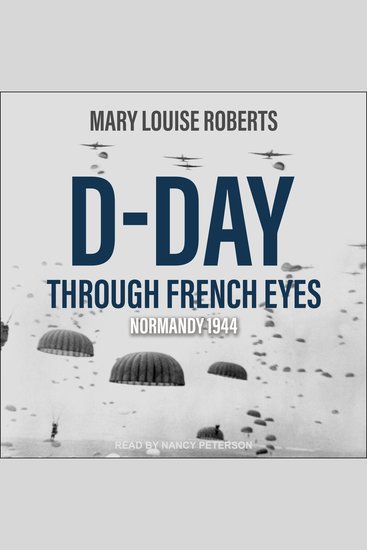
    Silent parachutes dotting the night sky—that's how one Normandy woman learned that the D-Day invasion was under way in June of 1944. Though they yearned for liberation, the French had to steel themselves for war, knowing that their homes, lands, and fellow citizens would have to bear the brunt of the attack. 


    With D-Day through French Eyes, Mary Louise Roberts turns the conventional narrative of D-Day on its head, taking listeners across the Channel to view the invasion anew. Roberts builds her history from an impressive range of gripping first-person accounts by French citizens throughout the region. A farm family notices that cabbage is missing from their garden—then discovers that the guilty culprits are American paratroopers hiding in the cowshed. Fishermen rescue pilots from the wreck of their B-17, then search for clothes big enough to disguise them as civilians. A young man learns to determine whether a bomb is whistling overhead or silently plummeting toward them. When the allied infantry arrived, French citizens guided them to hidden paths and little-known bridges, giving them crucial advantages over the German occupiers. As she did in her acclaimed account of GIs in postwar France, What Soldiers Do, Roberts here sheds vital new light on a story we thought we knew.
    Show book
  • A Rare Recording of Martha Graham - cover

    A Rare Recording of Martha Graham

    Martha Graham

    • 0
    • 0
    • 0
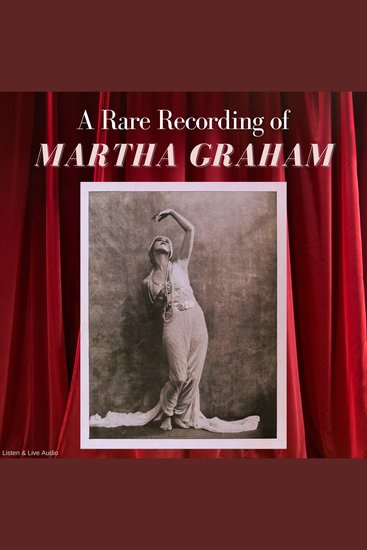
    Martha Graham (May 11, 1894 - April 1, 1991) was an influential American modern dancer and choreographer. In 1926, the Martha Graham Center of Contemporary Dance was established. In the following decades, it would help develop many of her famous proteges.  
    In 1938, Graham became the first dancer to perform at the White House. In 1976, she was awarded the Presidential Medal of Freedom by Gerald Ford. Graham's influence on dance has been compared with the influence of Picasso on modern visual arts, Stravinsky on music, and Frank Lloyd Wright on architecture.  
    This recording is from a lecture Graham gave on the requirements for being an exceptional dancer. 
    ©2016 Listen & Live Audio (P)2016 Listen & Live Audio
    Show book
  • Democritus - Atoms and the Birth of Materialism - cover

    Democritus - Atoms and the Birth...

    Hector Davidson

    • 0
    • 0
    • 0
    Democritus, often referred to as the "laughing philosopher," was a pre-Socratic Greek philosopher who is best known for his atomic theory of the universe. His ideas have significantly shaped modern science, especially in physics and chemistry. Democritus proposed that everything in the universe is made up of small, indivisible particles called atoms. These atoms are eternal, unchangeable, and infinite in number, differing only in shape, size, and arrangement. He was a strong proponent of materialism, the idea that everything that exists is composed of matter and that the properties of the world can be explained by the properties and interactions of atoms. 
    In addition to his contributions to atomic theory, Democritus also made significant contributions to epistemology, the study of knowledge. He suggested that our senses are the primary means by which we perceive the world, though they can sometimes be deceptive. His ideas influenced many later philosophers, including Leucippus, Epicurus, and even modern scientists like John Dalton, whose 19th-century atomic theory was inspired by Democritus's concepts. 
    Despite the lack of direct empirical evidence in his time, Democritus's theories laid the groundwork for the development of scientific thought and inquiry. He emphasized reason and observation over mythological explanations, helping to shape the way we understand the material world. Though much of his work has been lost to history, Democritus's legacy endures, continuing to inspire scientific exploration and contributing to our understanding of the universe.
    Show book
  • Denmark Vesey's Bible - The Thwarted Revolt That Put Slavery and Scripture on Trial - cover

    Denmark Vesey's Bible - The...

    Jeremy Schipper

    • 0
    • 0
    • 0
    On July 2, 1822, Denmark Vesey, a formerly enslaved man, was hanged in Charleston, South Carolina. He was convicted of plotting what might have been the largest insurrection against slaveholders in US history. Witnesses claimed that Vesey appealed to numerous biblical texts to promote and justify the revolt. While sentencing Vesey to death, Lionel Henry Kennedy, a magistrate at the trial, accused Vesey not only of treason but also of "attempting to pervert the sacred words of God into a sanction for crimes of the blackest hue." Denmark Vesey's Bible tells the story of this momentous trial, examining the role of scriptural interpretation in the deadly struggle against American white supremacy and its brutal enforcement. 


    Jeremy Schipper brings the trial and its aftermath vividly to life, drawing on court documents, personal letters, sermons, speeches, and editorials. He shows how Vesey compared people of African descent with enslaved Israelites in the Bible, while his accusers portrayed plantation owners as benevolent biblical patriarchs responsible for providing religious instruction to the enslaved. What emerges is an explosive portrait of an antebellum city in the grips of racial terror, violence, and contending visions of biblical truth.
    Show book
  • Whose Language Is English? - cover

    Whose Language Is English?

    Jieun Kiaer

    • 0
    • 0
    • 0
    Whose language is English? Although we often think of it as native to one place, today there are many Englishes. About seventy-five countries are now using English as their official or first language, and the number of people speaking it around the world continues to rise. But the makeup of the English-speaking population is changing. The proportion of speakers for whom English is a first language is decreasing, due to the explosion in popularity of English as a second language. 


    In this ambitious book, Jieun Kiaer explores the lives of English words in the twenty-first century, when the creation and use of language has become an increasingly dynamic, interactive, and diverse process in which ordinary people have taken leading roles—offering such coinages as "flexitarian," "MeToo," "glow up," and "shitizen" to "No sabo kids" and beyond. As English language grows ever more diverse, Kiaer believes, we need a paradigm shift. We must acknowledge that all varieties of English are languages in their own right when they are used by a community of speakers. English is a language that belongs to everyone. 


    Considering the effects of social media, the Covid-19 pandemic, virtual work, globalization, and artificial intelligence, Kiaer paints a compelling portrait of a rapidly evolving language characterized by creativity and democratization.
    Show book
  • Little Women Podcast: The Real-Life Friedrich Bhaer - cover

    Little Women Podcast: The...

    Niina Niskanen

    • 0
    • 0
    • 0
    There was a real-life Friedrich Bhaer. In fact, Louisa May Alcott wanted to marry him and even start a school with him. This man appears in literal disguises in all of her novels. He is Friedrich in Little Women, Mac in Rose in Bloom and David in Work and many more. Henry and Louisa shared a deep friendship, was it more than friendship? In Little Women Jo's and Friedrich's age gap is 16 years. It is the same age difference as between Henry and Louisa. 
    One of the models for Jo and Friedrich might be Louisa's friend Elizabeth and her husband. Her life was surprisingly similar to the book Jo. She wasn't a writer, but there are parallels. Based on what I have found, her marriage with her lawyer husband was a happy one. She was devoted to the educational work and in the same way, as Jo does, she promoted co-education, for both male and female students. She became a dean of the university. Same way as Jo who becomes the matriarch of the Bhaer Academy in "Jo´s Boys".. 
    There is a very compelling case to be made that Henry David Thoreau was the real-life Friedrich Bhaer. Louisa once called her friend Emerson "The God of my idolatry" but it was Henry who merited her lifelong affection. The ties between Henry and the Alcotts are more extensive than one might expect. From the time when the Alcotts moved to Concord in March 1840 until Henry's passing in 1862. He was a frequent guest in the Alcott´s home taking tea or dinner with the family. Bronson who admired the young man's intellect often visited him in his hut at Walden Pond. If the connection between Henry and the Alcotts was strong, the connection between Louisa and Henry was even stronger
    Show book