Join us on a literary world trip!
Add this book to bookshelf
Grey
Write a new comment Default profile 50px
Grey
Subscribe to read the full book or read the first pages for free!
All characters reduced
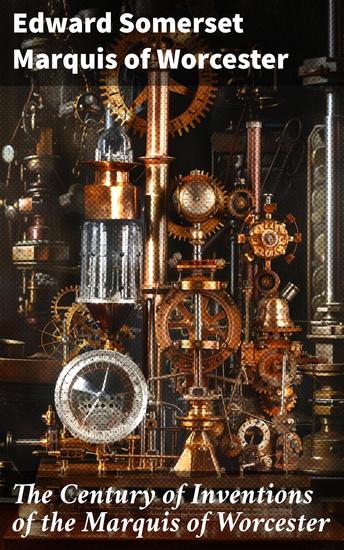
The Century of Inventions of the Marquis of Worcester - From the Original MS with Historical and Explanatory Notes and a Biographical Memoir - cover

The Century of Inventions of the Marquis of Worcester - From the Original MS with Historical and Explanatory Notes and a Biographical Memoir

Edward Somerset Marquis of Worcester

Publisher: Good Press

  • 0
  • 0
  • 0

Summary

In "The Century of Inventions of the Marquis of Worcester," Edward Somerset, the Marquis of Worcester, presents a seminal compilation of innovative ideas and inventions that deftly marries literary ambition with scientific inquiry. Written in the 1660s, this work showcases a remarkable range of inventions, from hydraulic machinery to steam power, reflecting the burgeoning spirit of the Scientific Revolution. Somerset'Äôs prose combines clarity with an eloquent style that invites both scholarly and popular audiences to explore the expanding frontiers of technology, while his detailed illustrations underscore the practical implications of his inventions, an aspect often overlooked in the scientific discourse of his time. Edward Somerset was not merely an aristocrat; he was an inventor and a man of science deeply influenced by the intellectual currents of his age. Born into a prestigious family with a penchant for innovation, Somerset participated in Royalist politics, aiming to impact society, especially after the English Civil War. His work was greatly inspired by the likes of Galileo and Descartes, propelling him to investigate mechanical systems and their potential to transform everyday life, while also addressing issues of sustainability and resource management, concerns that remain relevant today. This book is highly recommended for anyone interested in the intersection of technology and history, as it serves not only as a blueprint for some of the first applications of steam power but also as a testament to the bold imagination of 17th-century inventors. Readers will appreciate how Somerset's inventions laid the groundwork for future advancements and the context in which they emerged, making it an essential read for historians, engineers, and general enthusiasts of innovation.
Available since: 10/19/2023.
Print length: 114 pages.

Other books that might interest you

  • Life is Inevitable - Death is just life reshaped - cover

    Life is Inevitable - Death is...

    Eduardo Cruz Cabrera

    • 0
    • 0
    • 0
    What if death weren’t the end—but merely a change of form? 
     An intimate conversation about death, transformation… and the mystery of continued existence. 
    This book doesn’t try to convert you with religion or overwhelm you with science. It’s a direct, warm, and deeply human reflection on what it truly means to die… and to keep on existing. 
    From the mites that feed on your skin to the stars that shaped your body, Life Is Inevitable takes you on a fascinating journey—where everything transforms, everything recycles, and nothing is ever truly lost. 
    Because your loved ones haven’t disappeared. They’ve simply changed outfits. 
    Get ready to understand life like never before— and to discover that for over 3.7 billion years, life hasn’t stopped. It’s simply learned how to transform.They told you the story wrong:“We are not fading ash, but scattered seed.” 
    Perfect for gifting, and for keeping close in difficult moments.
    Show book
  • Science and Health - Knowledge and Medicine in Ancient Rome (3 in 1) - cover

    Science and Health - Knowledge...

    Rogan Fish

    • 0
    • 0
    • 0
    Science and Health: Knowledge and Medicine in Ancient Rome (3 in 1) explores the intellectual and spiritual forces that shaped Roman civilization, from its groundbreaking scientific ideas to its religious beliefs and the formidable enemies it battled across centuries. 
    In Roman Medicine and Science, uncover the practical and philosophical roots of Roman knowledge—how doctors, engineers, and scholars applied Greek theory, astrology, and firsthand experience to treat the sick, build aqueducts, and study the stars. Roman Religion and Mythology dives into the gods, rituals, and sacred practices that infused daily life with divine meaning and political power. From Jupiter to household spirits, religion in Rome was deeply entwined with science, healing, and war. The Roman Empire and Their Enemies offers a dynamic look at Rome’s greatest rivals—Persians, Carthaginians, Germanic tribes, and more—examining how these conflicts influenced Rome’s scientific developments, medical needs, and mythic self-image. 
    Together, these three books reveal how Romans understood the world—through logic and legend, reason and ritual. Ideal for readers fascinated by ancient science, belief systems, and military history, this volume reveals how Rome's view of knowledge shaped its rise—and echoed through its fall.
    Show book
  • Forgotten Forests: Twelve Thousand Years of British and Irish Woodlands - cover

    Forgotten Forests: Twelve...

    Jonathan Mullard

    • 0
    • 0
    • 0
    Ancient trees, some over a thousand years old, are dotted around the British Isles, the last survivors of a lost world. Now, new scientific studies of these trees and of fossilised forests and of our oldest wooden artifacts can help us to understand the many woodlands that have disappeared from our landscapes. 
    Locked in ice for more than twenty thousand years, the lands that now make up Britain and Ireland were some of the last settled by humans. The earliest people, Mesolithic hunter-gatherers like Cheddar Man, arrived around eleven thousand years ago to find dense forests. While they lived lightly, they did introduce fire, which they used to create clearings, and this was the beginning of the reshaping of Britain’s forests. 
    When Neolithic farmers migrated to Britain from Europe some six thousand years ago, it meant a violent end to the hunter-gatherers’ way of life. It also indicated a dramatic change for the ecosystems. Forests were cleared for fields, trees and plants fed to livestock and predators hunted. A wild, forested world became one of agriculture and villages. 
    As humans learned to work bronze, then iron, they also used wood in myriad ways, building homes, then cathedrals, hand tools then furniture and early machines, boats and eventually immense ships. The forests of Britain and Ireland fuelled the burgeoning human civilisation, from the Romans, Anglo Saxons, Vikings and Normans, to the British, Scottish, Welsh and Irish peoples through to the present day. In that time our woodlands have changed beyond recognition, but clues to their story remain. Biologist and Britain’s first senior officer for Areas of Outstanding Natural Beauty Jonathan Mullard retraces the history of the forgotten forests of Britain and Ireland, piecing together historical records going as far back as the written word and archaeological evidence going back far further. The result is a wealth of arcane anecdotes and the latest scientific understanding of our natural history, as well as a fascinating journey through the forests, landscapes and human history of Britain. 
    In his latest non-fiction work, Forgotten Forests, Jonathan Mullard takes us on a journey through time, exploring the habitats that once covered Britain and Ireland. His deep understanding of ecology and passion for nature shine through in this compelling narrative of human impact and ecological transformation. 
    For fans of Robert Macfarlane (Is a River Alive?), and Rough Guides (The Rough Guide to Morocco). 
    HarperCollins 2025
    Show book
  • The Artifice of Intelligence - Divine and Human Relationship in a Robotic Age - cover

    The Artifice of Intelligence -...

    Noreen Herzfeld, Ted Peters

    • 0
    • 0
    • 0
    AI is becoming ubiquitous. Whatever its arrival portends for our future, whether riches or ruin, it cannot be avoided. The Artifice of Intelligence explores two questions at the heart of a theological response to AI. Is it possible for human beings to have authentic relationships with an AI? How does the increasing presence of AI change the way humans relate to one another? In pursuing answers to these questions, Herzfeld explores what it means to be created in the image of God and to create AI in our own image. It utilizes and expands Karl Barth's relational understanding of the imago Dei to examine humanity's relationship both with AI and, through it, with one another. 


    Barth's injunctions—look the other in the eye (embodiment), speak to and hear the other (communication), aid the other (agency), and do it gladly (emotion)—provide the basis for the main chapters, each of which concludes with a case study of a current AI application that exemplifies the difficulties AI introduces into human relationality. The Artifice of Intelligence concludes with an examination of the incarnation, one that points toward the centrality of embodiment for full relationality.
    Show book
  • Cracking the Code: Introduction to Machine Learning for Novices - Building a Foundation for Artificial Intelligence - cover

    Cracking the Code: Introduction...

    Sarah Parker

    • 0
    • 0
    • 0
    Embark on a transformative journey into the world of Machine Learning with "Cracking the Code." This book is meticulously crafted to captivate novices and guide them through the intricate landscape of artificial intelligence. 
    Are you curious about the inner workings of the intelligent systems that power our digital world? "Cracking the Code" unveils the mysteries of Machine Learning, making it accessible to beginners eager to comprehend the algorithms shaping our technological future. Delve into the fundamentals, demystify the complex, and cultivate a deep understanding of Al. 
    Designed as a foundational resource, this book sparks the desire to master the principles of Machine Learning. From basic concepts to advanced applications, readers will develop a robust knowledge base, empowering them to navigate the evolving Al landscape. Cultivate the skills needed to decipher the algorithms that drive innovations in healthcare, finance, and beyond. 
    Through a pedagogical approach, "Cracking the Code" inspires action. Use practical examples, hands-on exercises, and real-world applications reinforcing theoretical concepts. Unleash your potential to create intelligent solutions, laying the groundwork for your journey into the dynamic field of artificial intelligence. 
    Whether a student, professional, or simply curious about the future, "Cracking the Code" is your gateway to mastering Machine Learning. Empower yourself with the tools to decipher the intricate code that shapes the technological landscape and embark on a transformative path toward becoming an Al enthusiast with a solid foundation in intelligent systems.
    Show book
  • Vaccine Nation - America’s Changing Relationship with Immunization - cover

    Vaccine Nation - America’s...

    Elena Conis

    • 0
    • 0
    • 0
    With employers offering free flu shots and pharmacies expanding into one-stop shops to prevent everything from shingles to tetanus, vaccines are ubiquitous in contemporary life. The past fifty years have witnessed an enormous upsurge in vaccines and immunization in the United States: American children now receive more vaccines than any previous generation, and laws requiring their immunization against a litany of diseases are standard. Yet, while vaccination rates have soared and cases of preventable infections have plummeted, an increasingly vocal cross section of Americans have questioned the safety and necessity of vaccines. In Vaccine Nation, Elena Conis explores this complicated history and its consequences for personal and public health. 
    Vaccine Nation opens in the 1960s, when government scientists—triumphant following successes combating polio and smallpox—considered how the country might deploy new vaccines against what they called the “milder” diseases, including measles, mumps, and rubella. In the years that followed, Conis reveals, vaccines fundamentally changed how medical professionals, policy administrators, and ordinary Americans came to perceive the diseases they were designed to prevent. She brings this history up to the present with an insightful look at the past decade’s controversy over the implementation of the Gardasil vaccine for HPV, which sparked extensive debate because of its focus on adolescent girls and young women. Through this and other examples, Conis demonstrates how the acceptance of vaccines and vaccination policies has been as contingent on political and social concerns as on scientific findings. 
    By setting the complex story of American vaccination within the country’s broader history, Vaccine Nation goes beyond the simple story of the triumph of science over disease and provides a new and perceptive account of the role of politics and social forces in medicine.
    Show book