Join us on a literary world trip!
Add this book to bookshelf
Grey
Write a new comment Default profile 50px
Grey
Subscribe to read the full book or read the first pages for free!
All characters reduced
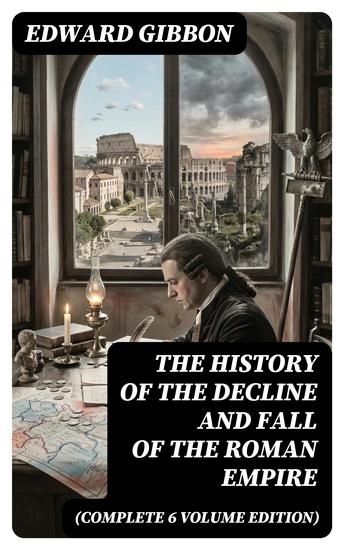
The History of the Decline and Fall of the Roman Empire (Complete 6 Volume Edition) - Enriched edition From the Height of the Roman Empire to the Fall of Byzantium - cover

The History of the Decline and Fall of the Roman Empire (Complete 6 Volume Edition) - Enriched edition From the Height of the Roman Empire to the Fall of Byzantium

Edward Gibbon

Publisher: DigiCat

  • 0
  • 0
  • 0

Summary

Edward Gibbon's monumental work, "The History of the Decline and Fall of the Roman Empire," spans six volumes and intricately examines the complex tapestry of Rome's deterioration from a powerful empire to its eventual disintegration. Gibbon's prose is characterized by its elegant style, profound insights, and masterful use of historical sources. The narrative is not merely a chronological account but a rich analysis of the socio-political and economic factors that contributed to Rome's decline, employing a critical lens that integrates both primary sources and Gibbon's own philosophical musings, thus situating the work firmly within the framework of Enlightenment thought. As a scholar and Member of Parliament, Gibbon was deeply influenced by the tumult of Enlightenment ideas and the events of his time, particularly the rise of modernity that contrasted sharply with the ancient past. His extensive travels throughout Europe granted him access to myriad historical texts and artifacts, fueling his fascination with the Roman Empire and enabling him to approach the subject with both scholarly rigor and literary flair. Gibbon's work reflects his own experiences in grappling with notions of civilization and decay, fostering an enduring legacy in the field of historical literature. This comprehensive edition is an essential read for both historians and lay readers interested in the intricacies of Rome's legacy. Gibbon's acute observations and judicious analyses provide timeless lessons on power and governance. Readers will be captivated by his narrative style and rigorous scholarship, making "The History of the Decline and Fall of the Roman Empire" not only a historical account but also an enduring exploration of human civilization.

In this enriched edition, we have carefully created added value for your reading experience:
- A succinct Introduction situates the work's timeless appeal and themes.
- The Synopsis outlines the central plot, highlighting key developments without spoiling critical twists.
- A detailed Historical Context immerses you in the era's events and influences that shaped the writing.
- An Author Biography reveals milestones in the author's life, illuminating the personal insights behind the text.
- A thorough Analysis dissects symbols, motifs, and character arcs to unearth underlying meanings.
- Reflection questions prompt you to engage personally with the work's messages, connecting them to modern life.
- Hand‐picked Memorable Quotes shine a spotlight on moments of literary brilliance.
- Interactive footnotes clarify unusual references, historical allusions, and archaic phrases for an effortless, more informed read.
Available since: 12/31/2023.
Print length: 3720 pages.


Other books that might interest you

  • The Real Moby Dick - The True Story behind the Legendary White Whale - cover

    The Real Moby Dick - The True...

    John Harpoon

    • 0
    • 0
    • 0
    For more than a century, Moby-Dick has captivated readers with its epic tale of obsession, revenge, and the relentless pursuit of an almost mythical white whale. Herman Melville’s novel, often considered one of the greatest works of American literature, is filled with symbolism and philosophical depth. Yet, behind this work of fiction lies a true story—one of survival, maritime danger, and an extraordinary encounter with a real-life white whale that terrorized whalers in the early 19th century. The legend of Moby Dick is more than just fiction; it is rooted in historical events, shaped by firsthand accounts, and woven into the fabric of seafaring lore.  
      
    The inspiration for Melville’s famous novel came from two key sources: the Essex tragedy and the real-life white whale known as Mocha Dick. The Essex, a whaling ship from Nantucket, was attacked and sunk by a massive sperm whale in 1820, leaving its crew stranded in the open ocean. Their harrowing tale of survival, including desperate decisions that pushed them to the limits of human endurance, became one of the most infamous maritime disasters of the era. Meanwhile, whalers of the Pacific frequently told stories of an unusually large and aggressive albino whale that had survived multiple harpoon attacks. This whale, named Mocha Dick after the Chilean island where he was often seen, was known to fight back with remarkable intelligence and force. These real events formed the foundation for Melville’s fictional masterpiece, blending reality with myth in a way that continues to spark curiosity and debate. 
    Show book
  • The Golden Verses of Pythagoras - cover

    The Golden Verses of Pythagoras

    Florence Firth

    • 0
    • 0
    • 0
    In this small volume an attempt has been made to gather together the best and most reliable of the sets of Ethical Verses attributed to the Pythagoreans.Both Hall's translation from the Greek (1657), and Rowe's translation from the French of André Dacier (1707), have been used in reproducing the Golden Verses of Pythagoras, but Dacier's version has been almost exclusively followed, being clearer and more intelligible.The Golden Sentences of Democrates, the Similitudes of Demophilus, and Pythagorean Symbols are from Bridgman's translation, and are to be found in his little book, Translations from the Greek, published in 1804. The Pythagorean Sentences of Demophilus, translated by Taylor, are contained in that volume also.The remaining sets of verses, translated by Taylor, are appended by him to his Iamblichus' Life of Pythagoras, published in 1818.
    Show book
  • Ancient Civilizations Explored - A Journey Through the Foundations of Human History and Culture - cover

    Ancient Civilizations Explored -...

    Virversity Online Courses

    • 0
    • 0
    • 0
    This course offers a comprehensive exploration of ancient civilizations, tracing the development of early human societies and their lasting impact on the modern world. Students gain insights into the historical, cultural, social, and technological advancements that shaped humanity’s past, enriching critical thinking and providing context for understanding today’s societies.Explore the origins and growth of early civilizations from Mesopotamia to ancient China. Study social structures, belief systems, and cultural expressions across diverse societies. Examine key technological innovations, economic systems, and trade routes connecting ancient peoples. Understand the roles of writing, art, architecture, and governance in shaping civilization and the causes behind the decline of ancient empires. Learn archaeological methods that reveal the secrets of the past.The course begins with the earliest human societies and their transition to complex civilizations, highlighting Mesopotamia as the “Cradle of Civilization” and the emergence of city-states. Discover Egypt’s riverine empires, Greece’s democratic and philosophical contributions, and Rome’s political and engineering achievements. Delve into writing systems like cuneiform and hieroglyphics, religious beliefs, social hierarchies, economic structures, and technological advances that shaped tools and infrastructure. Explore arts and architecture as expressions of power, faith, and identity.Further, examine Asian ancient civilizations such as the Indus Valley and early Chinese empires, emphasizing their unique contributions and roles in trade networks. The course addresses the complex causes behind the rise and fall of these societies and their enduring legacies. Students also learn archaeological techniques that help reconstruct historical narratives.
    Show book
  • Two Three Words (Do Se Kalameh) - cover

    Two Three Words (Do Se Kalameh)

    Aram Hessami

    • 0
    • 0
    • 0
    Where is the driving force for change? Who envisions a better future, crafts the path to democracy, and strategizes the movement? Who fuels it with revolutionary zeal and the will to power? And where is the force that can fulfill the unfinished promise of Iran's Constitutional Revolution? In three words: The Iranian Citizenry. Thirty years before Iran's Constitutional Revolution, the treatise One Word (Yek Kalameh) ignited a movement—challenging absolute monarchy, advocating the rule of law, and empowering the people. Now, Two, Three Words (Do, Se Kalameh) draws inspiration from the courageous youth of Iran. It articulates their aspirations, forges a new discourse, and unites a narrative that could pave the way for democratic alternatives.
    Show book
  • Manners for the Metropolis - cover

    Manners for the Metropolis

    Frank Crowninshield

    • 0
    • 0
    • 0
    Manners for the Metropolis is Frank Crowninshield’s razor-sharp, satirical guide to navigating the absurdities of New York’s high society in the early 20th century. With biting wit and upper-crust irony, Crowninshield delivers a tongue-in-cheek manual for proper behavior among the elite—offering “guidance” on everything from dinner etiquette and bath timing to the politics of RSVPs and the social capital of automobile ownership. 
    Part mockery, part mirror, this humorous exposé of "The 400" pokes fun at the pomp and posturing of the privileged class, leaving modern listeners both amused and astonished at the timelessness of social pretense. Narrator Mark Cohan brings just the right tone of charm and snark to this breezy, sophisticated romp through the gilded labyrinth of polite society. 
    Perfect for fans of satire, history, and vintage New York glamour.
    Show book
  • Titanic - The True History of North Atlantic Ocean on 15 April 1912 - cover

    Titanic - The True History of...

    Kelly Mass

    • 0
    • 0
    • 0
    At the time of her first journey from Southampton to N.Y. City, RMS Titanic hit an iceberg and died in the North Atlantic Ocean on April fifteenth, 1912. An overall of 2,224 guests and team were reported to have been on board when the ship sank, making it one of the absolute worst single ship catastrophes and the absolute worst peacetime superliner or cruise liner sinking to date. As a result of the general public's interest in the after-effects, the mishap has acted as a structure for the category of catastrophe movies. 
    The RMS Titanic was the second of 3 Olympic-class ocean liners run by the White Star Line when she began service in the year 1912. Harland & Wolff shipyard in Belfast produced her. That mishap said the life of the shipyard's Chief Naval Designer, Thomas Andrews. 
    In this book, you will get all the facts straight. Despite of Hollywood representations and conspiracy theories, you deserve to know the truth about the incident.
    Show book