Join us on a literary world trip!
Add this book to bookshelf
Grey
Write a new comment Default profile 50px
Grey
Subscribe to read the full book or read the first pages for free!
All characters reduced
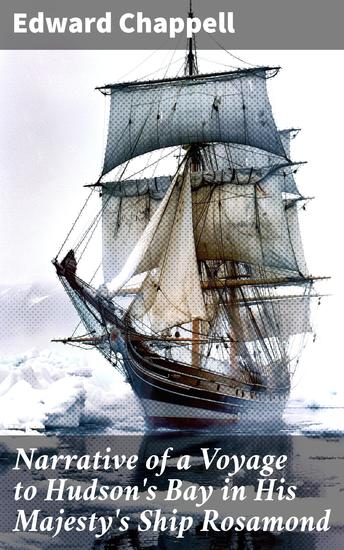
Narrative of a Voyage to Hudson's Bay in His Majesty's Ship Rosamond - With Account of the North-eastern Coast of America and of the Tribes Inhabiting That Region - cover

Narrative of a Voyage to Hudson's Bay in His Majesty's Ship Rosamond - With Account of the North-eastern Coast of America and of the Tribes Inhabiting That Region

Edward Chappell

Publisher: Good Press

  • 0
  • 0
  • 0

Summary

In "Narrative of a Voyage to Hudson's Bay in His Majesty's Ship Rosamond," Edward Chappell presents a vivid recounting of his 1812 expedition to the icy frontiers of Canada. Written in a richly descriptive literary style characteristic of early 19th-century travel literature, Chappell intertwines personal anecdotes with meticulous observations of the landscape and indigenous populations. His narrative serves as both a historical document and a reflection of the burgeoning British interest in North America during this period, offering insights into the maritime exploits that shaped colonial expansion and the natural world surrounding Hudson's Bay. Edward Chappell, an eminent figure in British naval exploration, drew upon his extensive maritime experience and keen observational skills to craft this work. His participation in multiple voyages equipped him with a nuanced understanding of the challenges faced by explorers, as well as the transformative realities of encounters with indigenous cultures. Chappell's firsthand experiences within the ship and his interactions with the local inhabitants fostered a profound respect for the resilience of the human spirit, which resonates throughout his writing. This meticulously crafted narrative is recommended to readers interested in maritime history, colonial exploration, and the intimate interplay between environment and human endeavor. Chappell's unique perspective provides an essential contextual backdrop, immersing readers in the exhilarating yet perilous world of early 19th-century exploration. For those seeking to understand the complexities of this historical period, his work is an invaluable resource.
Available since: 10/31/2023.
Print length: 123 pages.

Other books that might interest you

  • World War II in the Arctic: The History of the Aleutian Islands Campaign and Nazi Germany’s Arctic Invasion of the Soviet Union - cover

    World War II in the Arctic: The...

    Editors Charles River

    • 0
    • 0
    • 0
    Today, everyone remembers the most famous consequences of Hitler’s choice, particularly the fighting at Leningrad and Stalingrad, but the invasion was so comprehensive that it also involved fighting in the barren lands near the Arctic Circle, bringing fierce combat to the taiga and tundra. In fact, Arctic combat occurred in both the Pacific and European theaters of the war, and in both cases the operations were related in some measure to external lines of supply to the USSR. 
    Meanwhile, the Wehrmacht and the Red Army also met in the boreal pine forests, bogs, and tundra of Lapland and far northern Russia during the Barbarossa campaign of 1941. Fighting separately from the other Army Groups of the Third Reich, elite German Gebirgs (mountain) division soldiers and tough, resourceful Finns clashed with relatively determined and experienced Red Army soldiers in the forbidding terrain east of Finland’s border. This campaign bore the elegant operational tile of Silberfuchs, or “Silver Fox.” Aiming for Murmansk, a key Soviet port, or at least to sever the rail lines connecting it to points south and east, the Germans found themselves contending with the rugged, unfamiliar landscape, tough Soviet resistance, and as all too frequently occurred, the half-baked strategic meddling of Adolf Hitler, Fuhrer of the Third Reich. 
    For the Japanese, the secondary operation to the Aleutian Islands proved more successful than the main thrust at Midway Island. In a triumph of cryptanalytic skill and poker-player daring, codebreaker Joseph Rochefort and his team at “Hypo” cracked Japanese messages proving the main effort aimed at Midway. The U.S. Navy intercepted Yamamoto's fleet at Midway and smashed its carriers in one of the most decisive actions of the Pacific Theater on June 3rd to 7th, 1942. The Aleutians invasion, on the other hand, gave Japan a foothold on American territory that required almost a year to dislodge.
    Show book
  • Small Medium Large - How Government Made the US into a Manufacturing Powerhouse - cover

    Small Medium Large - How...

    Colleen A. Dunlavy

    • 0
    • 0
    • 0
    We live in a world of seemingly limitless consumer choice. Yet, as every shopper knows without thinking about it, many everyday goods—from beds to batteries to printer paper—are available in a finite number of "standard sizes." What makes these sizes "standard" is an agreement among competing firms to make or sell products with the same limited dimensions. But how did firms—often hotly competing firms—reach such collective agreements? 


    In exploring this question, Colleen Dunlavy puts the history of mass production and distribution in an entirely new light. She reveals that, despite the widely publicized model offered by Henry Ford, mass production techniques did not naturally diffuse throughout the US economy. On the contrary, formidable market forces blocked their diffusion. It was only under the cover of collectively agreed-upon, industry-wide standard sizes—orchestrated by the federal government—that competing firms were able to break free of market forces and transition to mass production and distribution. Without government promotion of standard sizes, the twentieth-century American variety of capitalism would have looked markedly less "Fordist." 


    Small, Medium, Large will make all of us think differently about the everyday consumer choices we take for granted.
    Show book
  • Underground Empire - How America Weaponized the World Economy - cover

    Underground Empire - How America...

    Henry Farrell, Abraham Newman

    • 0
    • 0
    • 0
    A deeply researched investigation that reveals how the United States is like a spider at the heart of an international web of surveillance and control, which it weaves in the form of globe-spanning networks such as fiber optic cables and obscure payment systemsAmerica’s security state first started to weaponize these channels after 9/11, when they seemed like necessities to combat terrorism—but now they’re a matter of course. Multinational companies like AT&T and Citicorp build hubs, which they use to make money, but which the government can also deploy as choke points. Today’s headlines about trade wars, sanctions, and technology disputes are merely tremors hinting at far greater seismic shifts beneath the surface.Slowly but surely, Washington has turned the most vital pathways of the world economy into tools of domination over foreign businesses and countries, whether they are rivals or allies, allowing the U.S. to maintain global supremacy. In the process, we have sleepwalked into a new struggle for empire. Using true stories, field-defining findings, and original reporting, Henry Farrell and Abraham Newman show how the most ordinary aspects of the post–Cold War economy have become realms of subterfuge and coercion, and what we must do to ensure that this new arms race doesn’t spiral out of control.A Macmillan Audio production from Henry Holt & Company.
    Show book
  • 100-Word Stories - A Short Form for Expansive Writing - cover

    100-Word Stories - A Short Form...

    Kim Culbertson

    • 0
    • 0
    • 0
    What can 100-word stories help your students understand about writing? The short answer is, everything! 
     
    This flash-fiction form has become a popular structure for efficiently teaching a wide variety of literary devices, terms, and processes in a targeted way. Part teaching guide, part anthology, 100-Word Stories is a dynamic guide complete with lessons and prompts to help young writers learn and practice literary elements, narrative skill, and personal voice. 
     
    Through a collection of accessible lessons, each with a mentor text that is either student- or author-created, Culbertson and Faulkner share insight into using these “small, bright things” in the ELA classroom. The book’s structure is meant to be flexible–you might dip in and out of the lessons as needed to supplement existing curricula, or you might choose to teach an entire unit based on the lessons. No matter how you employ them, this short form can create expansive practice for young writers.
    Show book
  • Bittersweet Lane - Creating Home(s) in the American Affordable Housing Crisis - cover

    Bittersweet Lane - Creating...

    Jamie Madden

    • 0
    • 0
    • 0
    The Bitter Reality. The Sweet Solutions. The Lane Forward.Housing dominates headlines, yet few truly understand how affordable housing works—or why it’s failing. Bittersweet Lane is the first book to demystify America’s housing crisis from both a professional and deeply personal perspective.Spanning from Ireland to America, from the Bittersweet Lane Apartments to M.I.T., Bittersweet Lane also carries the stories and deep scars of intergenerational poverty while offering a bold vision for change.Written by a community development professional with expertise in housing development and public policy, Madden blends gripping memoir with sharp policy insights to expose the brutal history of housing in the U.S.—and the tools we already have to fix it.A raw, eye-opening journey through class, race, and urban development, Bittersweet Lane offers:A class-crossing insider's perspective from housing insecurity to shaping policy.A clear breakdown of affordable housing without the jargon.Real solution to the crisis and why we haven't implemented them.Though the barriers to housing justice seem insurmountable, the solutions are within reach. Bittersweet Lane doesn’t just explain the crisis—it shows how we can all find home.
    Show book
  • Radical Equations - Civil Rights from Mississippi to the Algebra Project - cover

    Radical Equations - Civil Rights...

    Robert P. Moses, Jr. Charles E....

    • 0
    • 0
    • 0
    At a time when popular solutions to the educational plight of poor children of color are imposed from the outside, the acclaimed Algebra Project and its founder, Robert Moses, offer a vision of school reform based in the power of communities. Founded on the belief that math-science literacy is a prerequisite for full citizenship in society, the Project works with entire communities—parents, teachers, and especially students—to create a culture of literacy around algebra, a crucial stepping-stone to college math and opportunity. 


    Telling the story of this remarkable program, Robert Moses draws on lessons from the 1960s Southern voter registration he famously helped organize: "Everyone said sharecroppers didn't want to vote. It wasn't until we got them demanding to vote that we got attention. Today, when kids are falling wholesale through the cracks, people say they don't want to learn. We have to get the kids themselves to demand what everyone says they don't want." 


    We see the Algebra Project organizing community by community. Older kids serve as coaches for younger students and build a self-sustained tradition of leadership. And we see the remarkable success stories of schools like the predominately poor Hart School in Bessemer, Alabama, which outscored the city's middle-class flagship school in just three years.
    Show book