Join us on a literary world trip!
Add this book to bookshelf
Grey
Write a new comment Default profile 50px
Grey
Subscribe to read the full book or read the first pages for free!
All characters reduced
Athens - Its Rise and Fall - cover

Athens - Its Rise and Fall

Edward Bulwer-Lytton

Publisher: DigiCat

  • 0
  • 0
  • 0

Summary

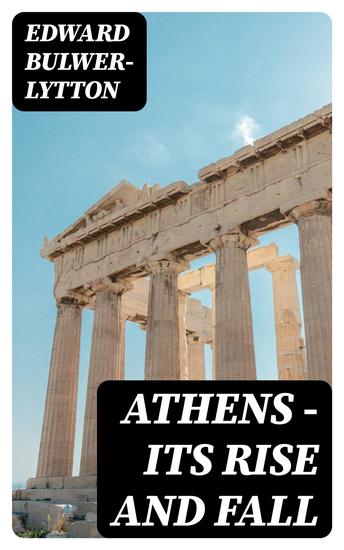
In "Athens - Its Rise and Fall," Edward Bulwer-Lytton meticulously chronicles the socio-political landscape of ancient Athens, exploring its transition from a nascent city-state to a dominant cultural beacon of the classical world. The book employs a narrative style that intertwines historical analysis with vivid storytelling, marking a blend of Romantic literary sensibility and Enlightenment rationality. Bulwer-Lytton's work stands as a significant contribution to 19th-century historical literature, reflecting his engagement with contemporary debates on governance, democracy, and the consequences of power as echoed in the trials of Athenian democracy. Bulwer-Lytton, a known figure in both literary and political circles, was deeply influenced by his fascination with classical antiquity and a belief in its lessons for modern society. His experiences as a politician and novelist informed his understanding of historical themes, and his intention to inspire moral and political reflection resonates throughout the text. In this work, he seeks to draw parallels between the aspirations of Athenian society and those of his contemporaries, commenting on the cyclical nature of history. This book is highly recommended for readers interested in the interplay between history and literature, as it masterfully captures the spirit of a civilization that shaped the very foundations of Western thought. Whether you are a scholar of ancient history or a casual reader drawn to classical literature, "Athens - Its Rise and Fall" promises to offer valuable insights and compelling narratives that remain relevant today.
Available since: 05/17/2022.
Print length: 585 pages.
Other books that might interest you

  • Freedom from Dark Forces and Hidden Bonds - Liberate Yourself: Dive into Audio Lessons for Mastery Over Dark Forces and Hidden Bonds! - cover

    Freedom from Dark Forces and...

    Dexter Hawthorne

    • 0
    • 0
    • 0
    Freedom from Dark Forces and Hidden Bonds 
    ⭐⭐ Simplified Audio Guide with Clear Explanations ⭐⭐ 
    Are you seeking to overcome life's unseen challenges and discover your inner strength? 
    Searching for a comprehensive guide that provides all the necessary elements to navigate these challenges? 
    Your search ends here! 
    This guide serves as your definitive companion for deepening your understanding, applying your skills, and engaging in hands-on exercises. With this, you're geared for success. 
    Key features of this enriched guide: 
    - Profound insights about overcoming hidden bonds and dark forces 
    - Detailed explanation of strategies to discover inner strength 
    - Fruitful tactics for preparation and tackling life's challenges 
    Our guide distinguishes itself through comprehensive coverage, which is essential for your personal victory. Concepts aren't merely skimmed; they are delved into with precision. 
    Please note that this guide is not affiliated with any official entity and is purely an independent resource for your benefit. 
    Designed with a clear structure and easy-to-understand language, our guide ensures smooth transitions between topics. Say goodbye to dense jargon and welcome clear, precise, and practically applicable content. 
    So, why wait? Click the BUY NOW button, secure your guide, and begin your journey to overcoming life's challenges and discovering your inner strength! 
    Secure your guide now and start your journey to a more empowered life!
    Show book
  • The Graeco-Roman Era - cover

    The Graeco-Roman Era

    Pericles, Julius Caesar, ...

    • 0
    • 0
    • 0
    Five speeches from the legendary orators Alexander the Great, Julius Caesar, Cicero, and Pericles.431 BCE: Pericles’ Funeral Oration is a valedictory and eulogy for the great age of Athenian democracy. Reported by Thucydides, it was given at the first annual public funeral for casualties of the Peloponnesian War. That war ended twenty-seven years later with the democratic government of Athens overthrown by an oligarchy known as The Four Hundred. 324BCE: Two speeches by Alexander the Great, reported by the historian Arrian in his Anabasis. Both speeches are a direct address to his army on embarking on a new campaign. The first was given in Opis, Mesopotamia, when rallying his armies to start a new campaign into Persia. The army took heart, and successfully conquered the Persian Empire, adding it to Alexander’s many existing conquests. The second speech is given after the first campaign is over. This time Alexander is ready to move into the Indian subcontinent. After travelling across the known world, the entire army took the offer to quit fighting and go home. This leaves Alexander understandably upset, and produces history’s most finely worded example of saying “After all I’ve done for you! Well, you can all get stuffed then, you bunch of ingrates. I hope you choke.”In 63BCE, the Cataline Conspiracy shook Rome. It was a deep shock to the Roman system, and risked civil war. Included here are speeches by the Consul Cicero and the only extant speech of Julius Caesar.Cicero’s First Speech is a rabble-rousing, impassioned, and slightly unhinged attack upon Cataline and his associates. It speaks to the outrage of the body politic and the masses.Caesar’s speech is a jurisprudential appeal to create no new laws to punish these crimes. Caesar argues that the republic would be ultimately harmed if they were not punished only under existing laws, as people remember the punishment but not the crime.
    Show book
  • Advanced Growth Strategies for Authors - cover

    Advanced Growth Strategies for...

    Russell Nohelty

    • 0
    • 0
    • 0
    I have a vision. 
    It's one that's haunted me for years…maybe haunted is not the right word, but in the absence of the right words, I have no choice but to use the ones that I have access to, and haunted feels right to me. 
    I've seen it in fits and starts, like somebody is turning on a fritzing light and illuminating a great darkness in my brain for a second here and a minute there. 
    When the light flickers on, though, I see the future. This book is what I see when I go there.  
    Unlock the secrets to creative success with Advanced Growth Tactics for Authors! Dive into a collection of powerful, no-nonsense essays from bestselling author Russell Nohelty, packed with practical strategies for building your writing career. 
    From mastering Kickstarter campaigns to navigating the ups and downs of indie publishing, this book offers invaluable insights to help you break through the noise, grow your audience, and thrive in the competitive world of authorship. 
    Whether you're just starting or looking to level up, this guide gives you the tools to take your writing career to the next
    Show book
  • The Conquest of Bread - cover

    The Conquest of Bread

    Peter Kropotkin

    • 0
    • 0
    • 0
    The Conquest of Bread  is an 1892 book by the Russian anarcho-communist Peter Kropotkin.
    Peter Kropotkin was born a Russian prince whose father owned 1,200 serfs. But he became  a Russian activist, writer, revolutionary, scientist, economist, sociologist, historian, essayist, researcher, political scientist, biologist, geographer  and philosopher.
    The Conquest of Bread has become a classic of political anarchist literature. It was heavily influential on both the Spanish Civil War and the Occupy movement.
    In the work, Kropotkin goes on to propose a more decentralized economic system based on mutual aid and voluntary cooperation, asserting that the tendencies for this kind of organization already exist, both in evolution and in human society.
    Show book
  • How to Recognize Toxic Thought Patterns - cover

    How to Recognize Toxic Thought...

    Olivia Werner

    • 0
    • 0
    • 0
    [How to Recognize Toxic Thought Patterns] delves deep into the intricate landscape of human consciousness, offering a lyrical and unflinching exploration of the ways our minds create and sustain patterns that both protect and constrain us. Through prose that mirrors the fluid, cyclical nature of thought itself, this illuminating work examines how toxic patterns disguise themselves as rationality, presenting as logical conclusions while quietly undermining our sense of self. Like a skilled cartographer mapping uncharted territory, the book traces the subtle ways these thought patterns weave themselves into the fabric of our daily existence, emerging in the spaces between breaths, in the gaps between messages, in the quiet moments before sleep. With its innovative approach to mental awareness, the work stands apart in its ability to capture the poetry of psychological experience while offering practical insights into the nature of toxic thinking, making the invisible visible through carefully crafted metaphors and precise psychological observation.
    Show book
  • The Time of My Life - Dirty Dancing - cover

    The Time of My Life - Dirty Dancing

    Andrea Warner

    • 0
    • 0
    • 0
    An engaging exploration into the enduring popularity of Dirty Dancing and its lasting themes of feminism, activism, and reproductive rights
    		 
    When Dirty Dancing was released in 1987, it had already been rejected by producers and distributors several times over, and expectations for the summer romance were low. But then the film, written by former dancer Eleanor Bergstein and starring Jennifer Grey and Patrick Swayze as a couple from two different worlds, exploded. Since then, Dirty Dancing’s popularity has never waned. The truth has always been that Dirty Dancing was never just a teen romance or a dance movie — it also explored abortion rights, class, and political activism, with a smattering of light crime-solving.
    		 
    In The Time of My Life, celebrated music journalist Andrea Warner excavates the layers of Dirty Dancing, from its anachronistic, chart-topping soundtrack, to Baby and Johnny’s chemistry, to Bergstein’s political intentions, to the abortion subplot that is more relevant today than ever. The film’s remarkable longevity would never have been possible if it was just a throwaway summer fling story. It is precisely because of its themes — deeply feminist, sensitively written — that we, over 30 years later, are still holding our breath during that last, exhilarating lift.
    		 
    About the Pop Classics Series
    		 
    Short books that pack a big punch, Pop Classics offer intelligent, fun, and accessible arguments about why a particular pop phenomenon matters.
    Show book