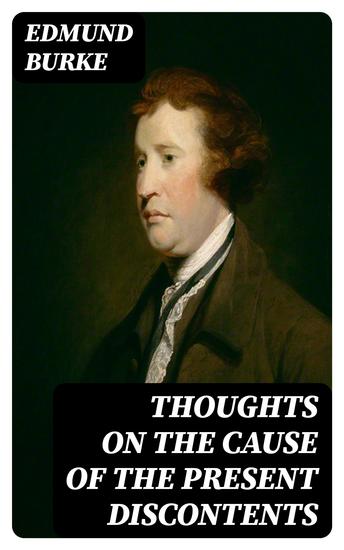
We are sorry! The publisher (or author) gave us the instruction to take down this book from our catalog. But please don't worry, you still have more than 500,000 other books you can enjoy!
Thoughts on the Cause of the Present Discontents
Edmund Burke
Publisher: DigiCat
Summary
In 'Thoughts on the Cause of the Present Discontents,' Edmund Burke expounds upon the political machinations of 18th-century Britain with agile prose and a keen interpretative eye, establishing a work of enduring relevance in political philosophy. Through a meticulous analysis of the personal influence of King George III and the ramifications of courtly nepotism, Burke pens a critique that straddles both the literary and the politically pragmatic. This essay, steeped in the historical context of pre-Revolutionary fervor, offers a prescient exposition of the intertwining of private interests and public duties within the House of Commons, making it a seminal text in the canon of British political thought.
In exploring his subject, Burke draws upon a wealth of political experience and a robust engagement with the philosophical principles of his time. As a statesman and member of the Whig party, his insights are grounded in the daily workings of government and colored by his own ideological leanings. Burke's erudition and his role as a critic of unchecked royal influence certify his arguments as both authentic and visionary, reflecting a deep-seated concern for constitutional balance and the welfare of society.
'Thoughts on the Cause of the Present Discontents' is recommended for readers interested in the historical roots of political advocacy and the timeless debate over the separation of powers. It is particularly essential for those seeking to understand the evolution of parliamentary democracy and the counterweights necessary for maintaining institutional integrity. Burke's essay captivates with its rhetorical elegance and its trenchant analysis of political organization, making it a touchstone for students of history, political science, and philosophy alike.
Available since: 05/29/2022.
Print length: 78 pages.