We are sorry! The publisher (or author) gave us the instruction to take down this book from our catalog. But please don't worry, you still have more than 500,000 other books you can enjoy!
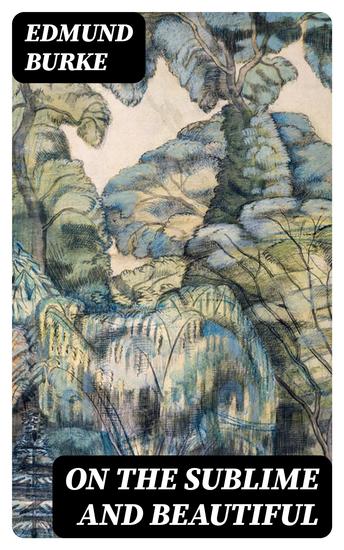
On the Sublime and Beautiful
Edmund Burke
Publisher: DigiCat
Summary
Edmund Burke's 'On the Sublime and Beautiful' stands as a critical work in the canon of 18th-century aesthetic philosophy. Diverging from the classical alignment of beauty with order and harmony, Burke embarks on a philosophical discourse that parses the distinct emotional responses elicited by the beautiful and the sublime. His examination is grounded in an empirical approach, rendering a meticulous distinction between the pleasing, genteel qualities of beauty and the grand, overwhelming force of the sublime. Through its eloquent prose and keen introspection, the work has laid the foundational concepts that would later influence the Romantic literary movement and the study of aesthetics as a distinct philosophical concern, resonating through the literary fabric of Europe and beyond.nBurke's exploration is far from merely academic; it is deeply intertwined with his broader intellectual pursuits and his profound engagement with the political and social issues of his day. Having already established himself as a sharp political thinker with the publication of 'A Philosophical Enquiry into the Origin of Our Ideas of the Sublime and Beautiful' in 1757, Burke's insights into aesthetics were informed by his keen observations of human nature and passion. Thus, his thoughts on aesthetics provided an allegorical lens through which the society of his time, characterized by its rigorous debates on morality, politics, and art, could be scrutinized and understood.nThis treatise is recommended to scholars and students of philosophy, literature, and history who seek to deepen their knowledge of aesthetic theory and its evolution within the Western intellectual tradition. Burke's nuanced treatment of the beautiful and the sublime offers a vantage from which to appreciate the reciprocal influence of philosophy on the development of cultural epochs and the expression of the human psyche in art and literature. His work invites a contemplation of how beauty and sublimity resonate through the ages, shaping our interpretation of the world and our place within it.
Available since: 05/29/2022.
Print length: 116 pages.