Join us on a literary world trip!
Add this book to bookshelf
Grey
Write a new comment Default profile 50px
Grey
Subscribe to read the full book or read the first pages for free!
All characters reduced
World War II in 1941 - The History of the War’s Most Pivotal Year - cover

World War II in 1941 - The History of the War’s Most Pivotal Year

Editors Charles River

Publisher: Charles River Editors

  • 0
  • 0
  • 0

Summary

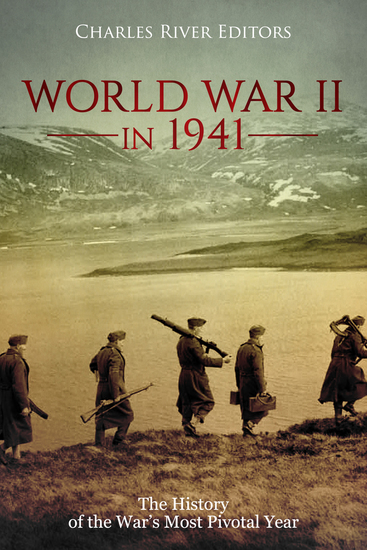
At the beginning of 1941, it was unclear whether the Allies would be able to remain in the war for much longer. British Prime Minister Winston Churchill had already immortalized the men of the Royal Air Force with one of the West’s most famous war-time quotes, but the potential of a German invasion of Britain still loomed. With the comfort of hindsight, historians now suggest that the picture was actually more complex than that, but the Battle of Britain, fought throughout the summer and early autumn of 1940, was unquestionably epic in scope. The largest air campaign in history at the time, the vaunted Nazi Luftwaffe sought to smash the Royal Air Force, but thankfully, the RAF stood toe to toe with the Luftwaffe and ensured Hitler’s planned invasion was permanently put on hold. The Allied victory in the Battle of Britain inflicted a psychological and physical defeat on the Luftwaffe and Nazi regime at large, and as the last standing bastion of democracy in Europe, Britain would provide the toehold for the June 1944 invasion of Europe that liberated the continent. For those reasons alone, the Battle of Britain was one of the decisive turning points of history’s deadliest conflict.
 
In the warm predawn darkness of June 22, 1941, 3 million men waited along a front hundreds of miles long, stretching from the Baltic coast of Poland to the Balkans. Ahead of them in the darkness lay the Soviet Union, its border guarded by millions of Red Army troops echeloned deep throughout the huge spaces of Russia. This massive gathering of Wehrmacht soldiers from Adolf Hitler's Third Reich and his allied states – notably Hungary and Romania – stood poised to carry out Operation Barbarossa, Hitler's surprise attack against the country of his putative ally, Soviet dictator Joseph Stalin.
 
Though Germany was technically Russia’s ally, Stalin had no delusions that they were friends.  Instead, he used this time to build up his forces for what he saw as an inevitable invasion.  First, on the heels of the German invasion of Poland in September 1939, Stalin had his troops invade and reclaim the land Russia had lost in World War I.  Next he turned his attention to Finland, which was only 100 miles from the newly named Leningrad.   He initially tried to negotiate with the Finnish government for some sort of treaty of mutual support.  When this failed he simply invaded.  While the giant Russian army ultimately won, the fact that little Finland held them off for three months demonstrated how poorly organized the bigger force was.
 
Stalin knew that if he could delay an invasion through the summer of 1941, he would be safe for another year, but Hitler began to plan to invade Russia by May of 1941.  Since military secrets are typically the hardest to keep, Stalin soon began to hear rumors of the invasion, but even when Winston Churchill contacted him in April of 1941 warning him that German troops seemed to be massing on Russia’s border, Stalin remained dubious. Stalin felt even more secure in his position when the Germans failed to invade the following May. 
 
What Stalin did not realize was that Hitler had simply overstretched himself in Yugoslavia and only planned to delay the invasion by a few weeks. Hitler aimed to destroy Stalin’s Communist regime, but he also hoped to gain access to resources in Russia, particularly oil.  Throughout the first half of 1941, Germany dug in to safeguard against an Allied invasion of Western Europe as it began to mobilize millions of troops to invade the Soviet Union.  Stalin even refused to believe the report of a German defector who claimed that the troops were massing on the Soviet border at that very moment. 
Available since: 05/01/2025.
Print length: 245 pages.

Other books that might interest you

  • The Dead Mountain - The Bizarre True Story of The 1959 Dyatlov Pass Incident - cover

    The Dead Mountain - The Bizarre...

    Daniel Turmoil

    • 0
    • 0
    • 0
    In the winter of 1959, a group of nine young and experienced hikers embarked on a journey into the Ural Mountains of Russia. Although they had previously undertaken cold-weather trips, this particular expedition would tragically be their last. During their trek, the hikers encountered something unexpected in the supposedly desolate region, resulting in the demise of the entire group. The exact events of that fateful night remain unknown, but the incident has since become one of the world's most perplexing mysteries.
    Show book
  • The Ark Deluge and the World’s Great Year - Ancient Egypt the Light of the World Book 9 - cover

    The Ark Deluge and the World’s...

    Gerald Massey

    • 0
    • 0
    • 0
    After the deluge in “the destruction of mankind” the god Ra establishes a covenant with those who have escaped from the flood. He says that what he commanded is well done, and that the destruction of his enemies removes destruction from themselves. “Said by the majesty of Ra, It is well done, all this. I shall now protect men on account of this. Said by Ra, I now raise my hand that I shall not destroy men” i.e. not again. The making of this covenant after the deluge is followed by the establishment of the New Year’s festival under the direction of the young priestesses of Hathor. ―from “The Ark, the Deluge, and the World’s Great Year” It goes unappreciated by modern Egyptologists, but it is embraced by those who savor the concept of a “hidden history” of humanity, and those who approach all human knowledge from the perspective of the esoteric. Gerard Massey’s massive Ancient Egypt: The Light of the World―first published in 1907 and the crowning achievement of the self-taught scholar―redefines the roots of Christianity via Egypt, proposing that Egyptian mythology was the basis for Jewish and Christian beliefs. Here, Cosimo proudly presents Book 9 of Ancient Egypt, in which Massey explores the prevalent imagery across numerous mythological traditions of a global flood unleashed at the behest of an angry god, and shows how they all sprang from Egyptian folklore. Peculiar and profound, this work will intrigue and delight readers of history, religion, and mythology. British author GERALD MASSEY (1828–1907) published works of poetry, spiritualism, Shakespearean criticism, and theology, but his best-known works are in the realm of Egyptology, including A Book of the Beginnings and The Natural Genesis.
    Show book
  • Warmth of Other Suns The: Book Summary & Analysis - cover

    Warmth of Other Suns The: Book...

    Briefly Summaries

    • 0
    • 0
    • 0
    This is a concise summary and analysis of The Warmth of Other Suns, by Isabel Wilkerson. It is not the original book and is not affiliated with or endorsed by Isabel Wilkerson. Ideal for those seeking a quick and insightful overview.
     
    This powerful and deeply researched historical narrative chronicles the Great Migration, the decades-long movement of Black Americans from the South to cities in the North and West in search of better opportunities and freedom from racial oppression. Through the personal stories of three individuals who embarked on this journey, the book weaves a compelling and emotional tapestry of resilience, sacrifice, and the pursuit of the American dream. Combining meticulous scholarship with novelistic storytelling, this work sheds light on one of the most transformative yet underappreciated chapters of American history.
    Show book
  • Loosen The Grip - Strategies for Raising Independent and Confident Critical Thinkers - cover

    Loosen The Grip - Strategies for...

    Lisa K. Anderson

    • 0
    • 0
    • 0
    How can parents take back their power to discover and develop the best way to parent for their child?By hitting the pause button, shutting out all the noise that tells them how they should parent, and building the confidence to create the relationship that best nurtures and supports their children’s well-being and independence.Three years into parenting, Lisa Anderson realized that the way she was parenting wasn’t healthy for her or her daughter. She sought counseling to help her figure it out, and so began her journey of discovering the best parenting approach for her child.Lisa had her work cut out for her. When her daughter was six, the advisors at her school expressed concern that she had ADHD. Lisa took her to a psychologist who, after months of testing, diagnosed her with BRAT syndrome. “It took me a minute to realize what he meant—she was a brat.”It was at this point that Lisa realized she had never said “no” to her daughter, not because she thought it was best for her daughter, but because that’s what she knew.“I was going to create a little monster if I didn’t change my way of thinking and shift my focus from what I needed to what my daughter needed.”It was a difficult concept to understand, and an even more challenging task to achieve, but through her work on her own trauma coupled with her education and experience in social work and counseling, Lisa figured it out. Not the way to be a perfect parent, but the way to be the best parent for her child. Isn’t that what every parent really wants and what every child deserves?Fear, guilt, and social pressures are driving parents to be over-involved and their children to be overscheduled and overstressed. Children’s freedom to develop their autonomy is being restricted under the guise of keeping them safe from things we simply cannot control. Hypervigilant parenting comes at a significant cost to all of us, as is evident through the increasing number of anxious and depressed children and the emerging adults who lack the confidence and the skills to be self-sufficient. Somewhere along the way we have forgotten that our number one job as parents is to raise our children to be capable, independent adults.Something needs to change.
    Show book
  • Henry VIII - The Charismatic King who Reforged a Nation - cover

    Henry VIII - The Charismatic...

    Kathy Elgin

    • 0
    • 0
    • 0
    Henry VIII is Britain's most notorious monarch, remembered for his six wives and splitting the church in two for the sake of annulling his first marriage. But few know the full story of his tempestuous reign. 
     
    This captivating biography chronicles Henry VIII's life and times, from his early childhood at Eltham to his dominant role as one of the leading players on the international stage. It includes his love affairs, military campaigns, the scheming and plotting of his courtiers and the way in which sex and politics were sometimes fatally intertwined with the Tudor Court.
    Show book
  • The Wolf Age - The Vikings the Anglo-Saxons and the Battle for the North Sea Empire - cover

    The Wolf Age - The Vikings the...

    Tore Skeie

    • 0
    • 0
    • 0
    The first major book on Vikings by a Scandinavian author to be published in English reframes the struggle for a North Sea empire and puts listeners in the mindset of Vikings, providing new insight into their goals, values, and what they chose to live and die for. 


    The Wolf Age takes listeners on a thrilling journey through the bloody shared history of England and Scandinavia, and on across early medieval Europe, from the wild Norwegian fjords to the wealthy cities of Muslim Andalusia. 


    Warfare, plotting, backstabbing, and bribery abound as Tore Skeie skillfully weaves sagas and skaldic poetry with breathless dramatization as he entertainingly brings the world of the Vikings and Anglo-Saxons to vivid life. 


    In the eleventh century, the rulers of the lands surrounding the North Sea are all hungry for power. To get power they need soldiers, to get soldiers they need silver, and to get silver there is no better way than war and plunder. 


    This vicious cycle draws all the lands of the north into a brutal struggle for supremacy and survival that will shatter kingdoms and forge an empire . . .
    Show book