Join us on a literary world trip!
Add this book to bookshelf
Grey
Write a new comment Default profile 50px
Grey
Subscribe to read the full book or read the first pages for free!
All characters reduced
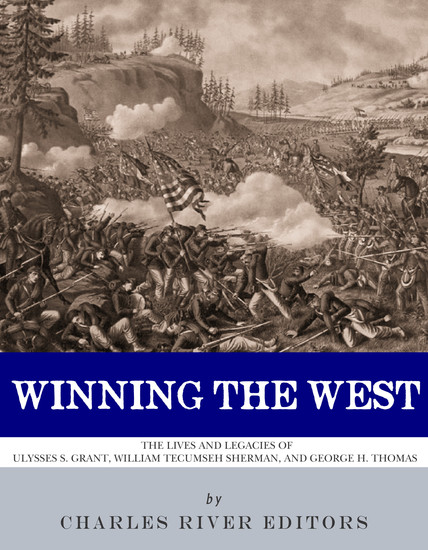
Winning the West - The Lives and Legacies of Ulysses S Grant William Tecumseh Sherman and George H Thomas - cover

Winning the West - The Lives and Legacies of Ulysses S Grant William Tecumseh Sherman and George H Thomas

Editors Charles River

Publisher: Charles River Editors

  • 0
  • 0
  • 0

Summary

In the 19th century, one of the surest ways to rise to prominence in American society was to be a war hero, like Andrew Jackson and William Henry Harrison. But few would have predicted such a destiny for Hiram Ulysses Grant, who had been a career soldier with little experience in combat and a failed businessman when the Civil War broke out in 1861.
 
However, while all eyes were fixed on the Eastern theater at places like Manassas, Richmond, the Shenandoah Valley and Antietam, Grant went about a steady rise up the ranks through a series of successes in the West. His victory at Fort Donelson, in which his terms to the doomed Confederate garrison earned him the nickname “Unconditional Surrender” Grant, could be considered the first major Union victory of the war, and Grant’s fame and rank only grew after that at battlefields like Shiloh and Vicksburg. Along the way, Grant nearly fell prey to military politics and the belief that he was at fault for the near defeat at Shiloh, but President Lincoln famously defended him, remarking, “I can’t spare this man. He fights.” Lincoln’s steadfastness ensured that Grant’s victories out West continued to pile up, and after Vicksburg and Chattanooga, Grant had effectively ensured Union control of the states of Kentucky and Tennessee, as well as the entire Mississippi River. At the beginning of 1864, Lincoln put him in charge of all federal armies, and he led the Army of the Potomac against Robert E. Lee in the Overland campaign, the siege of Petersburg, and famously, the surrender of the Army of Northern Virginia at Appomattox.
 
Sherman spent a majority of the war out west, although it is often forgotten that he was a brigade commander at the First Battle of Bull Run, and that the Civil War actually finished with General Joseph E. Johnston surrendering to Sherman weeks after Appomattox. By 1865, Sherman was the second most popular general in the North behind Grant, and history has accorded him a strong Civil War legacy.
 
Nevertheless, Sherman remains controversial across much of the United States today. He was unquestionably instrumental at battles like Shiloh, his victory in the Atlanta Campaign reassured Lincoln’s reelection, and his March to the Sea revolutionized total warfare. At the same time, the South considered him akin to a terrorist, violating the norms of warfare by targeting civilians, and accuse him of needlessly burning Atlanta and Columbia. In many ways, Sherman is still the scourge of the South, nearly 160 years after he vowed to make Georgia howl. 
 
One of the most unique and effective generals of the Civil War also happens to be one of the most overlooked. While there is a never ending stream of acclaim going to generals like Grant, Lee, and Sherman, General George H. Thomas has managed to fly under the radar, despite having an unusual background as a Southerner fighting for the Union and scoring almost inconceivable successes at Missionary Ridge, Franklin, and Nashville. Thomas also skillfully fought at Perryville, Stones River, and in Sherman’s Atlanta Campaign.


Despite all of those successes, however, Thomas is best remembered as “The Rock of Chickamauga”. On September 19, 1863, a Union gaffe created a quarter-mile gap in the Union center, directly in the path of an eight-brigade (15,000 man) force led by Confederate General James Longstreet, which subsequently drove a third of the Union army from the field. While commanding general William Rosecrans retreated with those men, Thomas rallied the remaining parts of the army and formed an impromptu defensive stand on Horseshoe Ridge, holding off a series of well-executed (albeit costly) assaults until nightfall. Thomas’s heroics prevented the destruction of the Union army and allowed it to successfully retreat to Chattanooga.
Available since: 05/22/2025.
Print length: 137 pages.

Other books that might interest you

  • The Mali Empire - The Tales of Sundiata Keita Mansa Musa and Timbuktu - cover

    The Mali Empire - The Tales of...

    History Retold

    • 0
    • 0
    • 0
    Discover the untold story of Mansa Musa and the Empire of Mali - the first great African kingdom of the Middle Ages!  
    This book paints a vivid picture of the rise and fall of Mansa Musa and the Empire of Mali, and explores the cultural, political, and spiritual foundations of this incredible civilization. 
    This book is a must-have for anyone interested in African history. With engaging stories, this book will take you deep into the past to discover the secrets of Mansa Musa and his kingdom. 
    Get this book today and explore the captivating history of Mansa Musa and the Mali Empire!
    Show book
  • Colonial Ideology and the classical 'Bildungsroman' - cover

    Colonial Ideology and the...

    José Santiago Fernández-Vázquez

    • 0
    • 0
    • 0
    This book examines the ideological affinity that can be established between the classical 'Bildungsroman' and colonialist ideology on the basis of a literary analysis of 'Wilhelm Meisters Lehrjahre'—considered by most critics to be the origin of the genre—and 'Great Expectations'—one of the paradigmatic examples of the development of the Bildungsroman in English literature. This ideological affinity is understood as an example of what the Palestinian critic Edward Said has called a 'structure of attitude and reference': the convergence of different cultural manifestations that, although formally independent, contribute to a common purpose. The monograph also undertakes a study of the main characteristics of the classical 'Bildungsroman' from a formal and thematic point of view, and an analysis of the relationship between genre theories and Eurocentric discourses.
    Show book
  • The Future of Palestine - How Discrimination Hinders Change - cover

    The Future of Palestine - How...

    Tamar Haddad

    • 0
    • 0
    • 0
    The Future of Palestine: How Discrimination Hinders Change was inspired by the shocking "honor killing" of the author's classmate and friend, Israa Ghrayeb. Her alleged crime? The simple act of going out, in broad daylight, with her fiancé and his sister-an act Ghrayeb's cousin maintained was unacceptable in a conservative society. While Ghrayeb's killers may be free, their manner of thinking is anything but.In The Future of Palestine, author Tamar Haddad seeks to open minds to diverse perspectives and to give voice to those who are commonly marginalized in conservative Palestinian society.In a world where prejudice is all too familiar, The Future of Palestine suggests that change can occur through:- Engaging in theoretical readings such as post colonialism, Orientalism, psychoanalysis, nationalism, race theory, queer theory, feminism, and marxism- Sharing stories of marginalized Palestinians- Providing non-Palestinians with a background about the Palestinian-Israeli conflictThis book is for those who reject discrimination against the marginalized and wish to make a difference. Coming together and discussing Palestinian history, identity, trauma, the notion of religion, women, race, sexual orientation, and class should change us all for the better.
    Show book
  • Corpse Care - Ethics for Tending the Dead - cover

    Corpse Care - Ethics for Tending...

    Mikeal C. Parsons, Cody J. Sanders

    • 0
    • 0
    • 0
    Corpse Care relates the history of death care in the US to craft robust, constructive, practical ethics for tending the dead. It specifically relates corpse care to economic, environmental, and pastoral concerns. 


    Death and the treatment of the dead body loom large in our collective, cultural consciousness. The authors explore the materiality and meaning of the dead body and the living's relationship to it. All the biggest questions facing the planetary human community relate in one way or another to the corpse. Surprisingly, Christian communities are largely missing in the discussion of the dead, having abdicated the historic role in care for the dead to the funeral industry. Christianity has stopped its reflection about the body once that body no longer bears life. Corpse Care stakes a claim that the fact of embodiment, this incarnational truth, this process of our bodily becoming, is a practical, ethical, and theological necessity.
    Show book
  • A Sense of Balance - On how our sense of balance has defined us as a nation and will safeguard our future - cover

    A Sense of Balance - On how our...

    John Howard

    • 0
    • 0
    • 0
    On how our sense of balance has defined us as a nation and will safeguard our future. 
      
    In the years that John Howard served in the national parliament he came to understand the special character of Australia; to appreciate its strengths and weaknesses; and most importantly to respect the sense of balance in the formulation of public policy that has long defined us as a nation and made Australia an attractive destination for people from across the world. 
    In this book he explores this balance, its foundations and its future. Written against the backdrop of the COVID-19 pandemic, as well as some of the more contested political events of recent years - the election of Donald Trump, the Brexit vote, the rise of China, and, within our own country, a carousel of six prime ministers in eleven years - these reflections touch on how Australia has responded to pressure over the last decade or so. Commentary on these subjects from politicians, opinion writers and social media can sometimes seem shrill and divisive. Australia's 25th and second longest serving prime minister has faith that no matter what challenges and extremes threaten to upset our sense of balance, the country's institutions and people will remain robust into the foreseeable future. 
    PRAISE 
    'John Howard's ongoing and important contribution to this country continues with his latest laser sharp book, A Sense of Balance. No former leader understands the Australian character better than our 25th Prime Minister' Janet Albrechtsen, columnist  
    HarperCollins Australia 2022
    Show book
  • Day of Reckoning - How the Far Right Declared War on Democracy - cover

    Day of Reckoning - How the Far...

    Mike Wendling

    • 0
    • 0
    • 0
    The United States has become an almost unrecognizable country—with millions in thrall to conspiracy theories, toxic populism, and the far right edging closer to total power—a dire threat to civil society and democratic institutions. While the MAGA movement was in remission due to Donald Trump's defeat in 2020, the fascist fringes have not just survived but have continued to thrive and burrow into the mainstream. The January 6th Capitol Riot prosecutions have done little to curb their enthusiasm for mayhem. 


    Trump's base in the Republican Party is committed to their candidate like never before. The institutionalization of racist voter suppression and the outdated logic behind the Electoral College means he could take back the White House. Apocalyptic messaging ensures the alt-right, anti-government, anti-LGBT, and white nationalist groups see the next election as a life-or-death struggle and are uniting to back the one person they can all agree on—guaranteeing another chaotic election. 


    In this chilling exposé, Wendling encounters Capital rioters, Covid deniers, QAnon supporters, and Proud Boys and uncovers the roots of a movement that threatens to shatter the foundations of democracy.
    Show book