Join us on a literary world trip!
Add this book to bookshelf
Grey
Write a new comment Default profile 50px
Grey
Subscribe to read the full book or read the first pages for free!
All characters reduced
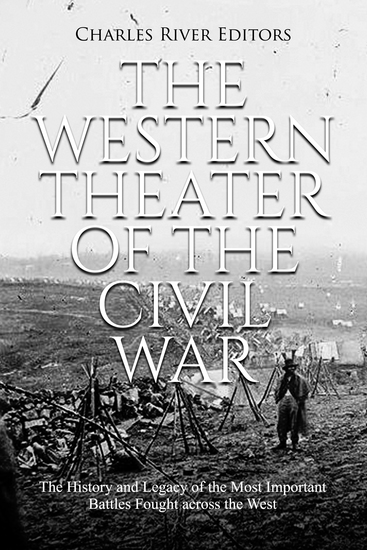
The Western Theater of the Civil War - The History and Legacy of the Most Important Battles Fought across the West - cover

The Western Theater of the Civil War - The History and Legacy of the Most Important Battles Fought across the West

Editors Charles River

Publisher: Charles River Editors

  • 0
  • 0
  • 0

Summary

While the Lincoln Administration and most Northerners were preoccupied with trying to capture Richmond in the summer of 1861, it would be the little known Ulysses S. Grant who delivered the Union’s first major victories, over a thousand miles away from Washington. Grant’s new commission led to his command of the District of Southeast Missouri, headquartered at Cairo, after he was appointed by “The Pathfinder”, John C. Fremont, a national celebrity who had run for President in 1856. Fremont was one of many political generals that Lincoln was saddled with, and his political prominence ensured he was given a prominent command as commander of the Department of the West early in the war before running so afoul of the Lincoln Administration that he was court-martialed.
 
In January of 1862, Grant persuaded General Henry “Old Brains” Halleck to allow his men to launch a campaign on the Tennessee River.  As soon as Halleck acquiesced, Grant moved against Fort Henry, in close coordination with the naval command of Flag Officer Andrew Hull Foote. The combination of infantry and naval bombardment helped force the capitulation of Fort Henry on February 6, 1862, and the surrender of Fort Henry was followed immediately by an attack on Fort Donelson on the Cumberland River, which earned Grant his famous nickname “Unconditional Surrender”. Grant’s forces enveloped the Confederate garrison at Fort Donelson, which included Confederate generals Simon Buckner, John Floyd, and Gideon Pillow. In one of the most bungled operations of the war, the Confederate generals tried and failed to open an escape route by attacking Grant’s forces on February 15. Although the initial assault was successful, General Pillow inexplicably chose to have his men pull back into their trenches, ostensibly so they could take more supplies before their escape. Instead, they simply lost all the ground they had taken, and the garrison was cut off yet again.
Available since: 05/01/2025.
Print length: 425 pages.

Other books that might interest you

  • Same Ground - Chasing Family Down the California Gold Rush Trail - cover

    Same Ground - Chasing Family...

    Russell Wangersky

    • 0
    • 0
    • 0
    “Read him.” — George Elliott Clarke, author of I & I and George and Rue
    		 
    An award-winning author goes looking for the meaning of family and belonging on a glorious wild-goose-chase road trip across middle America
    		 
    Wangersky’s great-great-grandfather crossed the continent in search of gold in 1849. William Castle Dodge was his name, and he was 22 years old. He wrote a diary of that eventful journey that comes into the author’s hands 160 years later. And typically, quixotically, Wangersky decides to follow Dodge’s westward trail across the great bulging middle of America, not in search of gold but something even less likely: that elusive thing called family.
    		 
    What ensues becomes this story, by turns hilarious and profound, about a very long trip — by car, in Wangersky’s case, and on mule and foot in Dodge’s. Interweaving his experiences on the road with Dodge’s diary, the author contemplates the human need to hunt for roots and meaning as he — and Dodge — encounter immigrants who risk everything to be somewhere else, while only glimpsing those who are there already and who want to hold onto their claim in the stream of human migration.
    		 
    Same Ground is a story about what time washes away and what persists — and what we might find, unexpectedly, if we go looking.
    Show book
  • The Queens Who Fought Rome - cover

    The Queens Who Fought Rome

    Editors Charles River

    • 0
    • 0
    • 0
    During one of the most turbulent periods in the history of Rome, men like Julius Caesar, Mark Antony, and Octavian participated in two civil wars that would spell the end of the Roman Republic and determine who would become the Roman emperor. In the middle of it all was history’s most famous woman, the Egyptian pharaoh Cleopatra (69-30 B.C.), who famously seduced both Caesar and Antony and thereby positioned herself as one of the most influential people in a world of powerful men. Cleopatra was a legendary figure even to contemporary Romans and the ancient world, as Plutarch’s quote suggests, and she was a controversial figure who was equally reviled and praised through the years, depicted as a benevolent ruler and an evil seductress, sometimes at the same time.  
    One of the reasons Hadrian's Wall existed was to protect against enemies, and given what happened in the mid-1st century CE, the Romans’ fears was understandable. Indeed, Londinium had become the largest city in Britannia shortly before being burned down in a native revolt led by an infamous Celtic Iceni queen named Boudica. With a name meaning “Victory,” Boudica was a charismatic woman who commanded nearly 100,000 Celts and led them on a campaign to expel the Roman overlords from Britain around the year 61 CE. Often called the “Celtic Queen,” she wore a warrior’s necklace around her delicate neck and rode upon a sturdy steed.  
    One of the most significant women in late antiquity was Zenobia, who for just a few short years in the late 3rd century CE ruled the wealthy merchant city of Palmyra. During her time as ruler, Zenobia extended Palmyra’s boundaries from its very circumscribed location in the Syrian desert to that of a full-fledged empire that included most of the Levant, Egypt, and part of Anatolia. Despite living in a man’s world, Zenobia was able to come to power and eventually challenge the Roman Emperor Aurelian (r. 270-275).
    Show book
  • Jena 1800 - The Republic of Free Spirits - cover

    Jena 1800 - The Republic of Free...

    Peter Neumann

    • 0
    • 0
    • 0
    Around the turn of the nineteenth century, a steady stream of young German poets and thinkers coursed to the town of Jena to make history. The French Revolution and the Napoleonic Wars had dealt a one-two punch to the dynastic system. Confidence in traditional social, political, and religious norms had been replaced by a profound uncertainty that was as terrifying for some as it was exhilarating for others. Nowhere was the excitement more palpable than among the extraordinary group of poets, philosophers, translators, and socialites who gathered in this Thuringian village. 


    Jena became the place for the young and intellectually curious, the site of a new departure, of philosophical disruption. Influenced by Johann Wolfgang von Goethe, then an elder statesman and artistic eminence, the leading figures among the disruptors—the translator August Wilhelm Schlegel; the philosophers Friedrich "Fritz" Schlegel and Friedrich Schelling; the dazzling, controversial intellectual Caroline Schlegel, married to August; Dorothea Schlegel, a poet and translator, married to Fritz; and the poets Ludwig Tieck and Novalis—resolved to rethink the world, to establish a republic of free spirits. They didn't just question inherited societal traditions; with their provocative views of the individual and of nature, they revolutionized our understanding of freedom and reality.
    Show book
  • Tears Over Russia - A Search for Family and the Legacy of Ukraine's Pogroms - cover

    Tears Over Russia - A Search for...

    Lisa Brahin

    • 0
    • 0
    • 0
    Between 1917 and 1921, twenty years before the Holocaust began, an estimated 100,000 to 250,000 Jews were murdered in anti-Jewish pogroms across the Ukraine. Lisa grew up transfixed by her grandmother Channa’s stories about her family being forced to flee their hometown of Stavishche, as armies and bandit groups raided village after village, killing Jewish residents. Channa described a perilous three-year journey through Russia and Romania, led at first by an American who had snuck into the Ukraine to save his immediate family and ended up leading an exodus of nearly eighty people to safety. With almost no published sources to validate her grandmother’s tales, Lisa embarked on an incredible journey to tell Channa’s story, forging connections with archivists around the world to find elusive documents to fill in the gaps of what happened in Stavishche. She also tapped into connections closer to home, gathering testimonies from her grandmother’s relatives, childhood friends, and neighbors. The result is a moving historical family narrative that speaks to universal human themes—the resilience and hope of ordinary people surviving the ravages of history and human cruelty. With the growing passage of time, it is unlikely that we will see another family saga emerge so richly detailing this forgotten time period. Tears Over Russia eloquently proves that true life is sometimes more compelling than fiction.
    Show book
  • Jewish Revolts in Antiquity The: The History of the Jews’ Uprisings against the Seleucids and Romans in Ancient Judea - cover

    Jewish Revolts in Antiquity The:...

    Editors Charles River

    • 0
    • 0
    • 0
    Judea is one of the most important regions in the modern world. It is the center of two of the world’s great religions and extremely important to a 3rd. Politically, the whole area is the focus of conflict between Jews and Arabs, as well as different Muslim sects. Its history is littered with wars, insurrections, and religious revolutions. To say that it has had a turbulent past is to understate the case in the extreme.  
    	The history of Judea is, of course, inextricably linked to the history of the Jewish people, their dispersal throughout the Mediterranean world, and their reestablishment of the modern state of Israel in the wake of the horrors of the Holocaust. And among all the tumultuous events associated with Jewish history, few can rival the period of Roman rule during the 1st century CE, when Roman attempts to suppress Jewish nationalism met with violent resistance. Ultimately, the Romans forcibly removed much of the Jewish population from the region, setting the scene for later events that have impacted so directly on world history. Events in the region during the 1st century CE also brought about the birth of Christianity, a religious movement that has been at the forefront of European history ever since.  
    This whole period relating to the United Monarchy, and the events leading up to the Assyrian invasion, has been the subject of fierce debate between religious scholars and what might be termed more dispassionate academics. The issue of the “Historicity of the Bible” is a massive field of study in its own right but for the purposes of this paper the words of T.L Thompson sums up the position of those who refuse to consider any possibility that the Bible may contain historical facts in relation to the original origins of the Kingdoms centered on Judea.
    Show book
  • Mindful Masculinity: An Anger Management Workbook for Men - Empowering Men to Navigate Anger with Wisdom and Compassion - cover

    Mindful Masculinity: An Anger...

    Alex Carter

    • 0
    • 0
    • 0
    Are you a man seeking a transformative journey toward emotional intelligence and self-mastery? Dive into "Mindful Masculinity: An Anger Management Workbook for Men Empowering Men to Navigate Anger with Wisdom and Compassion," an empowering book designed to guide you through the intricate landscape of anger with wisdom and compassion. 
    In a world where societal expectations often pressure men to suppress emotions, this workbook serves as a beacon for those ready to explore and understand their anger. Written by seasoned experts in psychology and mindfulness, this comprehensive guide offers a unique blend of practical exercises, insightful reflections, and mindfulness techniques tailored to the male experience. 
    "Mindful Masculinity" doesn't just address anger; it redefines masculinity by encouraging self-reflection and embracing vulnerability. Discover a roadmap to navigate anger in a healthy way, fostering better communication, enhanced relationships, and personal growth. As you progress through the workbook, you'll unlock the power of mindfulness, transforming anger into a tool for positive change.
    Show book