Junte-se a nós em uma viagem ao mundo dos livros!
Adicionar este livro à prateleira
Grey
Deixe um novo comentário Default profile 50px
Grey
Assine para ler o livro completo ou leia as primeiras páginas de graça!
All characters reduced
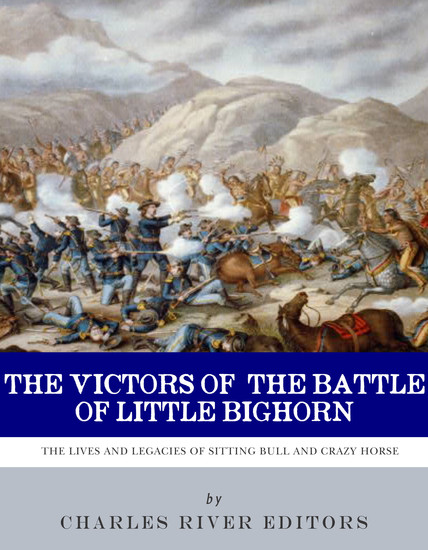
The Victors of the Battle of Little Bighorn - The Lives and Legacies of Sitting Bull and Crazy Horse - cover
LER

The Victors of the Battle of Little Bighorn - The Lives and Legacies of Sitting Bull and Crazy Horse

Editors Charles River

Editora: Charles River Editors

  • 0
  • 0
  • 0

Sinopse

Sitting Bull ensured he would become a legend at the Battle of the Little Bighorn, during which an estimated 2,000 Lakota and Cheyenne warriors inspired by one of his visions routed and then annihilated the 7th U.S. Cavalry led by George Custer. That disaster led the American government to double down on its efforts to “pacify” the Sioux, and by the end of the decade many of them had surrendered and been moved onto a reservation. Sitting Bull defiantly refused to surrender, instead heading with a smaller band into Canada and remaining exiled.
 
When he finally surrendered to the U.S. in 1881, he was a celebrity of sorts, and Sitting Bull went on to appear in Buffalo Bill Cody’s Wild West Show during the decade. Not surprisingly, his death was as controversial as his life; in 1890 Sitting Bull was killed on a reservation after plans to arrest him went terribly awry, leading to fighting in the aftermath that left over a dozen dead.
 
As he lay dying, Tashunke Witco, whose name is literally translated as “His Horse is Spirited” or “His Horse is Crazy,” refused to be placed on an army cot, and he insisted upon being placed on the floor. He had spent his life avoiding white people whenever possible, and after he died, his cousin Touch the Clouds pointed to the blanket covering the dead Chief’s body and said, “This is the lodge of Crazy Horse.”
 
Throughout his life, Tashunke Witco tried to live the life his people had enjoyed for centuries. He never signed a treaty with the U.S. government and was never photographed, largely because he wanted to avoid contact with the settlers encroaching further west upon Native American lands. By staying away from white settlements and military forts, he thus avoided the places where a photographer might be lurking. As the great Lakota leaders surrendered to the U.S. military or were killed, they became symbols of the qualities and character of their people. Red Cloud is often referred to as a symbol of Lakota concession. Sitting Bull is considered symbolic of Lakota spirituality. Crazy Horse, because he delayed surrender and never entered into treaty agreements with the U.S. military, became a symbol of Lakota resistance.
 
Crazy Horse may have fervently wished to avoid white settlers, but he’s a Native American icon today because of the inability to do so. Like Geronimo in the Southwest and Sitting Bull on the Plains, Crazy Horse was a chief who fought in several skirmishes against settlers and U.S. forces during the 1860s, and he became one of the most famous Native Americans in American history because of one fateful confrontation with whites: the legendary Battle of the Little Bighorn, during which an estimated 2,000 Lakota and Cheyenne warriors routed and then annihilated the 7th U.S. Cavalry led by George Custer. That disaster led the American government to double down on its efforts to “pacify” the Plains, and by the end of the decade many of them had surrendered and been moved onto a reservation. Like Sitting Bull, Crazy Horse tried to avoid surrendering for as long as he could, and both suffered a controversial death.  
Disponível desde: 21/06/2025.
Comprimento de impressão: 60 páginas.

Outros livros que poderiam interessá-lo

  • King John Henry III and England’s Lost Civil War - cover

    King John Henry III and...

    John Paul Davis

    • 0
    • 0
    • 0
    This sweeping history of thirteenth century England examines how the successive reigns of two very different kings established the English way of life. 


    In 1204, the great Angevin Empire was fragmenting under King John's rule. Unable to withstand France's invasion of Normandy, John also faced difficult relations with the papacy, and rising dissent among his barons. By the time John died in 1216, the failed Magna Carta gave way to civil conflict, and more than half of the country had fallen to the dauphin of France. These troubles were then passed, along with the crown, to John's nine-year-old son, Henry III. 


    Even with a regency government commanding the ship of state, Henry faced a dire threat to his royal authority. But the First Baron's War came to an end as Henry aligned himself with the pope and offered a revised Magna Carta. While this may have ensured short-term survival, living up to the promises of this foundational contract would create a more significant challenge—and lay the groundwork for the Second Baron's War.
    Ver livro
  • Edgar Allan Poe - Chapter & Verse - Poetry and prose together from literary greats - cover

    Edgar Allan Poe - Chapter &...

    Edgar Allan Poe

    • 0
    • 0
    • 0
    Literature is a world of words and wonder, able to take us on almost unimaginable journeys from the wild and fantastic to the grind and minutiae of life. 
     
    An author’s ideas are his building blocks, his architecture of the mind, building a structure on which all else will rest; the narrative, the characters, the words - those few words that begin the adventure. 
     
    In this series we look at some of our leading classic authors across two genres: the short story and the poem.  In this modern world there is an insatiable need to categorise and pigeon-hole everyone and everything.  But ideas, these grains and saplings of the brain, need to roam, to explore and find their perfect literary use vehicle.  Our authors are masters of many literary forms, perhaps known for one but themselves favouring another. 
     
    Story. Poems. Story.  Within these boundaries come all manner of invention and cast of characters.  And, of course, each author has their own way of revealing their own chapter and verse.    
     
    1 - Chapter & Verse - Edgar Allan Poe - An Introduction 
    2 - The Premature Burial by Edgar Allan Poe 
    3 - Alone by Edgar Allan Poe 
    4 - Annabel Lee by Edgar Allan Poe 
    5 - The Bridal Ballad by Edgar Allan Poe 
    6 - A Dream Within a Dream by Edgar Allan Poe 
    7 - A Dream by Edgar Allan Poe 
    8 - El Dorado by Edgar Allan Poe 
    9 - To My Mother by Edgar Allan Poe 
    10 - In Youth I Have Known One by Edgar Allan Poe 
    11 - Evening Star by Edgar Allan Poe 
    12 - Israfel by Edgar Allan Poe 
    13 - Sonnet - Silence by Edgar Allan Poe 
    14 - The Raven by Edgar Allan Poe 
    15 - The Fall of the House of Usher Part 1 by Edgar Allan Poe 
    16 - The Fall of the House of Usher Part 2 by Edgar Allan Poe
    Ver livro
  • Faith Against Evil - Bonhoeffer's Stand in The Shadow of The Third Reich - cover

    Faith Against Evil -...

    Davis Truman

    • 0
    • 0
    • 0
    This audiobook is narrated by an AI Voice.   
    What makes a person hold steadfast in their Faith amid profound trials? Faith Against Evil: Bonhoeffer's Stand in the Shadow of the Third Reich delves into this compelling question by examining the life and theology of Dietrich Bonhoeffer, a pastor and theologian whose unwavering convictions led him to resist Nazi tyranny at great personal cost. 
    While Bonhoeffer's story of resistance is extraordinary, this study goes beyond mere biography. It explores the theological framework that fortified his resolve, asking whether specific beliefs or contextual factors provided the strength to endure when Faith was put to the ultimate test. By integrating Bonhoeffer's theological writings with the realities of his activism and suffering, this work sheds light on how theology can serve as a source of endurance. 
    This study is not simply an addition to the Bonhoeffer scholarship. Its purpose reaches further, offering insights into systematic theology and contributing to a broader understanding of perseverance in Faith. 
    Faith Against Evil, Bonhoeffer's Stand in the Shadow of the Third Reich, invites readers to reflect on the enduring power of Faith under pressure. It provides a foundation for future theological explorations into what sustains believers in the face of adversity. It is a resource for theologians, historians, and anyone seeking to understand the profound interplay between belief and resilience.
    Ver livro
  • Some Sort of Epic Grandeur - The Life of F Scott Fitzgerald - cover

    Some Sort of Epic Grandeur - The...

    Matthew J. Bruccoli

    • 0
    • 0
    • 0
    “Epic indeed, this is the definitive biography of Fitzgerald, plain and simple. There’s no reason to own another.” —Library Journal  The Great Gatsby, The Beautiful and Damned, Tender Is the Night, “The Curious Case of Benjamin Button.” These works and more elevated F. Scott Fitzgerald to his place as one of the most important American authors of the twentieth century. After struggling to become a screenwriter in Hollywood, Fitzgerald was working on The Last Tycoon when he died of a heart attack in 1940. He was only forty-four years old.   Fitzgerald left behind his own mythology. He was a prince charming, a drunken author, a spoiled genius, the personification of the Jazz Age, and a sacrificial victim of the Depression. Here, Matthew J. Bruccoli strips away the façade of this flawed literary hero. He focuses on Fitzgerald as a writer by tracing the development of his major works and his professional career. Beginning with his Midwest upbringing and first published works as a teenager, this biography follows Fitzgerald’s life through the successful debut of This Side of Paradise, his turbulent marriage to Zelda Sayre, his time in Europe among The Lost Generation, the disappointing release of The Great Gatsby, and his ignominious fall. As former US poet laureate James Dickey said, “the spirit of the man is in the facts, and these, as gathered and marshalled by Bruccoli over thirty years, are all we will ever need. But more important, they are what we need.”
    Ver livro
  • On Life and Death - cover

    On Life and Death

    Aristotle

    • 0
    • 0
    • 0
    "On Life and Death" is a work of the Greek philosopher and scientist Aristotle, which was included in the collection Parva Naturalia ("short treatises on nature"). The collection consists of seven essays discussing various natural phenomena related to the body and soul.
     The culmination of Aristotle's "Parva Naturalia" is the definition of the stages of the life cycle, from the birth of a new living being to death.
    Ver livro
  • When the Heart Waits - Spiritual Direction for Life's Sacred Questions - cover

    When the Heart Waits - Spiritual...

    Sue Monk Kidd

    • 0
    • 0
    • 0
    The bestselling author's inspiring autobiographical account of personal pain, spiritual awakening, and divine grace. 
    ""Inspiring. Sue Monk Kidd is a direct literary descendant of Carson McCullers.""—Baltimore Sun 
    ""Grounded in personal experience and bolstered with classic spiritual disciplines and Scripture, this book offers an alternative to fast-fix spirituality.""—Bookstore Journal  
    Blending her own experiences with an intimate grasp of spirituality, Sue Monk Kidd relates the passionate and moving tale of her spiritual crisis, when life seemed to have lost meaning and her longing for a hasty escape from the pain yielded to a discipline of ""active waiting."" Full of wisdom, poise, and grace, Kidd’s words will encourage us along our spiritual journey, toward becoming who we truly are.
    Ver livro