Join us on a literary world trip!
Add this book to bookshelf
Grey
Write a new comment Default profile 50px
Grey
Subscribe to read the full book or read the first pages for free!
All characters reduced
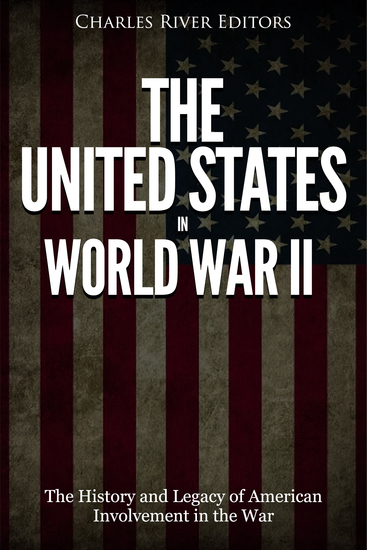
The United States in World War II - The History and Legacy of American Involvement in the War - cover

The United States in World War II - The History and Legacy of American Involvement in the War

Editors Charles River

Publisher: Charles River Editors

  • 0
  • 0
  • 0

Summary

All Americans are familiar with the “day that will live in infamy.” At 9:30 a.m. on Sunday, December 7, 1941, Pearl Harbor, the advanced base of the United States Navy’s Pacific Fleet, was ablaze. It had been smashed by aircraft launched by the carriers of the Imperial Japanese Navy. All eight battleships had been sunk or badly damaged, 350 aircraft had been knocked out, and over 2,000 Americans lay dead. Indelible images of the USS Arizona exploding and the USS Oklahoma capsizing and floating upside down have been ingrained in the American conscience ever since. In less than an hour and a half the Japanese had almost wiped out America’s entire naval presence in the Pacific.
 
The United States began 1942 determined to avenge Pearl Harbor, but the Allies, now including the Soviet Union by necessity, did not agree on the war strategy.  In 1941, both the Germans and British moved armies into North Africa, where Italy had already tried and failed to reach the Suez Canal.  The British sought American help in North Africa, where British General Bernard Montgomery was fighting the legendary “Desert Fox,” General Erwin Rommel.  At the same time, Stalin was desperate for Allied action on the European continent that could free up the pressure on the besieged Soviets. 
 
President Roosevelt had a consequential decision to make, and he eventually decided to land American forces on North Africa to assist the British against Rommel, much to Stalin’s chagrin.  While the Americans and British could merely harass the Germans with air power and naval forces in the Atlantic, Stalin’s Red Army had to take Hitler’s best shots in Russia throughout 1942.  But the Red Army’s tenuous hold continued to cripple the Nazi war machine while buying the other Allies precious time.
 
As it turned out, Roosevelt’s decision to first fight in North Africa would make an Allied invasion of the European continent possible in 1943.  As Rommel pushed east, he now had to worry about American forces to his west.  The Allies eventually gained the upper hand across North Africa after the battle at El Alamein near the end of 1942 that all but forced the Germans to quit the theater without achieving their objectives. 
 
With the Axis forced out of North Africa, the Allies had freed up its North African forces for an invasion of Western Europe.  Moreover, with North Africa as a potential staging around for that invasion, the Germans had to prepare for the possibility of the Allies invading not only from Britain but also from North Africa.  The Allies would make that decision in early 1943.
 
Despite fighting in North Africa and the Atlantic, the United States still had the resources and manpower to fight the Japanese in the Pacific.  Though the Japanese had crippled the American fleet at Pearl Harbor, its distance from Japan made an invasion of Pearl Harbor impossible, and Japan had not severely damaged important infrastructure.  Thus, the United States was able to quickly rebuild a fleet, still stationed at Pearl Harbor right in the heart of the Pacific.  This forward location allowed the United States to immediately push deeply into the Pacific theater.
 
In fact, the turning point in the Pacific theater took place in 1942 near Midway Island.  The Japanese had moved a sizable fleet intending to occupy Midway Island and draw the American navy near.  Instead, American aircraft flying from three aircraft carriers that had been away from Pearl Harbor in December 1941 got a bearing on the Japanese fleet and sunk four Japanese aircraft carriers, permanently crippling Japan’s navy.  The Battle of Midway was the first naval battle in history where the enemy fleets never saw or came into contact with each other.
 
Thus, 1942 ended with the Allies turning the tide in the Pacific and North Africa, giving them momentum entering 1943.  
Available since: 05/01/2025.
Print length: 849 pages.
Other books that might interest you

  • Undoing Manifest Destiny - Settler America Christian Colonists and the Pursuit of Justice - cover

    Undoing Manifest Destiny -...

    L. Daniel Hawk

    • 0
    • 0
    • 0
    As White settlers spread across North America, they crafted and enacted an epic story of their God-given dominion―over the land, over Indigenous nations, and over the future. Their narrative constructed a myth of innocence that justified a massive program of violence and dispossession by suppressing a darker history. That history still reverberates today, from settler America's relations with the Indigenous nations of the United States to ways the land has been commodified as property. It's time for the whole truth to be told. 
     
    In Undoing Manifest Destiny, L. Daniel Hawk exposes the belief systems and practices that settlers developed to justify the displacement, destruction, and cultural erasure of Indigenous peoples, beginning in the early American colonial period and extending to the present day. Writing as the descendant of White settlers and as a biblical scholar, he challenges settler Christians to uncover what the settler narrative denies and to work toward addressing historic injustices. 
     
    Hawk asserts that Christians were complicit with programs of erasure, and so Christians are called to confront and heal their residue today. Joining historical research with theology and biblical scholarship, Hawk helps us recognize the myths that shape the American imagination and to engage our faith for a better way forward.
    Show book
  • The Canadian Citizenship Test - Study Guide with 500+ Official Style Practice Questions & Answers (Living in Canada) - cover

    The Canadian Citizenship Test -...

    Toronto Publications

    • 0
    • 0
    • 0
    What the students who pass the Canadian Citizenship Test on their first attempt know, that you don’t... 
    Maybe you’re worried about not passing your examination and getting your passport? 
    Or maybe you have no idea where to begin when it comes to preparing for the test? 
    If that sounds like you, fortunately, we’ve got your back. 
    We want to ensure that you pass your citizenship test with confidence. 
    We’ve handwritten and narrated over 500 questions from the Official Discover Canada Guide – so you can be sure that the questions and answers you’re practising are accurate and up-to-date. The questions and answers are spread across 10 different chapters such as History, the Economy, Laws, & Responsibilities of Canadians. Each of the questions and answers are multiple choice questions, as well as true and false questions, just like you’ll get on the day of the real test. 
    On the day of your test, you’ll need to get at least 15 out of 20 questions correct within 30 minutes - students who practice with our audiobook increase their chance of passing by at least 60%. 
    Here’s what you’ll get inside this audiobook:500+ Practice Questions, from the official Discover Canada guideAnswers narrated after a 10 second gap, to give you time to think about your answers!Key information on how & where to take your testWorld-class narration. 
    *BONUS* - We’ve also included the updated Oath of Canada (King Charles) for all important recital! 
    Regardless of where in the world you are from, this audiobook will help you to pass your Canadian Citizenship exam faster, and with more confidence – on your first attempt.  
    If you want to get your Canadian Passport and pass the examination with ease, then.. 
    Listen to this audiobook now!
    Show book
  • The Whispering Woods - Where Every Leaf Has a Secret to Tell - cover

    The Whispering Woods - Where...

    Lila Fernwillow

    • 0
    • 0
    • 0
    Step into The Whispering Woods, a mystical forest where nature’s whispers come alive with every rustle of leaves. Here, the trees hold ancient stories, and the gentle breeze carries secrets passed down through generations. Each leaf, shimmering with dewy light, seems to murmur its own tale — from forgotten legends to hidden dreams. Wander through winding paths where shadows dance and every step reveals a new mystery waiting to be uncovered. In this enchanted sanctuary, the woods don’t just breathe—they speak, inviting you to listen closely and discover the magic that lies beneath their canopy.
    Show book
  • Women of Ancient Greece - Philosophers Leaders and Goddesses - cover

    Women of Ancient Greece -...

    Layla Gupta

    • 0
    • 0
    • 0
    The ancient Greeks created a rich tapestry of gods and goddesses that embodied the complexities of the human experience, and among them, the divine feminine figures stood out as powerful symbols of strength, wisdom, love, and conflict. The goddesses of ancient Greece were not merely passive figures but rather active forces that shaped both the natural world and the lives of mortals. Their stories reveal a deep understanding of the roles and expectations of women, as well as the power dynamics that governed ancient Greek society. 
    Among the most prominent of these divine figures was Athena, the goddess of wisdom, warfare, and craft. Athena was a paradoxical figure, blending intelligence with martial prowess. As the patron goddess of Athens, she embodied the city's values of logic, strategy, and civic duty. Her virginity, a defining characteristic, symbolized purity and independence, and her role as a warrior was unique in that it was based on strategic thinking rather than physical aggression. Athena's guidance was sought not just in matters of war but also in philosophy and the arts, making her one of the most revered figures in the pantheon. 
    In stark contrast to Athena's intellectual and strategic prowess, Aphrodite, the goddess of love, beauty, and desire, represented the compelling and often uncontrollable forces of attraction. Aphrodite's influence was not confined to the physical realm; she also governed the emotional and relational dynamics of gods and mortals alike. Her beauty and charm were legendary, capable of inciting both creation and destruction. Through her, the Greeks understood love not just as a harmonious union but also as a force that could disrupt order, as seen in the myth of her involvement in the Trojan War. Aphrodite’s power was as much about seduction as it was about the more fragile human emotions, teaching that love could be both transcendent and tumultuous.
    Show book
  • 80K per month from Instagram - cover

    80K per month from Instagram

    Sindhy Kashyap

    • 0
    • 0
    • 0
    This woman found her niche online with Instagram sales and now makes Rs 80k a month
    Show book
  • French For Travelers with Fun - cover

    French For Travelers with Fun

    Nancy Loyat

    • 0
    • 0
    • 0
    Here is the ideal companion for a pleasant stay in Quebec. The most common and necessary words and expressions for accommodation, food, shopping and sightseeing during your trip to la belle province.
    Show book