Join us on a literary world trip!
Add this book to bookshelf
Grey
Write a new comment Default profile 50px
Grey
Subscribe to read the full book or read the first pages for free!
All characters reduced
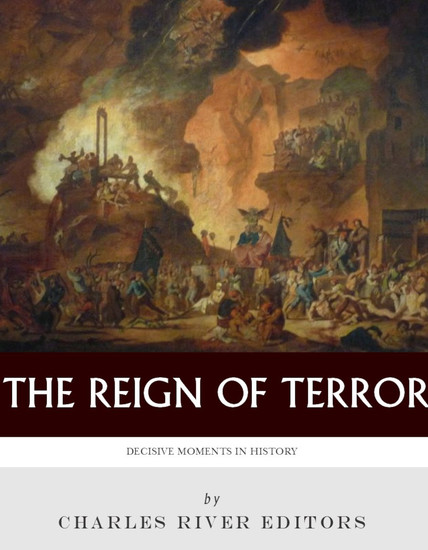
The Reign of Terror - Decisive Moments in History - cover

The Reign of Terror - Decisive Moments in History

Editors Charles River

Publisher: Charles River Editors

  • 0
  • 0
  • 0

Summary

“Citizens, did you want a revolution without a revolution?” – Maximilien Robespierre
 
In the 19th century, the Scottish writer Thomas Carlyle famously wrote, "The history of the world is but the biography of great men", popularizing the “Great Man” theory that the course of history is shaped by a select few heroic individuals. While historians and others continue to debate the accuracy of the Great Man theory of history, there is no question that the course of history is permanently altered by decisive moments in time, where a different result would have produced drastically different outcomes. Charles River Editors’ Decisive Moments in History examines the events that changed history forever and set the world down the path it finds itself on today.
 
As one of the seminal social revolutions in human history, the French Revolution holds a unique legacy, especially in the West. The early years of the Revolution were fueled by Enlightenment ideals, seeking the social overthrow of the caste system that gave the royalty and aristocracy decisive advantages over the lower classes. But history remembers the French Revolution in a starkly different way, as the same leaders who sought a more democratic system while out of power devolved into establishing an incredibly repressive tyranny of their own once they acquired it.
 
The height of Republican France’s tyranny came during a 10 month period forever known as the Reign of Terror, the most notorious and arguably most memorable part of the French Revolution. One of the first victims of the Reign of Terror was its most famous: former French Queen Marie Antoinette. But Antoinette was followed by thousands more, including everyone from aristocrats to clergy to prostitutes and even instrumental revolutionaries like Danton, Desmoulins, and, most notably, Robespierre. It was Robespierre whose position on the Committee of Public Safety made him the Reign of Terror’s instrumental figure until he himself became a victim of it in July 1794. Robespierre’s date with the guillotine is often considered the official end of the Reign of Terror, but by then it is estimated that at least 16,000 people were guillotined in that time and possibly 25,000 more were summarily executed across the country.
 
Although Robespierre is almost singlehandedly associated with the Reign of Terror and is typically blamed for it, many factors influenced the actions and beliefs of Paris and the remainder of France during late 1793 and 1794. Robespierre and the Committee of Public Safety believed passionately in the Revolution and fought to eliminate any threat to the young French Republic. Robespierre envisioned a Republic of Virtue, with no room for anyone who did not abide by his rules and morality. Counterrevolutionaries certainly did threaten the Revolution; however, most of those killed during the Reign of Terror were not counterrevolutionaries and posed no serious threat to the Revolution or Republic.
 
Decisive Moments in History: The Reign of Terror chronicles this instrumental period of the French Revolution, explaining the historical background leading up to it, the seminal moments of the Reign of Terror, and its aftermath and legacy. Along with pictures of important people, places, and events, you will learn about the Reign of Terror like you never have before, in no time at all.
Available since: 05/22/2025.
Print length: 80 pages.


Other books that might interest you

  • On Airs Waters and Places - cover

    On Airs Waters and Places

    Hippocrates

    • 0
    • 0
    • 0
    On Airs, Waters, and Places is a treatise by Hippocrates in which he sets forth his ideas on the impact of climate and geography on human health. In particular, he believed that certain climates and types of terrain were more conducive to good health than others, and that people who lived in unhealthy environments were more likely to suffer from illness. Read in English, unabridged.
    Show book
  • 17 Runs - The Unbeaten Path to Unlock Life’s True Potential - cover

    17 Runs - The Unbeaten Path to...

    Olivia Chadwick, Garnet Morris

    • 0
    • 0
    • 0
    Olivia Chadwick—a young mother and self-critical personal trainer—first met insurance magnate Garnet Morris at 6 am on a winter morning in Saskatoon, Canada. Chadwick's task was to help prepare Morris for the grueling,100-mile Kananaskis relay, but she had reservations—about his coachability as well as her ability to reach him while juggling her own professional, familial and maternal struggles. 
    Through mutual hesitations, their seasons-long training schedule led to profound and unexpected conversations. As it turned out, the coach needed coaching on self-esteem and self-forgiveness—as well as someone to believe in her as she rebuilt her own strength. 
     In 17 Runs, co-authors Chadwick and Morris chart the course of their unique camaraderie around initial differences and toward mutual transformation. Through their challenging push-pull, they tell a story that’s a testament to the renewing power friendship can have on our lives, businesses and ability to love. 
    Full of entrepreneurial wisdom on overcoming limitations, 17 Runs is a self-development story like no other. By turns motivational, amusing and heart-breaking, it is a must-read for anyone who needs coaching on how to run toward a life they truly choose.
    Show book
  • Healing Trauma With Emdr - cover

    Healing Trauma With Emdr

    Jim Colajuta

    • 0
    • 0
    • 0
    We all have a natural emotional healing process, just as we do a natural physical healing process within us. When we get a wound, our bodies' natural healing process takes care of it. When emotionally painful events occur in our lives, we usually manage to overcome them and move on with our lives. On the other hand, a cut does not always heal until it has been cleaned and an antibiotic has been applied. Similarly, when something emotionally upsetting occurs, the brain's processing system isn't always able to absorb it and put it into the context of our entire lives without assistance. Sometimes we are completely unaware of what is going on.Although the image of the incident may not come to us consciously, we may feel unworthy, sad, afraid, or nauseous. We may be unaware that we are being swamped with dysfunctionally stored material from the past. We may act in ways we later regret and not wholly comprehend why. The EMDR method recognizes that you aren't reacting on purpose; the triggered memories are at the root of your actions that aren't consistent with who you are now. EMDR can assist the brain's processing system repair emotional wounds in the same way that an antibiotic ointment can help cure a cut. It's still your own internal process conducting the healing; EMDR simply "jump starts" it when it's needed and speeds it up.Once the isolated "land mine" of trauma has been reprocessed using EMDR, it is neutralized, meaning it will no longer go off and flood into the present. It's woven into the fabric of your existence, so it appears to be over and cannot derail you from your current state of bliss.The information appears to be stimulated, and the brain can reprocess the situation due to eye movements or other bilateral stimulation. Eye movements are only a tiny part of EMDR. In processing traumatic memories, current concerns, or future fears, integrates imagery, beliefs, emotions, and physical sensations.
    Show book
  • The ABC’s of Preschool - Your Guide to Owning Operating and Thriving in Early Childhood Education - cover

    The ABC’s of Preschool - Your...

    Amber Jayne

    • 0
    • 0
    • 0
    MS. AMBER'S UNIQUE APPROACH IS HER ABILITY TO INTERTWINE HER PERSONAL STORIES OF TRIUMPHS 
    AND SETBACKS, CREATING A NARRATIVE THAT IS BOTH RELATABLE AND INSPIRING. 
    She encourages readers to dream big and, more importantly, equips them with the tools they need to find their own success in the world of preschool education. 
    In The ABC's of Preschool you'll find a roadmap to a more fulfilling life and a 
    thriving career. 
    Create Financial Security: Discover the path to a financially rewarding career in 
    the field of early childhood education. You can achieve both financial stability 
    and the satisfaction of making a profound impact on your community. 
    Spend Quality Time With Your Children: Unleash the potential for more quality 
    time with your own children during their crucial formative years. 
    Realize Your Dream Childcare Center: Learn how to create, open, and operate 
    your dream preschool. Gain the knowledge and insights needed to not only start 
    your center but ensure it THRIVES for years to come.
    Show book
  • Xia Dynasty - The Myth and Mystery of China's First Dynasty - cover

    Xia Dynasty - The Myth and...

    Rolf Hedger

    • 0
    • 0
    • 0
    The Xia Dynasty is often considered the first dynasty of China, marking the transition from a prehistoric era dominated by tribal alliances to a structured monarchy. However, much of what is known about the Xia comes from ancient texts written centuries later, blurring the line between history and legend. At the heart of this foundation myth is Yu the Great, a figure credited with taming the catastrophic floods that once plagued the Yellow River region. 
    According to traditional accounts, China before the Xia was ruled by the Five Emperors, semi-mythical sages who brought order and knowledge to early societies. The final ruler of this period, Emperor Shun, recognized Yu for his brilliance and appointed him to control the devastating floods that had threatened agricultural settlements for generations. Unlike his predecessors, who attempted to block or divert the waters, Yu devised a system of dredging and canal-building that allowed the floodwaters to drain naturally into rivers and the sea. His efforts reportedly took over a decade, during which he traveled across the land, surveying the terrain and directing large-scale labor projects. His selfless dedication won him the admiration of the people, and his success in flood control cemented his reputation as a leader with the Mandate of Heaven. 
    The concept of the Mandate of Heaven, though later fully developed under the Zhou Dynasty, has its roots in the Xia period. It suggested that rulers were chosen by divine will and that their legitimacy depended on their ability to maintain order and prosperity. Yu's ability to tame the floods demonstrated both his virtue and his right to rule. Upon Emperor Shun’s abdication, Yu became the first king of the Xia Dynasty, establishing a hereditary monarchy that would continue for generations.
    Show book
  • The Land of Peek-a-Boo - cover

    The Land of Peek-a-Boo

    Roz Rosenbluth

    • 0
    • 0
    • 0
    Fun sound-effects and whimsical music help tell the story of “The Land Of Peek-a-Boo!” Tina loves to play Peek-a-Boo with her brother Timmy. When Tina jumps out of the closet and yells “Peek-A-Boo”, her brother is afraid.  And when Tina jumps out of the toy chest and yells “Peek-A-Boo,” Timmy tells her to STOP! Tina loves to scare Timmy and doesn't understand why he doesn't want to play this game. Find out what happens when Tina has a dream and goes to The Land of Peek-A-Boo. Will Tina understand how Timmy feels after being frightened in Peek-A-Boo Land? A positive ending adds interest to this adorable story and encourages a lifelong love for storytime.
    Show book