Junte-se a nós em uma viagem ao mundo dos livros!
Adicionar este livro à prateleira
Grey
Deixe um novo comentário Default profile 50px
Grey
Assine para ler o livro completo ou leia as primeiras páginas de graça!
All characters reduced
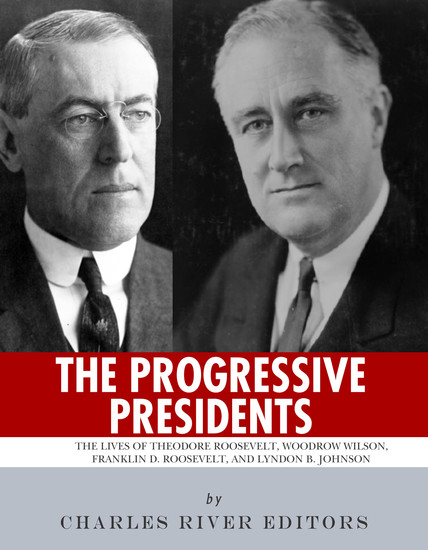
The Progressive Presidents - The Lives of Theodore Roosevelt Woodrow Wilson Franklin D Roosevelt and Lyndon B Johnson - cover
LER

The Progressive Presidents - The Lives of Theodore Roosevelt Woodrow Wilson Franklin D Roosevelt and Lyndon B Johnson

Editors Charles River

Editora: Charles River Editors

  • 0
  • 0
  • 0

Sinopse

For a man who grew up to become the “Bull Moose”, Theodore Roosevelt was a sickly child, suffering from asthma and other maladies. But his physical weakness actually drove him to be more active, which also fostered an interest in nature. It also helped that Teddy’s family was wealthy, allowing him privileges including home school and the ability to attend Harvard, where he was an athlete and took an interest in naval affairs. After finishing at Harvard, Teddy entered politics, but it didn’t stop him from writing The Naval War of 1812 in 1882, establishing himself as a professional writer and historian.
 
In the 1890s, it was Teddy’s turn to make history, leading the Rough Riders during the Spanish-American War and being decorated for his service with a Medal of Honor. He parlayed his glory into the governorship of New York and then the Vice Presidency under William McKinley. When McKinley was assassinated in 1901, young Teddy was thrust into the presidency, one that would earn him a place on Mount Rushmore, Roosevelt’s “Square Deal” domestic policies favored average citizens while busting trusts and monopolies. Roosevelt also promoted conservation as an environmental stance, while his “speak softly and carry a big stick” foreign policy is still an oft used phrase today. Roosevelt even earned a Nobel Prize during his presidency. 
 
As one of the most influential men of the 20th century, there is no shortage of adjectives to use when describing Woodrow Wilson’s two terms as president of the United States. Wilson was a pioneer of the Progressive movement both before and during his presidency, becoming a populist champion a generation before Franklin Roosevelt’s New Deal. He ran for reelection by touting his neutrality during World War I, only to lead his nation into the war and become the architect of a world body that would lead to greater inter-connection among nations. Today Wilson is best remembered for his Fourteen Points, one of the most forceful arguments for an idealistic foreign policy in American history, and his fight for the League of Nations, which set the model for today’s United Nations.
 
Wilson’s presidency was monumentally consequential, but it is not without its critics, nor is the man himself. Even as Wilson has come to be viewed as one of America’s greatest presidents, perception of Wilson and his administration as racist have also taken hold. Despite being one of the early 20th century’s most forceful proponents of a globalized foreign policy, Wilson’s personal views and comments were ardently anti-immigration, and Wilson’s administration entrenched and expanded segregation in the federal government.
 
Franklin Delano Roosevelt might be America’s greatest 20th century president, but there’s no question that he was the most unique. A well-connected relative of Theodore Roosevelt, FDR was groomed for greatness until he was struck down by what was widely believed to be polio at the time. Nevertheless, he persevered, rising through New York politics to reach the White House just as the country faced its greatest challenge since the Civil War, beginning his presidency with one of the most iconic lines ever spoken during an inaugural address. For over a decade, President Roosevelt threw everything he had at the Great Depression, and then threw everything the country had at the Axis powers during World War II. Ultimately, he succumbed to illness in the middle of his fourth term, just before the Allies won the war.
 
Kennedy has been nostalgically and fondly remembered for his youth, vigor and sense of unfinished potential, but it would be President Johnson who would bring much of the agenda to fruition. He pushed through a progressive social agenda that formed the backbone of modern American society. Known as the Great Society, the legislation included the landmark Civil Rights Act of 1964, as well as the establishment of Medicare, environmental protection, and more.
Disponível desde: 06/05/2025.
Comprimento de impressão: 168 páginas.

Outros livros que poderiam interessá-lo

  • A Womanist Theology of Worship - Liturgy Justice and Communal Righteousness - cover

    A Womanist Theology of Worship -...

    Lisa Allen

    • 0
    • 0
    • 0
    In this "love letter to the Black Church," Dr. Lisa Allen examines the history of worship in the Black Church in America (and its legacy of equating liturgy with justice), the enduring effects of white supremacy on its liturgical heritages, and finally proffers a new liturgical paradigm, using a womanist hermeneutic, for students, liturgists, liturgical musicians, and lay people.
    Ver livro
  • The Duty of Civil Disobedience - cover

    The Duty of Civil Disobedience

    Henry David Thoreau

    • 0
    • 0
    • 0
    The Duty of Civil Disobedience by Henry David Thoreau, narrated by Marcus Locke, is a thought-provoking essay that explores the individual's moral responsibility to resist unjust government actions. Written in 1849, Thoreau's work has become a cornerstone of political philosophy, advocating for peaceful protest and nonviolent resistance to oppressive authority. Thoreau emphasizes the importance of following one's conscience over conforming to laws that violate fundamental human rights. 
    Narrator Marcus Locke brings Thoreau’s powerful message to life, delivering the essay with clarity and conviction. His narration invites listeners to reflect on their role in society and the power of individual action against injustice. Locke’s voice captures the calm yet resolute tone of Thoreau’s work, making this audiobook an engaging and inspiring experience for those interested in civil rights, social justice, and personal activism. 
    This audiobook is perfect for listeners drawn to philosophical works and the history of social movements, as well as anyone seeking inspiration for standing up for their beliefs. The Duty of Civil Disobedience remains a timeless call to action, encouraging peaceful resistance to unjust laws and policies.
    Ver livro
  • Forgotten Terrorist Bombings in America: The History of Some of the Earliest Attacks in the United States - cover

    Forgotten Terrorist Bombings in...

    Editors Charles River

    • 0
    • 0
    • 0
    Bombs have been around for centuries. The military units called “Grenadiers” in European armies used throwable black powder bombs, early versions of what today are called grenades. They were heavy, so Grenadiers were tall, strong soldiers able to throw grenades for a distance. Terrorism has been around for many centuries, most infamously the period called The Terror (1793-94) in the French Revolution. However, the combination of bombs and terrorism is considerably more recent, dating to the 1870s and 1880s. 
    	Black powder had been used occasionally for terrorism before the 1800s, with the most famous incident being the Guy Fawkes gunpowder plot to blow up the English Parliament in 1605. Fawkes used barrels of gunpowder rather than a bomb in the modern sense. Terrorism was nothing new in the United States, where, for example, tarring and feathering of Loyalists during the American Revolution was a terror technique designed to quell Tory sentiments. However, terrorists using bombs to accomplish political ends in the United States goes back only about 150 years. That’s partly a result of the rise of political movements seeing violence as legitimate, and partly the result of the development of dynamite. 
    	Alfred Nobel invented dynamite in 1867, making usable a substance that had been invented years before, called nitroglycerine. The substance was known to be a powerful explosive, but it was too unstable and too dangerous to be of much use, until Nobel devised a way to make it stable and usable. Nobel also invented the blasting cap, which would ignite the dynamite, using a fuse that could be lit, and later, allow it to be ignited by an electric charge provided by a battery. Nobel would late in his life feel remorse for the harm his invention had caused, and established the Nobel Prizes as a kind of atonement.
    Ver livro
  • The 7-Minute Admissions Decision - Making Every Second Count to Gain Acceptance to Your Dream School - cover

    The 7-Minute Admissions Decision...

    Sean Ma

    • 0
    • 0
    • 0
    The average college admissions officer makes their decision in 7 minutes.This book will help you and your child make every minute count. If your child dreams of attending a top U.S. college, you know they’re facing an epic challenge. Everyone has heard of a student with perfect test scores and GPA who was rejected by their first-choice school, and sometimes even their second-choice school. Just what are admissions officers at top schools looking for, and what can your child do to rise above the competition and get their dream school to say “yes?”  This book answers those questions, and more.  Written by college admissions expert Sean Ma, Founder/CEO of Ma Academy and President/Board Member of Shanghai Leighton School, The 7-Minute Admissions Decision provides you and your child with a blueprint to help them identify, apply to and win admission to the elite schools that are the best fit for them. Using the same process he uses with his clients, Ma helps readers maximize their high school years by identifying their passion, going deep, and gaining the kinds of experiences that make a winning college application. He then guides them through creating that application step by step. Featuring interviews with admissions officers from top U.S. schools, you’ll learn what makes an application stand out, what top schools are looking for, and most importantly, how your child can prepare for the future, achieve their dreams, and live the lives they want to live.
    Ver livro
  • Is There in the Brain Anything Untouched By Culture? - Brockwood Park and Gstaad 1975 - Dialogue 9 - cover

    Is There in the Brain Anything...

    Jiddu Krishnamurti

    • 0
    • 0
    • 0
    Is there in the brain anything untouched by culture?" - 6 August 1975Can there be a total perception which completely heals the brain?What benefit has culture?Does speech come before thought?Is it possible to say something without the operation of thought?Is there in the brain anything untouched by culture?Is attention a conscious process?Is love the factor of profound change?You explain all this, and you say that whatever the damaged brain – which is the result of thought and tradition and all the rest of it – whatever it does will produce further damage. So, because you point it out, I realise that. That is the first necessity – I realise it. Then, after I’ve realised it, you talk to me at a depth which thought has not touched. You planted a seed.
    Ver livro
  • The Arthurian Legends - The Epic Tales of King Arthur and His Knights - cover

    The Arthurian Legends - The Epic...

    Julia Blacksmith

    • 0
    • 0
    • 0
    The Arthurian legends have captivated audiences for centuries, blending history, myth, and romance into a timeless narrative. At the heart of these tales stands King Arthur, the noble ruler of Camelot, surrounded by his valiant knights, wise counsel, and a destiny shaped by magic and fate. These stories, filled with chivalry, heroism, and tragedy, have evolved over time, transforming from medieval folklore into one of the most enduring mythological traditions in the Western world. Whether viewed as a historical figure or a fictional hero, Arthur’s legend continues to inspire literature, art, and modern storytelling.  
      
    The roots of the Arthurian legends can be traced back to early medieval Britain, a period marked by conflict and shifting power. The earliest references to Arthur appear in Welsh and Celtic traditions, portraying him as a warrior who defended his land against invading forces. As these stories spread, they were enriched by medieval chroniclers such as Geoffrey of Monmouth, whose twelfth-century work *Historia Regum Britanniae* established Arthur as a grandiose king with a mythical kingdom. French and English writers expanded the legend, introducing characters like Lancelot, Guinevere, and the Holy Grail, further shaping the narrative into the form known today.  
      
    The debate over whether King Arthur was a real historical figure or merely a legendary construct has fascinated scholars for centuries. Some believe that Arthur may have been based on a real Brittonic war leader who fought against Saxon invasions in the fifth or sixth century. However, definitive historical evidence remains elusive. What is clear is that Arthurian stories took on a life of their own, infused with elements of medieval knighthood, Christian symbolism, and mythical enchantment. Arthur became more than just a king—he became an ideal, embodying the virtues of justice, bravery, and sacrifice. 
    Ver livro