Join us on a literary world trip!
Add this book to bookshelf
Grey
Write a new comment Default profile 50px
Grey
Subscribe to read the full book or read the first pages for free!
All characters reduced
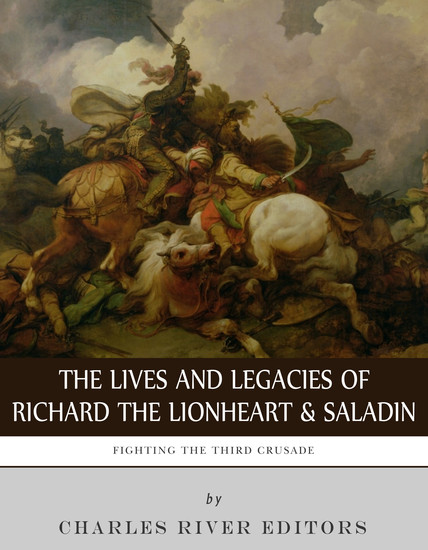
The Lives and Legacies of Richard the Lionheart and Saladin - Fighting the Third Crusade - cover

The Lives and Legacies of Richard the Lionheart and Saladin - Fighting the Third Crusade

Editors Charles River

Publisher: Charles River Editors

  • 0
  • 0
  • 0

Summary

Saladin is widely considered one of the greatest generals in history and one of the most famous leaders of the Middle Ages, but he remains a paradox, both in personal and in historical terms. A military genius, he first served other generals and was overshadowed, late in life, by his greatest rival, Richard I of England. He was far more admired by his Christian enemies, who extolled his chivalry, than some of his Muslim rivals, who fought him for control of Egypt and Syria in the 12th century. His Christian enemies continued his name long after it was forgotten in the Middle East, only to spark a revival of his reputation in Arab culture in the 20th century.
 
Revered as the flower of Arab culture, he was really a Kurd who nearly destroyed it. Taught to Egyptian children as a native born Egyptian hero, he was, in fact, Egypt's conqueror, the man who destroyed its native dynasty and suppressed the local Shi'ite sect. Praised for his mild temper and mercy, he made it his mission in the last decade of his life to destroy the Frankish states created by the First Crusade in 1099. The most powerful man in the Levant for the last ten years of his life, he died a virtual pauper after giving away his personal fortune to the poor. Having united almost all of the Levant under one rule, he left it as divided as before. He founded a dynasty that was eventually destroyed by slaves.
 
Richard I Plantagenet (1157-1199), nicknamed “Coeur de Lion” (Lionheart), eventually became King of England, Grand Duke of Aquitaine, Duke of Poitou, and Duke of Anjou, but as the third son in a large family, he did not expect to or even want to rule England. Nevertheless, it was he who eventually came to the throne upon his father's death. Richard lived in an age when knights were first asserting themselves as capable of being moral forces for good rather than only agents of chaos. This attitude resolved itself into the mystique of chivalry. As one of the strongest knights of his age, Richard was also considered a flower of chivalry and greatly admired as a model of what it meant to be a knight, both in his lifetime and afterward. But as the son of the most famous power couple of the age – Henry II of England (1133-89) and Eleanor of Aquitaine (1122/24-1204) – and an expansionist noble contesting over land with other expansionist nobles, he also had many enemies. These enemies portrayed Richard as evil incarnate, at the same time his admirers were portraying him an emblem of virtue. As with all such great and controversial figures, the real Richard lay somewhere in between.
 
 In many parts of the world today, Richard the Lionheart is remembered not for being a medieval king but for being perhaps the Crusades’ most famous European figher. In the Third Crusade, Richard was pitted against the best known Muslim leader in history, Saladin, who like Richard was considered a flower of chivalry by some, a tyrant by others, and even a herald of the Antichrist by Christians. Richard and Saladin's contest was cast by their contemporaries as a battle between Good and Evil (though who was Good and who was Evil depended greatly on the source), but eventually the legend and lore of mutual respect between the two and popular depictions of both leaders helped cement their legacies. Richard's eventual reputation was bound up as much in the crusading spirit of his age as in his reputation as a fearsome warrior or the history of his tumultuous family. If anything, stories like The Lion in Winter have oversimplified the complex Plantagenets who were Richard's closest kin.
Available since: 06/29/2025.
Print length: 64 pages.

Other books that might interest you

  • Gaslighting: How to Recognize Manipulation and Narcissistic Abuse and Set Boundaries So You Can Break Free and Recover from an Emotionally Abusive Relationship - cover

    Gaslighting: How to Recognize...

    Andy Gardner

    • 0
    • 0
    • 0
    Understand the psychology of gaslighting and learn to deal with manipulation tactics effectively. 
    Do you feel like you’ve been doubting yourself too much recently? 
    Does someone make you feel bad for something that was clearly their fault? 
    Do you have a codependent relationship with someone and feel completely at their mercy when you’re at odds? 
    Gaslighting is a far too common manipulation tactic, yet very few people understand the psyche behind this behavior. Recognizing the signs of emotionally manipulative behavior is vital to protect yourself from psychic vampires and emotional abusers. Manipulation tactics like gaslighting leave you unable to make sound decisions and have you doubting your self-worth. 
    In this audiobook, you will:Learn about the signs of gaslighting and how to identify themUnderstand the psyche behind an emotional manipulator’s mindDiscover how your closest relationships can have toxic, gaslighting behavior without you knowing itLearn how you can avoid gaslighting individuals and their tacticsUnderstand how to set boundaries to avoid toxic individualsLearn how to recover from an abusive gaslighting relationshipDiscover techniques to protect yourself from gaslighting 
    A proper guide for navigating a gaslighting relationship can be essential to living a joyful life. 
    So, click the “add to cart” button now and figure out how to break free of toxic relationships and heal as you move forward.
    Show book
  • Mesoamerican Astronomy: The History of Celestial Observations Made by the Maya Aztec and Inca - cover

    Mesoamerican Astronomy: The...

    Editors Charles River

    • 0
    • 0
    • 0
    For the Maya, astronomy was not a purely scientific pursuit but intimately linked to religious, mythological, and ideological elements that were of the highest importance. The celestial realm held a sacred nature, as did the many gods and goddesses that dwelt there, so for all Mesoamerican cultures, astronomy was a fundamental part of their everyday lives. Thus, astronomy was present in their calendars, religion, and even agriculture, and in close relation to astronomy, the concept of time was also an essential part of their worldview.  
    The Aztec recorded many of the astronomical events they observed in codices and hieroglyphic inscriptions, but the main evidence of their deep astronomical knowledge comes from their calendar system. This information was then used to plan the orientation of buildings and ceremonial centers, which were aligned to sunrises or sunsets corresponding to special dates, such as solstices or equinoxes. Observational calendars were also used to schedule agricultural activities, as well as rituals, festivals, and celebrations. 
    Though the Spanish physically conquered them in quick fashion, the culture and legacy of the Inca Empire has continued to endure throughout the centuries in both Europe and South America, due in no small part to the fact they were one of the most advanced and sophisticated cultures on the continent. The sun was the main element present in the Inca worldview, so Inti, the sun god, was worshipped above all others and, even though the different parts of the empire were allowed to practice their individual beliefs, they were encouraged to venerate the sun. The connection with the sun even extended to their kings since they were considered to be the sons of the sun. Naturally, this meant astronomy was a key component of the Incas’ beliefs, and in addition to the sun, the Inca observed the moon, stars, constellations, and some planets, all of which became integral parts of their cosmology.
    Show book
  • The End of Antiquity - cover

    The End of Antiquity

    Nick Holmes

    • 0
    • 0
    • 0
    How did a remote desert people change the course of world history? 
     
    In the seventh century AD, the Eastern Roman Empire collapsed—defeated by the rising power of Arabia. How did this happen? And why then? 
    In this gripping new history, Nick Holmes offers a fresh view of the end of the Ancient World and the rise of Islam—it wasn't just religion and war that shaped history, but a hidden force also played a vital role—climate change. A mysterious climatic shift—the Late Antique Little Ice Age—devastated the Roman and Persian empires while Arabia thrived. 
    The End of Antiquity brings together history, science, and religion to uncover the truth behind one of the most enigmatic centuries in history. It's the fifth book in Holmes' acclaimed series on the fall of the Roman Empire—and the most surprising yet.
    Show book
  • Social & Communication Skills: The Subtle Art of How to Talk to Anyone and Read People Like a Book to Boost Your Confidence Become a People Person Make Friends and Achieve Relationship Success - cover

    Social & Communication Skills:...

    Sebastian Clark

    • 0
    • 0
    • 0
    Expand your horizons and become an approachable person with amazing communication and social skills! 
    We all know that being able to communicate effectively is key to success in life, but it's not always easy. 
    It's tough enough trying to figure out what we're feeling, let alone trying to put that into words and communicate it effectively to someone else. 
    You may feel like you're not good at socializing, and that can hold you back from achieving success in your personal and professional life. 
    Being able to read people and communicate effectively is a valuable skill that can help you in any situation. Whether you're trying to make friends, network, or get ahead at work, being able to connect with others is key. 
    Social & Communication Skills will teach you the subtle art of communication! 
    This bundle will help you read people like a book, understand their emotions, and respond in a way that builds relationships instead of tearing them down. 
    You'll learn how to talk to anyone with confidence and ease, making friends and achieving relationship success along the way. 
    Armed with these valuable skills, you'll be able to make a good impression in any situation and improve your overall communication technique. 
    From reading body language and understanding facial expressions, to knowing what topics are safe for conversation and how to start (and end) a dialogue, these audiobooks have it all. 
    You'll become a people person in no time!Scroll up, get the audiobook, and start listening!
    Show book
  • Healing Through the Vagus Nerve - Improve Your Body's Response to Anxiety Depression Stress and Trauma Through Nervous System Regulation - cover

    Healing Through the Vagus Nerve...

    Amanda Armstrong

    • 0
    • 0
    • 0
    “Thoroughly researched, clearly explained, and beautifully illustrated…[this book] provides powerful insights and actionable steps for regulating the nervous system.”—Alex Korb, Ph.D., Neuroscientist, Personal Development Coach, and Author of The Upward SpiralA somatic approach to treating trauma, anxiety, and depression has never been more popular. Perhaps that’s because recent studies show that 80% of mind-body communication originates in the body —the vagus nerve is the superhighway that facilitates this communication.  Healing Through the Vagus Nerve walks you through how the nervous system and the vagus nerve function, with approachable, non-academic language and helpful illustrations. Amanda Armstrong (founder of Rise as We) teaches all about vagal tone and the impact it has on your mental health and everyday life. Then, a variety of exercises and practices provide an adaptable approach to improving nervous system function:Breathing techniques including diaphragmatic breathing, physiological sigh, voo breath, and the Valsalva techniqueMassage techniques for the ear, neck, and abdomenVisual techniques including lateral eye stretches, eye pushups, orienting, eye cupping, and gaze openingPhysical techniques including cold exposure, yoga, and moreFeaturing relatable client stories, key details of the author’s own journey healing her nervous system, and a selection of entry points to help engage with the process, Healing Through the Vagus Nerve is a complete guide to improving your stress response through optimizing your vagus nerve and nervous system.Learn how to work with your nervous system instead of against it.
    Show book
  • Early Organized Crime in Detroit - Vice Corruption and the Rise of the Mafia - cover

    Early Organized Crime in Detroit...

    James A. Buccellato, Scott M....

    • 0
    • 0
    • 0
    Social scientist and crime writer James A. Buccellato explores Detroit's struggle with gang violence, public corruption, and the politics of vice during the tumultuous first half of the twentieth century. 


    Though detectives denied it, the Italian mafia was operating in Detroit as early as 1900, and the city was forever changed. Bootleggers controlled the Detroit River and created a national distribution network for illegal booze during Prohibition. Gangsters, cops, and even celebrities fell victim to the violence. Some politicians and prominent businessmen like Henry Ford's right-hand man, Harry Bennett, collaborated closely with the mafia, while others, such as popular radio host Gerald Buckley, fought back and lost their lives.
    Show book