Join us on a literary world trip!
Add this book to bookshelf
Grey
Write a new comment Default profile 50px
Grey
Subscribe to read the full book or read the first pages for free!
All characters reduced
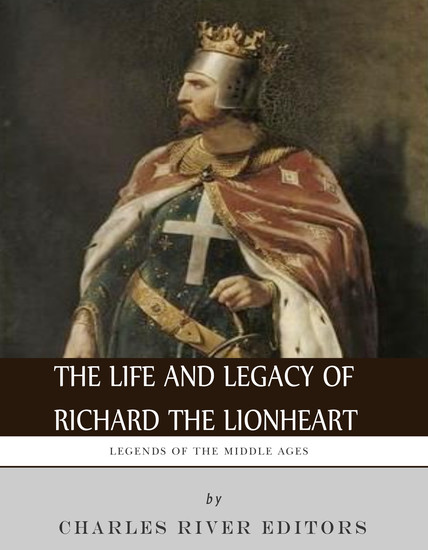
The Life and Legacy of Richard the Lionheart - cover

The Life and Legacy of Richard the Lionheart

Editors Charles River

Publisher: Charles River Editors

  • 0
  • 0
  • 0

Summary

“We, however, place the love of God and His honour above our own and above the acquisition of many regions.” – Richard the Lionheart
 
A lot of ink has been spilled covering the lives of history’s most influential figures, but how much of the forest is lost for the trees? In Charles River Editors’ Legends of the Middle Ages series, readers can get caught up to speed on the lives of important medieval men and women in the time it takes to finish a commute, while learning interesting facts long forgotten or never known.
 
The enduring figure of the Middle Ages is the chivalrous knight, who played the role of hero across much of Europe and was equal parts courage and valor. Nobody played a more defining role in casting the popular image of medieval knights than Richard the Lionheart, one of the most famous English kings and crusaders. In many respects, it was ironic that Richard became one of the central characters of the Middle Ages, and his very popular legacy today belies centuries of controversy.
 
 Richard I Plantagenet (1157-1199), nicknamed “Coeur de Lion” (Lionheart), eventually became King of England, Grand Duke of Aquitaine, Duke of Poitou, and Duke of Anjou, but as the third son in a large family, he did not expect to or even want to rule England. Nevertheless, it was he who eventually came to the throne upon his father's death. Richard lived in an age when knights were first asserting themselves as capable of being moral forces for good rather than only agents of chaos. This attitude resolved itself into the mystique of chivalry. As one of the strongest knights of his age, Richard was also considered a flower of chivalry and greatly admired as a model of what it meant to be a knight, both in his lifetime and afterward. But as the son of the most famous power couple of the age – Henry II of England (1133-89) and Eleanor of Aquitaine (1122/24-1204) – and an expansionist noble contesting over land with other expansionist nobles, he also had many enemies. These enemies portrayed Richard as evil incarnate, at the same time his admirers were portraying him an emblem of virtue. As with all such great and controversial figures, the real Richard lay somewhere in between.
 
 In many parts of the world today, Richard the Lionheart is remembered not for being a medieval king but for being perhaps the Crusades’ most famous European figher. In the Third Crusade, Richard was pitted against the best known Muslim leader in history, Saladin, who like Richard was considered a flower of chivalry by some, a tyrant by others, and even a herald of the Antichrist by Christians. Richard and Saladin's contest was cast by their contemporaries as a battle between Good and Evil (though who was Good and who was Evil depended greatly on the source), but eventually the legend and lore of mutual respect between the two and popular depictions of both leaders helped cement their legacies. Richard's eventual reputation was bound up as much in the crusading spirit of his age as in his reputation as a fearsome warrior or the history of his tumultuous family. If anything, stories like The Lion in Winter have oversimplified the complex Plantagenets who were Richard's closest kin.
 
Legends of the Middle Ages: The Life and Legacy of Richard the Lionheart chronicles the historic life and reign of the famous leader, and it analyzes his influential and enduring legacy. Along with pictures of important people, places, and events, you will learn about Richard like you never have before, in no time at all.
Available since: 06/29/2025.
Print length: 48 pages.

Other books that might interest you

  • Do You Mind? - cover

    Do You Mind?

    Habib Khan MD

    • 0
    • 0
    • 0
    Dr. Habib Khan is an award-winning neurologist and a sleep specialist at the Arizona Institute of Neurology & Polysomnography in Casa Grande, Arizona. He is a published poet and author. His latest book, An Ounce of Prevention, is a good example of his out-of-the-box thinking and creativity in patient care. Dr. Khan founded the DIL Foundation (www.dilfoudation.org), a 501(c)3, in 2012, established to support a vibrant community, raising the standard of living in Phoenix by providing low-cost healthcare, lifestyle counseling, and entrepreneurial education. 
    He has served on the Arizona Board of Behavioral Health examiners, appointed by the Governor of Arizona, between 2015 and 2017. In addition, Dr. Khan has proudly served as President of the Arizona chapter of APPNA(Association of Physicians of Pakistani Descent of North America), a nonprofit physician organization, between 2014 and 2016.
    Show book
  • John Lennon Nelson Mandela Charles Chaplin Mario Moreno "Cantinflas" Octavio Paz Franklin Chang - A Short Biography Of Great People In History Vol 6 (Unabridged) - cover

    John Lennon Nelson Mandela...

    Jorge Alfonso Sierra Quintero

    • 0
    • 0
    • 0
    Volume containing the biographies in English of the following characters: Francisco Morazán, Miguel Ángel Asturias, Gabriel García Márquez, Justo Arosemena, Simón Bolívar, Alberto Masferrer and Rubén Darío
    Show book
  • The Red Ripper - Inside the Mind of Russia's Most Brutal Serial Killer - cover

    The Red Ripper - Inside the Mind...

    Peter Conradi

    • 0
    • 0
    • 0
    By the time he was brought to trial in 1992, Soviet serial killer Andrei Chikatilo had killed more than fifty women and children, often sexually abusing them and leaving their bodies mutilated beyond recognition. Although he was initially arrested in 1984, the police lacked enough evidence to pin the unsolved murders on him and he was able to torture and kill dozens more before his eventual conviction. Compiling exclusive interviews and trial transcripts, journalist and editor at London's Sunday Times Peter Conradi reveals how the grandfather and former teacher carried out a horrific twelve-year killing spree. 


    Based on extensive research into Chikatilo's past and the elements of Soviet society that allowed his crimes to go unsolved for so long, Conradi delves into the life of one of history's most prolific and disturbing serial killers. Interviews with Moscow police detectives detail the fervent hunt for the man who preyed on young children, prostitutes, and runaways. 


    A chilling look into the deranged mind of a monster, The Red Ripper is a comprehensive and shocking true crime account of one of the twentieth century's deadliest killers. 


    Contains mature themes.
    Show book
  • Like Falling Through a Cloud - A Lyrical Memoir of Coping with Forgetfulness Confusion and a Dreaded Diagnosis - cover

    Like Falling Through a Cloud - A...

    Eugenia Zukerman

    • 0
    • 0
    • 0
    What if the dreaded world of Alzheimer's was also a world of emotional discovery? Eugenia Zukerman's poetry and simple prose, both heartbreaking and ultimately inspirational, ushers the reader into her world as she unflinchingly examines familial loyalties, moments from her past and present, and the need to face an uncertain future due to the diagnosis of a condition that she truly hopes "will remain unnamed." Flutist, writer, artistic director of major music series, television journalist, educator and internet entrepreneur, Zukerman addresses her "lapses and losses" as she confronts and deals with a future under the shadow of her Alzheimer's diagnosis. Touching, honest, and fearlessly heartfelt, Like Falling Through a Cloud recounts Zukerman's discovery, consultations, and diagnosis, all while navigating the death of her 103-year-old mother, a performance at the Kennedy Center, and the consolidation of her life via a full-time move to upstate New York. As she finds strength in family love, self-examination, and the enduring power of creating music, Zukerman teaches us the importance of living in the now, while accepting that what comes next may remain a mystery.
    Show book
  • A Year of Ebola - cover

    A Year of Ebola

    David Brett-Major

    • 0
    • 0
    • 0
    Who should read this book? Someone on their way out the door for their first or an early career health emergency and disaster risk management (HEDRM) experience, regardless of role, or someone who is trying to support one who is, or who does it all of the time and wants to know that they are not alone 
    What does this book tell the reader? It provides the shock of jumping into the cold water of health emergency and disaster risk management (HEDRM), without the risk of drowning; it focuses on practical aspects of the experience of doing the work that guidelines and playbooks (as important as they are) do not address 
    Who else might be interested in this book? People keen to understand how HEDRM happens in the context of highly communicable diseases, or about how global public health, emergencies, aid, and development mix, or medical history... the technical and contextual curious 
    Who should NOT read this book? Anyone who is looking for gory details 
    What is the main strength of this book? It is a raw view of the experience of conducting such responses at the clinical: public health interface, with some lessons durable across emergencies 
    What is the main weakness of this book? It carries all of the biases of such experiences. There is a lot not said; the book has snapshots and cannot relate the 10,000,000 events during the year not described 
    What is new in the 2024 edition? In print and e-book, overdue editing without loss of content, a forward that reflects on the COVID-19 pandemic in the context of themes in the book, and in the print edition available on www.amazon.com, a series of essays stepping back and exploring the ways in which people interact with the threat of infectious diseases that defines our willingness and readiness to meet them
    Show book
  • William Shakespeare - The True Story of Life & Time of the Great Author - cover

    William Shakespeare - The True...

    Liam Dale

    • 0
    • 0
    • 0
    Mentioning William Shakespeare to English students worldwide elicits a range of reactions, from indifference to dread. 
     
    When approaching the works of a literary giant like Shakespeare, three perspectives must be considered. First, there are the writer's literary creations, such as novels, plays, and poems, for readers to explore. 
     
    Secondly, it's essential to place the author's work within the context of the society in which they lived. This doesn't entail an exhaustive history lesson but rather a snapshot of the author's life and era, which this journal provides. 
     
    Explore: 
    - William Shakespeare's life, from birth to passing 
    - His family life and places of residence 
    - The significance of the Globe Theatre 
    - Analysis of characterizations in his plays 
    - Deconstructing his works 
    - A closer look at plays like Twelfth Night, Romeo & Juliet, and Macbeth 
    - Helpful tips for students studying his literature
    Show book