Join us on a literary world trip!
Add this book to bookshelf
Grey
Write a new comment Default profile 50px
Grey
Subscribe to read the full book or read the first pages for free!
All characters reduced
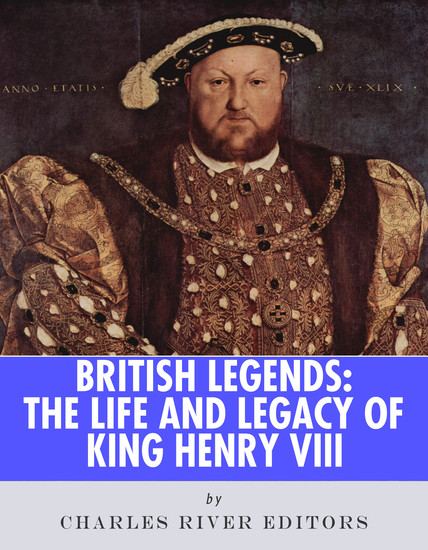
The Life and Legacy of of King Henry VIII - cover

The Life and Legacy of of King Henry VIII

Editors Charles River

Publisher: Charles River Editors

  • 0
  • 0
  • 0

Summary

"We are, by the sufferance of God, King of England; and the Kings of England in times past never had any superior but God." – King Henry VIII
 
In Charles River Editors’ History for Kids series, your children can learn about history’s most important people and events in an easy, entertaining, and educational way. Pictures help bring the story to life, and the concise but comprehensive book will keep your kid’s attention all the way to the end.
 
Over 450 years after his reign, Henry VIII is still the most famous and recognizable King of England, but it’s for all the wrong reasons. Though well regarded by contemporaries as a learned king and "one of the most charismatic rulers to sit on the English throne", he is best remembered today for his gluttony and multiple marriages, particularly the gruesome way in which he was widowed on more than one occasion. Naturally, that was the focus of the popular Show Time drama series centered around his life, The Tudors.
 
Henry VIII will probably continue to be best known for beheading some of his wives, most notably Anne Boleyn, so it is somewhat fitting that his most decisive act came as a result of a marital mishap. Sharply at odds with the Catholic Church over his attempt to dissolve his marriage with Catherine of Aragon, Henry VIII ultimately broke with the Church and established the Church of England, which forever both the religious history of England and the social hierarchy of the nation and its empire.  
 
 Though the popular perception of his reign has taken hold, King Henry VIII did not start life in any of those ways. In fact, he did not even start life as heir to the English throne. And when he did come to the throne at the age of 18, King Henry VIII’s earliest monarchical years showed his promise as a quintessential renaissance, polymath Prince. Even on the religious front, Henry VIII started out believing in the essential Catholic theology, even after the Pope and the Vatican excommunicated Henry from the Catholic Church (until then, the undisputed political as well as theological leader of Christendom, from which monarchs often needed various forms of legitimacy).
 
 For all these reasons, the manner in which his life and legacy diverge makes him an even more fascinating topic, one that clearly continues to captivate audiences around the world today. This book chronicles Henry VIII’s life and reign, but it also humanizes the man who fashioned himself both an athlete and scholar. Along with pictures of important people, places, and events in his life, your kids will learn about Henry VIII like never before.
Available since: 06/21/2025.
Print length: 30 pages.

Other books that might interest you

  • Psychology - Abuse Body Language Dark Psychology Hypnosis Intelligence Listening Skills and Memory Improvement (7 in 1) - cover

    Psychology - Abuse Body Language...

    Coral Nunez

    • 0
    • 0
    • 0
    This bundle consists of 7 titles, which are: 
    Abuse 
    Body Language 
    Dark Psychology 
    Hypnosis 
    Intelligence 
    Listening Skills 
    Memory Improvement 
    Get this special discount now! Enjoy the book bundle.
    Show book
  • No Room for Small Dreams - Courage Imagination and the Making of Modern Israel - cover

    No Room for Small Dreams -...

    Anonymous

    • 0
    • 0
    • 0
    In 1934, eleven-year-old Shimon Peres emigrated to the land of Israel from his native Poland, leaving behind an extended family who would later be murdered in the Holocaust. Few back then would have predicted that this young man would eventually become one of the towering figures of the twentieth century. Peres would indeed go on to serve the new nation as prime minister, president, foreign minister, and the head of several other ministries. He was central to the establishment of the Israeli Defense Forces and the defense industry that would provide the young nation with a robust deterrent power. He was crucial to launching Israel’s nuclear energy program and to the creation of its high-tech “Start Up Nation” revolution. His refusal to surrender to conventional wisdom and political conventions helped save the Israeli economy and prompted some of the most daring military operations in history, among them the legendary Operation Entebbe. And yet, as important as his role in creating and deploying Israel’s armed forces was, his stunning transition from hawk to dove–with its accompanying unwavering commitment to peace–made him one of the globe’s most recognized, honored, and admired statesmen.  
    In this, his final work, finished only weeks before his passing, Peres offers a long-awaited examination of the crucial turning points in Israeli history through the prism of having been a decision maker and eyewitness. Told with the frankness of someone aware this would likely be his final statement, No Room for Small Dreams spans decades and events, but as much as it is about what happened, it is about why it happened. Examining pivotal moments in Israel’s rise, Peres explores what makes for a great leader, how to make hard choices in a climate of uncertainty and distress, the challenges of balancing principles with policies, and the liberating nature of imagination and unpredicted innovation. In doing so, he not only charts a better path forward for his beloved country but provides deep and universal wisdom for younger generations who seek to lead–be it in politics, business, or the broader service of making our planet a safer, more peaceful, and just place.
    Show book
  • The Noble Eightfold Path - Way to the End of Suffering - cover

    The Noble Eightfold Path - Way...

    Bhikkhu Bodhi

    • 0
    • 0
    • 0
    The Buddha's teachings center around two basic principles. One is the Four Noble Truths, in which the Buddha diagnoses the problem of suffering and indicates the treatment necessary to remedy this problem. The other is the Noble Eightfold Path, the practical discipline he prescribes to uproot and eliminate the deep underlying causes of suffering.
     
    This book offers a concise and thorough explanation of the Eightfold Path. Bhikkhu Bodhi examines each factor of the path to determine what it implies in the way of practical training. In the concluding chapter, he shows how all factors of the path function in unison to bring about the realization of the goal of liberation.
     
    From the preface by the author:
     
    "The essence of the Buddha's teaching can be summed up in two principles: the Four Noble Truths and the Noble Eightfold Path. The first covers the side of doctrine, and the primary response its elicits is understanding; the second covers the side of discipline, in the broadest sense of that word, and the primary response it calls for is practice."
    Show book
  • Whiskey Lore: Volume One - The Real Stories Behind Bourbon Scotch Irish Whiskey's Biggest Myths and Legends - cover

    Whiskey Lore: Volume One - The...

    Drew Hannush

    • 0
    • 0
    • 0
    Prepare to unearth the hidden truths of whiskey history in Whiskey Lore: Volume One, a groundbreaking exploration of 24 popular whiskey myths that have shaped our understanding of the world’s great spirits. With meticulous research and a talent for captivating storytelling, Drew Hannush takes readers on a journey through the forgotten corners of whiskey’s past, shedding light on the stories that are too often oversimplified or misunderstood. 
    Many of these myths have been repeated so many times, they seem like truth. Drew goes beyond conventional wisdom to seek the truth, offering heavily footnoted insights that separate fact from fiction. By blending rich storytelling with historical rigor, this book provides readers with a deeper appreciation of whiskey’s evolution, while challenging long-held assumptions. 
    The questions to be challenged?Did Bourbon’s legend really begin with a Baptist minister?Did Irish distillers really change the spelling of whiskey to separate themselves from Scotch?Was Prohibition really the start of the speakeasy?Is Jack Daniel's Bourbon?What’s the real story behind the first female distillers in history?Do people go blind from moonshine made by inexperienced distillers?What is the oldest distillery in the world?Was Bourbon named after Bourbon Street in New Orleans?Is blended Scotch inferior to single malts, or is it simply misunderstood?Does whiskey age in a bottle?Why does Canadian whisky use flavoring, and does it make their spirits inferior? 
    Through vivid narratives and thorough investigation, Drew from the Whiskey Lore podcast provides an engaging and enlightening experience for whiskey enthusiasts and history buffs alike. 
    Contains a Bonus Chapter from Drew's epic "The Lost History of Tennessee Whiskey"
    Show book
  • Black Women Ivory Tower - Revealing the Lies of White Supremacy in American Education - cover

    Black Women Ivory Tower -...

    Jasmine L. Harris

    • 0
    • 0
    • 0
    Black women are heading to college in record numbers, and more and more Black women are teaching in higher education. But these statistics don’t guarantee our safety there.  
     
    Willpower and grit may improve achievement for Black people in school, but they don’t secure our belonging. In fact, the very structure of higher education ensures that we’re treated as guests, outsiders to the institutional family—outnumbered and unwelcome. 
     
    In this compelling exploration of what it means to be a Black woman pursuing higher education, Dr. Jasmine L. Harris moves beyond the “data points” to examine the day-to-day impacts of racism in education on Black women as individuals, the longer-term consequences to our personal and professional lives, and the generational costs to our entire families. 
     
    “I want to arm as many Black girls and women as I can with the knowledge about these spaces that I lacked,” says Dr. Harris. “By laying bare my own traumas, and those of Black women before me, I am providing them the tools to protect themselves, with an understanding of how deliberately many institutions will try to undercut them.” 
     
    Trial and error have been required of Black students to navigate systems of discrimination and disadvantage. But this book now offers useful support, illuminating the community of Black women dealing with similar issues. The author’s story is not unusual, nor are her interactions anomalies. Black Women, Ivory Tower explores why.
    Show book
  • Cornerstone at the Confluence - Navigating the Colorado River Compact's Next Century - cover

    Cornerstone at the Confluence -...

    Jason A. Robison

    • 0
    • 0
    • 0
    Signed on November 24, 1922, the Colorado River Compact is body of laws colloquially called the "Law of the River" that governs how human beings use water from the river system dubbed the "American Nile." No fewer than forty million people have come to rely on the Colorado River system in modern times—a system immersed in an unprecedented, unrelenting megadrought for more than two decades. Attempting to navigate this "new normal," policymakers are negotiating new management rules for the river system, a process coinciding with the compact's centennial that must be completed by 2026. 


    Animated by this remarkable confluence of events, Cornerstone at the Confluence leverages the centennial year to reflect on the compact and broader "Law of the River" to envision the future. It is a volume inviting dialogue about how the river system's flows should be apportioned given climate change, what should be done about environmental issues such as ecosystem restoration and biodiversity protection, and how long-standing issues of water justice facing Native American communities should be addressed. 


    These topics touch on the concept of "equity" embedded within the compact—a concept that tees up what is perhaps the foundational question confronted by Cornerstone at the Confluence: Who should have a seat at the table of Colorado River governance?
    Show book