Join us on a literary world trip!
Add this book to bookshelf
Grey
Write a new comment Default profile 50px
Grey
Subscribe to read the full book or read the first pages for free!
All characters reduced
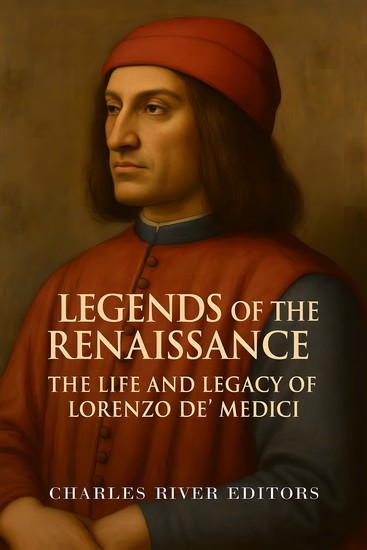
The Life and Legacy of Lorenzo de' Medici - cover

The Life and Legacy of Lorenzo de' Medici

Editors Charles River

Publisher: Charles River Editors

  • 0
  • 0
  • 0

Summary

"How beautiful is youth that is always slipping away.” – Lorenzo de' Medici
 
A lot of ink has been spilled covering the lives of history’s most influential figures, but how much of the forest is lost for the trees? When historians are asked to pick a point in history when Western civilization was transformed and guided down the path to modernity, most of them point to the Renaissance. Indeed, the Renaissance revolutionized art, philosophy, religion, sciences and math, with individuals like Galileo, Leonardo, Michelangelo, Raphael, Dante, and Petrarch bridging the past and modern society. In Charles River Editors’ Legends of the Renaissance, readers can get caught up to speed on the lives of the most important men and women of the Renaissance in the time it takes to finish a commute, while learning interesting facts long forgotten or never known.
 
Most historians credit the city-state of Florence as the place that started and developed the Italian Renaissance, a process carried out through the patronage and commission of artists during the late 12th century. If Florence is receiving its due credit, much of it belongs to the Medicis, the family dynasty of Florence that ruled at the height of the Renaissance. The dynasty held such influence that some of its family members even became Pope. 
 
Among all of the Medicis, its most famous member ruled during the Golden Age of Florence at the apex of the Renaissance’s artistic achievements. Lorenzo de Medici, commonly referred to as Lorenzo the Magnificent, was groomed both intellectually and politically to rule Venice, and he took the reins of power at just 20 years old.
 
Of all the fields that were advanced during the Renaissance, the period’s most famous works were art, with iconic paintings like Leonardo’s Mona Lisa and timeless sculptures like Michelangelo’s David. Thus it is fitting that both Leonardo and Michelangelo were at times members of Lorenzo’s court, and the Florentian ruler, who also considered himself an artist and poet, became known for securing commissions for the most famous artists of the age, including the aforementioned legends, Piero and Antonio del Pollaiuolo, Andrea del Verrocchio, Sandro Botticelli and Domenico Ghirlandaio. When Lorenzo died in April 1492, he was buried in a chapel designed by Michelangelo.
 
Legends of the Renaissance: The Life and Legacy of Lorenzo de' Medici chronicles the life and reign of Lorenzo the Magnificent, examines the relationships he had with other Renaissance legends, and analyzes his enduring legacy. Along with pictures of important people, places, and events in his life, you will learn about Lorenzo de’ Medici like you never have before, in no time at all.
Available since: 06/20/2025.
Print length: 37 pages.
Other books that might interest you

  • Stories on lord Shiva series - 21 - From various sources of Shiva Purana - cover

    Stories on lord Shiva series -...

    Anusha HS

    • 0
    • 0
    • 0
    Lord shiva is adi and he is only the anthya. He is the sole reason for the happenings in both the movable and immovable worlds. Therefore, it is said that not even a spring of grass will move without his permission. He is the one who has given life to all the creatures. He is also the one who takes away the lives of all the creatures. Sadhus sages and aghoraas practice severe penance without minding day and night on Lord Shiva.He blesses his devotees with boons. He is called Bole Shankar. All recite his five syllabled mantra or panchakshari mantra " om Namah Shivaya" which is the most popular one among all the other mantras. Lord Shiva who is also called Parameswara is the one who has got no birth and death. He is only the beginning and he is the end. Nandi which happens to be the vehicle of Lord Shiva is a bull. The abode of Lord Shiva is Mount Kailash. In Hindu religion Lord Shiva is called Devaadi Deva Mahadeva which means God for all the Gods. He is the supreme God. Lord Shiva has three eyes. The third eye is situated in between his brows. The third eye is used by him only whenever he wants to destroy the things. He is the one who dwells at cemetery.Once Lord Shiva had presented his dancing skills before the sage Bharata. He had one follower while dancing whose name was Tandava. That's how it became Shiva Tandava. During the time of Mahashivratri whosoever takes the darshan of Lord Shiva's twelve jyotirlingas they are believed to incur special blessings from Lord Shiva. In olden days where ever, Lord Shiva appeared on the planet Earth, in those places Shivalinga came out from the ground naturally such places became Jyotirlingas.
    Show book
  • A Stalker's Brain - The Disturbing Truth about Obsessive Minds - cover

    A Stalker's Brain - The...

    John Harpoon

    • 0
    • 0
    • 0
    Obsession is often mistaken for love. The idea of someone being unable to stop thinking about you, watching your every move, and doing whatever it takes to be close may sound romantic in books and movies, but in reality, it is anything but. Stalking is not about love—it is about control, possession, and a dangerous detachment from reality. This book delves deep into the psychology of obsession, the minds of stalkers, and the devastating impact they have on their victims.  
      
    Stalking is not a new phenomenon, nor is it limited to any specific demographic. From rejected lovers to strangers who become fixated on a public figure, stalking takes many forms. Some stalkers believe they are destined to be with their victims, while others seek revenge or dominance. Many operate under elaborate delusions, convinced that their actions are justified. Understanding these obsessive minds requires an exploration of psychology, trauma, and the social factors that contribute to such behavior.  
      
    With the rise of technology, stalking has evolved. The internet has made it easier than ever for stalkers to track, harass, and manipulate their victims from a distance. Social media provides a constant stream of personal information, and modern surveillance tools have turned everyday life into an open book for those determined enough to pry. What once required physical proximity can now be achieved with just a few clicks. Digital stalking is no less terrifying than its physical counterpart—it is often the gateway to something even more dangerous. 
    Show book
  • Dispersals - On Plants Borders and Belonging - cover

    Dispersals - On Plants Borders...

    Jessica J. Lee

    • 0
    • 0
    • 0
    A prize-winning memoirist and nature writer turns to the lives of plants entangled in our human world to explore belonging, displacement, identity, and the truths of our shared future 


    A seed slips beyond a garden wall. A tree is planted on a precarious border. A shrub is stolen from its culture and its land. What happens when these plants leave their original homes and put down roots elsewhere? 


    In fourteen essays, Dispersals explores the entanglements of the plant and human worlds: from species considered invasive, like giant hogweed; to those vilified but intimate, like soy; and those like kelp, on which our futures depend. Each of the plants considered in this collection are somehow perceived as being "out of place"—weeds, samples collected through imperial science, crops introduced and transformed by our hand. Combining memoir, history, and scientific research in poetic prose, Jessica J. Lee meditates on the question of how both plants and people come to belong, why both cross borders, and how our futures are more entwined than we might imagine.
    Show book
  • Destiny's Path: Immersive Journeys Through History - Embark on Destiny's Path! Discover captivating audio tales for unforgettable historical adventures - cover

    Destiny's Path: Immersive...

    Oliver Thorne

    • 0
    • 0
    • 0
    "Destiny's Path: Immersive Journeys Through History 
    ⭐⭐ Simplified Audio Guide ⭐⭐ 
    Are you eager to advance in your career and deepen your understanding by unlocking history's secrets and embarking on timeless journeys? 
    Looking for a comprehensive guide that encompasses all essential elements for exploring historic narratives? 
    Your search ends here! 
    This audiobook serves as your ultimate companion for broadening your knowledge, applying your skills, and engaging in enriching experiences. With this guide, you're set for success. 
    Updated for the latest trends and insights. 
    Key features of this enriched guide: 
    - Profound insights into unlocking history's secrets. 
    - Detailed explanations of timeless journeys. 
    - Effective strategies for exploration and engagement. 
    Our guide stands out with its comprehensive coverage, crucial for your journey's success. Topics aren't merely mentioned; they are explored with precision. 
    Please note that this guide is an independent resource designed solely for your benefit. 
    Formulated with a clear structure and easy-to-understand language, our guide ensures seamless transitions between topics. Say goodbye to complex jargon and welcome clear, precise, and insightful content. 
    So, why wait? Click the BUY NOW button, secure your guide, and begin your journey through history's timeless paths! 
    Begin your immersive journey and embrace the wisdom of the past today!
    Show book
  • Executive Functioning and Psychotherapy - The New Neuroscience of Adaptive Intelligence - cover

    Executive Functioning and...

    Louis Cozolino, Carly Trissler,...

    • 0
    • 0
    • 0
    A new model of executive functioning which illuminates the somatic, social, and emotional influences on how we make decisions. 
     
    Executive functioning (EF) can be defined as a person's ability to successfully navigate their physical, intellectual, and social worlds. Interest in EF is expanding within psychotherapy, but like many scientific concepts which are adapted to the consulting room, there is a great deal of confusion and misinformation surrounding EF within clinical and lay communities. 
     
    In this book, Louis Cozolino—a master of translating complex neuroscientific concepts into digestible, applicable literature for therapists and laypeople alike—is joined by experts Chloe Drulis and Carly Trissler to illuminate how our brains and minds successfully navigate the challenges of day—to—day life. The book offers a new, neurodynamic model of EF that explains the three main executive systems in the brain and the specific ways that they influence how we think, focus, and solve problems. This neurobiological framework highlights the interconnectedness of cognition, emotion, and relationships, providing readers with a deeper understanding of how humans function and strategies to improve outcomes in therapy, parenting, executive coaching, and personal development.
    Show book
  • Mixtec Empire - Skilled Artisans and the Masters of Codices in Mesoamerica - cover

    Mixtec Empire - Skilled Artisans...

    Rolf Hedger

    • 0
    • 0
    • 0
    The Mixtec civilization, known as the Ñuu Savi or "People of the Rain," emerged in the rugged mountains and fertile valleys of what is now Oaxaca, Mexico. Their origins date back to the Preclassic period, around 1500 BCE, when small agricultural communities began to flourish in the Mixteca Alta, Mixteca Baja, and Mixteca de la Costa regions. These early settlements were shaped by the challenging geography, with steep hills and limited arable land requiring innovative farming techniques. Over centuries, the Mixtec people developed sophisticated agricultural systems, including terracing and irrigation, which allowed them to sustain growing populations and establish permanent communities. 
    Mythology played a central role in Mixtec identity, reinforcing their connection to the land and legitimizing the rule of their elite class. The Mixtec creation story, recorded in their intricate codices, tells of divine ancestors emerging from a sacred place known as Apoala, a cave associated with the origins of humanity. These ancestors, believed to be both human and divine, established the first Mixtec lineages, which would later claim authority over the various city-states. This mythology was not just a story but a political tool that reinforced the power of Mixtec rulers, linking them directly to the gods and the forces of nature. 
    The early Mixtec communities were organized into small chiefdoms, each ruled by a hereditary elite. These leaders controlled land, resources, and religious ceremonies, ensuring stability and continuity within their societies. Over time, as populations expanded and rivalries grew, these chiefdoms evolved into larger political entities, forming the foundation for the powerful Mixtec city-states that would dominate the region in later centuries.
    Show book