Join us on a literary world trip!
Add this book to bookshelf
Grey
Write a new comment Default profile 50px
Grey
Subscribe to read the full book or read the first pages for free!
All characters reduced
The Life and Legacy of Hammurabi - cover

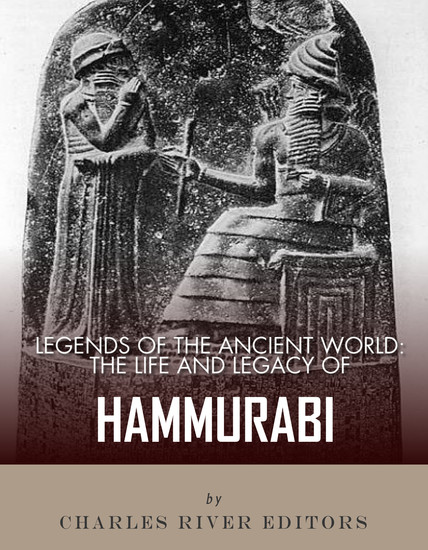
The Life and Legacy of Hammurabi

Editors Charles River

Publisher: Charles River Editors

  • 0
  • 0
  • 0

Summary

“If a man has accused another of laying a kišpu (spell) upon him, but has not proved it, the accused shall go to the sacred river, he shall plunge into the sacred river, and if the sacred river shall conquer him, he that accused him shall take possession of his house. If the sacred river shall show his innocence and he is saved, his accuser shall be put to death. He that plunged into the sacred river shall appropriate the house of him that accused him.” – The Code of Hammurabi
 
A lot of ink has been spilled covering the lives of history’s most influential figures, but how much of the forest is lost for the trees? In Charles River Editors’ Legends of the Ancient World series, readers can get caught up to speed on the lives of antiquity’s most important men and women in the time it takes to finish a commute, while learning interesting facts long forgotten or never known.
 
The Babylonians were one of the earliest of history’s great ancient civilizations, and the most famous Babylonian of them all was Hammurabi, who came to the throne as the first king of the Babylonian empire around the beginning of the 18th century B.C. Hammurabi had a long and fruitful reign that saw him consolidate most of Mesopotamia under his control, but he’s best known today for Hammurabi’s Code, one of the earliest known code of laws in human history. Inscribed on stone tablets, Hammurabi’s Code was found over 3,500 years later in the early 20th century, making him one of antiquity’s most famous men.
 
Babylonian culture, including art, architecture and literature, flourished during his reign, and Hammurabi (or the scribes in his employ) wrote enough public royal inscriptions and personal official letters to store in museums across the world. There are also many letters from other contemporary rulers that make reference to him or to significant events during his reign.  The large amount of documentation available, both from and about him, has allowed modern scholars to paint a colorful picture of the famous king and the various facets of his life.
 
Although there is no information on the age of Hammurabi when he took the throne, he ruled Babylon for 43 years from 1792-1750 B.C., when he became gravely ill and handed the throne to one of his sons, Samsu-iluna.  Hammurabi spent the first 28 years of his career strengthening the kingdom he inherited and managing construction projects ranging from temples to irrigation canals. He also focused himself on winning the hearts of his people by making a reliable, transparent judicial system.  He fought a few local skirmishes on the outskirts of his kingdom that seemed to involve securing his own borders from outside threats more than increasing the size of his own kingdom.  During most of that time he ruled in the shadow of his neighbor to the north, Šamši-Adad, the king of Ekallatum (and later Assyria).
 
The last decade or so of his reign was spent empire building.  Hammurabi established powerful alliances and conquered enemies on all sides expanding his kingdom to a monumental empire.  He stopped the Elamite incursion from the east, driving them from regions they had taken adjacent to Babylon, and he finally routed Rim-Sîn, his long-time enemy to the south in Larsa.  Hammurabi subsequently brought the kingdom of Assyria under his control, and after several years being allied with the powerful northwestern kingdom of Mari, he defeated their army as well and brought Mari under the ultimate control of Babylon.  When all was said and done, Hammurabi handed over to his son a vast empire eight times the size of the kingdom left to him by his own father. It is no wonder that later generations of Babylonians considered the reign of Hammurabi to be the golden age of Babylon, a sentiment shared by many today. 
 
 
Available since: 06/29/2025.
Print length: 30 pages.

Other books that might interest you

  • Roman Architecture - Building the Empire's Legacy - cover

    Roman Architecture - Building...

    Rogan Fish

    • 0
    • 0
    • 0
    Roman architecture emerged as a distinctive style that blended elements from earlier civilizations, primarily Greek and Etruscan influences. As Rome expanded from a small settlement into a powerful empire, its architectural identity evolved, incorporating new techniques and materials that allowed for grander and more functional structures. The early foundations of Roman architecture set the stage for innovations that would shape the empire’s urban landscape for centuries. 
    One of the most significant influences on Roman architecture came from the Etruscans, a civilization that dominated central Italy before Rome’s rise. The Etruscans were skilled builders who introduced techniques such as the use of the arch and vault, both of which would later become hallmarks of Roman engineering. Etruscan temples, with their high podiums and deep porches, also served as models for early Roman religious structures. Another major influence was Greek architecture, which Romans admired and adapted to suit their needs. The Greeks provided inspiration in the use of columns, decorative friezes, and symmetrical design, elements that were later integrated into Roman temples, public buildings, and monuments. 
    Roman architectural development was also shaped by advancements in building materials and construction techniques. The early Romans initially built using wood and mudbrick, but as they refined their skills, they transitioned to more durable materials like stone and concrete. The introduction of concrete was a groundbreaking innovation, allowing for stronger and more flexible structures. Unlike the Greeks, who relied heavily on marble, the Romans preferred concrete for its affordability and adaptability, enabling them to construct larger and more complex buildings, such as amphitheaters, aqueducts, and domes.
    Show book
  • Settling the Score -- Part 4: Coach's Boy (a jock's gay slave training) - cover

    Settling the Score -- Part 4:...

    Josh Hunter

    • 0
    • 16
    • 0
    Things are getting complicated for the golden boy jock. 
    Up until last week, everything in life had come easily for the high school quarterback-- football, girls, friends. So what if he was a little rough on Kevin, the gay guy in his class? Isn’t every jock supposed to pick on “queers”? 
    Now Wade is learning his lesson the hard way. Ever since Kevin got his hands on that video, Wade has been at Kevin’s mercy... and at his service. Wade has had to do things that he swore he never would. But the worst part is that he’s starting to like it. Wade’s gotten a taste for something that he can’t get from this cheerleader girlfriend. 
    But that may be the least of the straight stud’s problems. Because Kevin’s not the only one who’s found leverage on Wade. 
    And if Wade thought his coach was hard on him before, he has no idea what’s coming. 
    •First time gay BDSM high school jock slave training story•
    Show book
  • What Remains? - Life Death and the Human Art of Undertaking - cover

    What Remains? - Life Death and...

    Rupert Callender

    • 0
    • 0
    • 0
    When he became an undertaker, Rupert Callender undertook to deal with the dead for the sake of the living. This book is his brilliant, unforgettable story—the life and work of the world’s ?rst punk undertaker—but it's also about ordinary, everyday humanity and our capacity to face death with courage and compassion, to say goodbye to the people we love in our own way. In becoming the world’s first “punk undertaker” and establishing the Green Funeral Company in Devon, UK, Ru Callender and his partner Claire challenged the stilted, structured world of the funeral industry—fusing what he had learned from his own deeply personal experiences with death with the surprising and profound answers and raw emotion he discovered in rave culture and ritual magick. From his unresolved grief for his parents and his cultural ancestors to political and religious non-conformists, social outlaws, experimental pioneers, and acid-house culture, Ru Callender has taken to a “DIY” ethos to help people navigate grief. He has carried coffins across windswept beaches, sat in pubs with caskets on beer-stained tables, helped children fire flaming arrows into their father’s funeral pyre, turned occult rituals into performance art, and, with the band members of KLF, is building the People’s Pyramid of bony bricks in Liverpool. What Remains? is a profound, deeply moving, and politically charged book that will change the way listeners think about life, death, and the all-important end-of–life experience.
    Show book
  • Famine of Fear - The Holodomor and Soviet Suppression - cover

    Famine of Fear - The Holodomor...

    Sarah Willards

    • 0
    • 0
    • 0
    The Holodomor, one of the most devastating famines in modern history, cannot be understood without first examining the upheaval that gave rise to the Soviet Union. The collapse of the Russian Empire in 1917 marked the beginning of radical change across Eastern Europe, and Ukraine found itself at the center of a volatile political landscape. The chaos of World War I, followed by the Bolshevik Revolution, dismantled centuries-old institutions, replacing them with a new, ideologically driven regime determined to reshape society. 
    Ukraine’s struggle for autonomy intensified during this transitional period. After the fall of the Romanovs, various Ukrainian factions attempted to establish an independent nation, but their efforts were short-lived. The Bolsheviks, intent on consolidating power, saw Ukraine not as a sovereign entity but as a key agricultural region vital to the survival and success of the Soviet state. By the early 1920s, Ukraine was forcibly incorporated into the USSR, and its political identity was subordinated to Moscow's vision of a unified socialist republic. 
    The Bolsheviks, led initially by Vladimir Lenin, promised land to peasants and equality for all workers, which won them temporary support. However, these promises quickly dissolved into policies that centralized power and suppressed regional identities. The Soviet leadership viewed Ukrainian nationalism as a threat to their authority, prompting efforts to erase cultural distinctions and eliminate opposition. Lenin’s New Economic Policy offered some relief and flexibility to rural communities, but this period of relative leniency ended with his death and Joseph Stalin’s rise to power.
    Show book
  • Mastering Alchemy - The Key to Success and Spiritual Grow - cover

    Mastering Alchemy - The Key to...

    Dan Desmarques

    • 0
    • 0
    • 0
    Unlock the secrets to success and spiritual enlightenment with Mastering Alchemy, a groundbreaking guide that combines ancient alchemical wisdom with modern applications. Immerse yourself in the transformative power of alchemy as we explore its practical applications in business and personal development. Discover how the symbolism of the pentagram can lead you on a path to spiritual growth and enlightenment, while mastering the alchemical mindset for wealth, popularity, and happiness. 
    In this book, you will learn how to harness the power of alchemical principles to create success in all areas of your life. From improving business performance to thriving in personal relationships, the wisdom of alchemy offers a holistic approach to achieving prosperity and fulfillment. By aligning actions with intentions and embracing a mindset of abundance, you can pave the way for sustainable growth and prosperity in today's competitive world. 
    Join us on a journey of self-discovery, transformation, and realizing your full potential as we blend ancient wisdom with modern insights. Mastering Alchemy is your roadmap to personal and professional success, leading you to a life of purpose, abundance, and spiritual enrichment.
    Show book
  • Starved for Light - The Long Shadow of Rickets and Vitamin D Deficiency - cover

    Starved for Light - The Long...

    Christian Warren

    • 0
    • 0
    • 0
    A wide-ranging history of rickets tracks the disease’s emergence, evolution, and eventual treatment—and exposes the backstory behind contemporary worries about vitamin D deficiency. Rickets, a childhood disorder that causes soft and misshapen bones, transformed from an ancient but infrequent threat to a common scourge during the Industrial Revolution. Factories, mills, and urban growth transformed the landscape. Malnutrition and insufficient exposure to sunlight led to severe cases of rickets across Europe and the United States, affecting children in a variety of settings: dim British cities and American slave labor camps, moneyed households and impoverished ones. By the late 1800s, it was one of the most common pediatric diseases, seemingly an intractable consequence of modern life. Starved for Light offers the first comprehensive history of this disorder. Tracing the efforts to understand, prevent, and treat rickets—first with the traditional remedy of cod liver oil, then with the application of a breakthrough corrective, industrially produced vitamin D supplements—Christian Warren places the disease at the center of a riveting medical history, one alert to the ways society shapes our views on illness. 
     
    
    Sweeping and engaging, Starved for Light illuminates the social conditions underpinning our cures and our choices, helping us to see history’s echoes in contemporary prescriptions.
    Show book