Join us on a literary world trip!
Add this book to bookshelf
Grey
Write a new comment Default profile 50px
Grey
Subscribe to read the full book or read the first pages for free!
All characters reduced
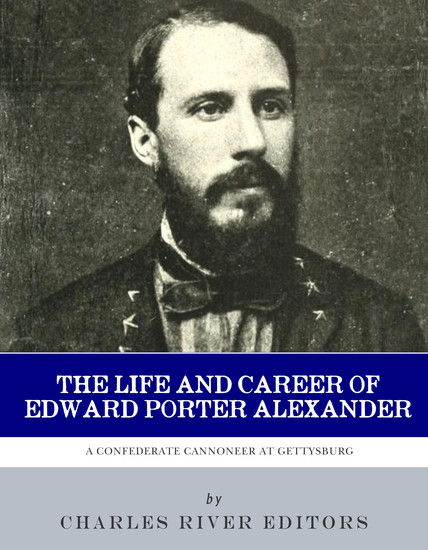
The Life and Career of Edward Porter Alexander - A Confederate Cannoneer at Gettysburg - cover

The Life and Career of Edward Porter Alexander - A Confederate Cannoneer at Gettysburg

Editors Charles River

Publisher: Charles River Editors

  • 0
  • 0
  • 0

Summary

In the narrative of the Civil War, Edward Porter Alexander has loomed larger in death than in life. Just 25 years old when the war broke out, Porter Alexander had already served as an engineer and officer in the U.S. Army, but the native Georgian resigned his commission in May 1861 and joined the Confederacy after his home state seceded.
 
Porter Alexander spent 1861 as an intelligence officer, and he served as part of a signal guard, but he soon became chief of ordnance for Joseph Johnston’s army near Richmond. Half a year later, Johnston would be injured during the Peninsula Campaign at the Battle of Seven Pines, after which he was replaced by Robert E. Lee. Over the course of 1862, Porter Alexander took on more roles in the Army of Northern Virginia’s artillery branch, particularly under James Longstreet’s 1st Corps.
 
Though he participated in several battles, he played his biggest role at the Battle of Gettysburg. On the third day, Lee decided to make a thrust at the center of the Union’s line with about 15,000 men spread out over three divisions. Though it is now known as Pickett’s Charge, named after division commander George Pickett, the assignment for the charge was given to Longstreet, whose 1st Corps included Pickett’s division. Lee’s decision necessitated a heavy artillery bombardment of the Union line in an attempt to knock out the Union’s own artillery before beginning the charge that would cover nearly a mile of open space from Seminary Ridge to the Union line on Cemetery Ridge. Lee tasked Porter Alexander, in charge of the 1st Corps’ guns, to conduct the artillery bombardment. What resulted was the largest sustained bombardment of the Civil War, with over 150 Confederate cannons across the line firing incessantly at the Union line for nearly 2 hours.
 
Unfortunately for Porter Alexander and the Confederates, the sheer number of cannons belched so much smoke that they had trouble gauging how effective the shells were. As it turned out, most of the artillery was overshooting the target, landing in the rear of the Union line. Reluctant to order the charge, Longstreet commanded Porter Alexander to order the timing for the charge. As Longstreet and Alexander anticipated, the charge was an utter disaster, incurring a nearly 50% casualty rate and failing to break the Union line.
 
Porter Alexander would continue to serve under Longstreet’s corps for most of the rest of the war, and he famously suggested to Lee at Appomattox that the Confederate army should disband and melt away instead of surrender. Porter Alexander would later regret the suggestion, and Lee scolded him for it anyway.
 
Though he had served with distinction during the Civil War, it was Porter Alexander’s memoirs that have kept his name alive today. While many prominent officers on both sides wrote memoirs, Porter Alexander’s were among the most insightful and often considered by historians as the most evenhanded. With a sense of humor and a good narrative, Porter Alexander skillfully narrated the war, his service, and what he considered the successes and faults of others, including Lee, when he thought they had made good decisions or mistakes. As a result, historians continue to rely heavily on his memoirs as a source for Civil War history.
Available since: 06/21/2025.
Print length: 89 pages.
Other books that might interest you

  • Sophocles - A Very Short Introduction - cover

    Sophocles - A Very Short...

    Edith Hall

    • 0
    • 0
    • 0
    This Very Short Introduction introduces the life, work, and influence of one of the greatest dramatists of all time, Sophocles the Athenian. 


    Placing his plays within their historical context, and explaining the conventions of ancient Greek tragic theatre, Edith Hall spotlights their distinctive features—tight plots, titanic personalities, lucid style, sympathetic women, exquisite poetry, and stagecraft. This analysis is followed by an account of how and why Sophoclean dramas have survived to be read and widely performed into the twenty-first century.
    Show book
  • Power & Pleasure - The Devonshire House Jubilee Ball 1897 - cover

    Power & Pleasure - The...

    Elisabeth Kehoe

    • 0
    • 0
    • 0
    At the zenith of its power, Britain, the 'Workshop of the World', dominated the globe with military might and commercial acuity. The celebration of Queen Victoria's sixty years on the throne was carefully positioned to highlight the country's strength, especially in the face of rising competition from other nations. The festivities brought together, in a show of force, the Queen's widely extended family, foreign dignitaries, diplomats, foreign royals and world leaders.
    Extraordinary pageantry, parades and royal receptions served to dramatise the unparalleled significance of the event. The most important occasion, however, was the Devonshire House Ball, given at huge expense by the Hanover-born German 'Double Duchess' of Devonshire. The Duchess – having married not one but two English Dukes – took to the task with alacrity, bringing together an extraordinary group of nobles, politicians, plutocrats, influential foreigners and bankers, hosting the most famous party of the century: a fancy-dress ball with a guest list of the 700 social, political, cultural and prominent 'celebrities' of the day.
    A specially commissioned tent – equipped with hand-painted backdrops, the most technically advanced cameras and lighting, along with realistic props – was set up in the magnificent gardens to capture the glamorous guests.
    Many of the exquisite costumes – all of pre-eighteenth-century characters – were preserved by photograph and are shown here, colourised for the first time, to give us a sense of the wondrous, glorious occasion of the Ball.
    Show book
  • Nehru - The Debates that Defined India - cover

    Nehru - The Debates that Defined...

    Anonymous

    • 0
    • 0
    • 0
    From being elected as Congress president in 1929 till his death in 1964, Jawaharlal Nehru remained a towering figure in Indian politics, a man who left an indelible stamp on the history of South Asia. As a leading light of the nationalist struggle and as India's first and longest-serving prime minister, his ideas shaped the political contours of the country and left an imprint so deep that his legacy continues to be debated furiously today. 
    In life, as in afterlife, Nehru was many things to many people. Going beyond the imposed labels of contemporary discourse, this book illuminates four encounters that Nehru had with contemporaries from across the political spectrum - Muhammad Iqbal, Muhammad Ali Jinnah, Sardar Patel and Syama Prasad Mookerjee - that are critical to understanding his ideas, and his long afterlife and impress on the present.  
    Nehru may no longer be alive to answer his critics today, but there was a time when he pitted himself vigorously against his opponents in the marketplace of ideas, debating the most profound questions in South Asian history and decisively influencing political events. It is this intellectually combative Nehru whom we meet in this book - voicing ideological disagreements, forging political alliances, moulding political opinion, offering visions of the future and staking out the political field - a key figure in the debates that defined India
    Show book
  • The 101 of Book Marketing - A Self-Published Author's Guide - cover

    The 101 of Book Marketing - A...

    Bo Bennett PhD

    • 0
    • 0
    • 0
    "Master Book Marketing for Self-Published Authors: A Comprehensive Guide" 
     
    Navigating self-publishing doesn't end with your book's release. Promoting it to the right audience is key. "The 101 of Book Marketing" is your comprehensive guide to this vital phase. 
     
    This book defines self-publishing and its challenges while emphasizing the importance of marketing. Develop and maintain your author brand, bolster your online presence, and leverage platforms like Facebook, Twitter, LinkedIn, and Instagram. 
     
    Offline marketing strategies are explored too, including book readings, networking events, and speaking engagements. Learn to gather book reviews and employ promotional techniques. Discover the world of book advertising, including paid and free options, AI's role, and Amazon's algorithm. 
     
    Measure your success, maintain marketing momentum, and find inspiration in successful self-published author case studies. The appendix offers valuable resources. Get your copy today and master the art of self-published book marketing!
    Show book
  • State of the Union 1987 - cover

    State of the Union 1987

    Ronald Reagan

    • 0
    • 0
    • 0
    The 1987 State of the Union Address delivered January 27, 1987, in the 200th anniversary year of the U.S. Constitution, notes dramatic improvements in the inflation rate, interest rates, housing starts, and the unemployment rate. Reagan regrets the Iran-Contra controversy and promises to get to the bottom of it and take whatever action is called for. 
    Though the Soviets transferred $75 billion in weapons to client-states like Syria, Vietnam, Cuba, Libya, Angola, Ethiopia, Afghanistan, and Nicaragua, the Congress cut administration requests for security assistance and defense. There “is no surer way to lose freedom than to lose our resolve.” As President Truman said: “International communism seeks to crush and undermine and destroy the independence of the Americas. We cannot let that happen here.” 
    Our Strategic Defense Initiative, SDI, “is the most positive and promising defense program we have undertaken. It's the path, for both sides, to a safer future -- a system that defends human life instead of threatening it.” 
    We support free trade and “expanding peaceful commerce across the world.” We remain opposed as ever to protectionism…” 
    The “federal deficit is outrageous.” We need “a constitutional amendment that mandates a balanced budget”. We need “a line-item veto so we can carve out the boondoggles and pork…” “We have deficits because big government spends too much.” 
    The U.S. Constitution “grew out of the most fundamental inspiration of our existence: that we are here to serve Him by living free -- that living free releases in us the noblest of impulses and the best of our abilities; that we would use these gifts for good and generous purposes and would secure them not just for ourselves and for our children but for all mankind.” 
    Audio recording courtesy of the Ronald Reagan Presidential Library. 
    AspenLeafMedia.com
    Show book
  • Oracle of Dodona The: The History of Ancient Greece’s Oldest Oracle - cover

    Oracle of Dodona The: The...

    Editors Charles River

    • 0
    • 0
    • 0
    In ancient Greece, “no other practice was so universal than the consultation of oracles.” These holy sites were found in 260 locations around the Greek-speaking world, and they were considered the “most satisfactory means of ascertaining the future.” These sanctuaries were “set apart from the profane, ordinary world” and were in the beginning restricted to natural locations where the divine was thought to be “especially present.” They were set aside for special spiritual functions, and a state of purity was generally required of its participants. A historical tendency toward providing haven for criminals was based on the fear of shedding blood in a holy place, and the “fear that the evil magic would emanate from his curse.” 
    	Despite the interest in Greek oracles, modern knowledge remains limited in certain respects, because cult history has become so intertwined with mythology that the lines separating one from another have been nearly lost. Modern scholars studying the oracles have tried to pull the shroud of mythology away from historical facts to illuminate the realities of the Greek cults, but the job has often proved trickier than imagined. If anything, the work of scholars has deepened the mysticism of the oracles rather than dispel it, in large measure due to documenting fascinating and mysterious stories about them. For example, much has been written about natural vapors and fumes that may have caused psychoactive effects in petitioners at oracles. Modern civilizations at times employ this argument to excuse the supposed ignorance of the ancient Greeks, and in some cases, such vapors have been identified and may indeed explain the activities at certain oracles. However, archaeologist Jelle de Boer, intimately associated with some of the most iconic Greek oracles, cautioned that “something can be extra-natural without being outright supernatural.”
    Show book