¡Acompáñanos a viajar por el mundo de los libros!
Añadir este libro a la estantería
Grey
Escribe un nuevo comentario Default profile 50px
Grey
Suscríbete para leer el libro completo o lee las primeras páginas gratis.
All characters reduced
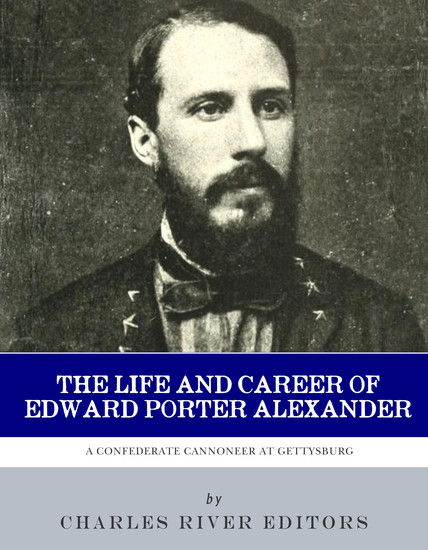
The Life and Career of Edward Porter Alexander - A Confederate Cannoneer at Gettysburg - cover

The Life and Career of Edward Porter Alexander - A Confederate Cannoneer at Gettysburg

Editors Charles River

Editorial: Charles River Editors

  • 0
  • 0
  • 0

Sinopsis

In the narrative of the Civil War, Edward Porter Alexander has loomed larger in death than in life. Just 25 years old when the war broke out, Porter Alexander had already served as an engineer and officer in the U.S. Army, but the native Georgian resigned his commission in May 1861 and joined the Confederacy after his home state seceded.
 
Porter Alexander spent 1861 as an intelligence officer, and he served as part of a signal guard, but he soon became chief of ordnance for Joseph Johnston’s army near Richmond. Half a year later, Johnston would be injured during the Peninsula Campaign at the Battle of Seven Pines, after which he was replaced by Robert E. Lee. Over the course of 1862, Porter Alexander took on more roles in the Army of Northern Virginia’s artillery branch, particularly under James Longstreet’s 1st Corps.
 
Though he participated in several battles, he played his biggest role at the Battle of Gettysburg. On the third day, Lee decided to make a thrust at the center of the Union’s line with about 15,000 men spread out over three divisions. Though it is now known as Pickett’s Charge, named after division commander George Pickett, the assignment for the charge was given to Longstreet, whose 1st Corps included Pickett’s division. Lee’s decision necessitated a heavy artillery bombardment of the Union line in an attempt to knock out the Union’s own artillery before beginning the charge that would cover nearly a mile of open space from Seminary Ridge to the Union line on Cemetery Ridge. Lee tasked Porter Alexander, in charge of the 1st Corps’ guns, to conduct the artillery bombardment. What resulted was the largest sustained bombardment of the Civil War, with over 150 Confederate cannons across the line firing incessantly at the Union line for nearly 2 hours.
 
Unfortunately for Porter Alexander and the Confederates, the sheer number of cannons belched so much smoke that they had trouble gauging how effective the shells were. As it turned out, most of the artillery was overshooting the target, landing in the rear of the Union line. Reluctant to order the charge, Longstreet commanded Porter Alexander to order the timing for the charge. As Longstreet and Alexander anticipated, the charge was an utter disaster, incurring a nearly 50% casualty rate and failing to break the Union line.
 
Porter Alexander would continue to serve under Longstreet’s corps for most of the rest of the war, and he famously suggested to Lee at Appomattox that the Confederate army should disband and melt away instead of surrender. Porter Alexander would later regret the suggestion, and Lee scolded him for it anyway.
 
Though he had served with distinction during the Civil War, it was Porter Alexander’s memoirs that have kept his name alive today. While many prominent officers on both sides wrote memoirs, Porter Alexander’s were among the most insightful and often considered by historians as the most evenhanded. With a sense of humor and a good narrative, Porter Alexander skillfully narrated the war, his service, and what he considered the successes and faults of others, including Lee, when he thought they had made good decisions or mistakes. As a result, historians continue to rely heavily on his memoirs as a source for Civil War history.
Disponible desde: 21/06/2025.
Longitud de impresión: 89 páginas.

Otros libros que te pueden interesar

  • Healing in Your Hands - Self-Havening Practices to Harness Neuroplasticity Heal Traumatic Stress and Build Resilience - cover

    Healing in Your Hands -...

    PhD Kate Truitt, Steven J. Ruden

    • 0
    • 0
    • 0
    Written by Dr. Kate Truitt, a psychologist, neuroscientist, and trauma expert, Healing in Your Hands is the first book of its kind to integrate the neuroscience of trauma with cutting-edge research on self-havening—a groundbreaking technique that draws on the power of mindful touch to heal even the most profound traumatic stress. It weaves together powerful client stories, insights from the field of neuroscience, and personalized havening practices to create a complete self-healing program that anyone can use. 


    With the simple and effective tools in this book, you will learn how to: 


    ● Draw upon your brain's amazing ability to heal itself 


    ● Build a trusting relationship with your mind and body 


    ● Soothe your nervous system in moments of reactivity 


    ● Create feelings of safety, agency, and personal empowerment 


     . . . all with the palms of your own hands.
    Ver libro
  • Mystical and Magical Societies and Practitioners - cover

    Mystical and Magical Societies...

    Martin K. Ettington

    • 0
    • 0
    • 0
    This book a reference guide to mystical and magical orders around the world. Major religions are not the focus although I do in include some mystical organizations within some religions. These organizations include Jewish Kabbalah in Judaism, and the Sufis in Islam.There are many societies around the world which don’t fall into the standard religious categories. Some are spiritual in nature, and the ones listed here are those which follow some types of mystical and/or spiritual practices or beliefs.Many of these organizations subscribe to the beliefs that through our own efforts we can develop our spiritual abilities which can do amazing things.The groups listed are also current and have active members in our world. I’ve also included some metaphysical organizations which also have spiritual goals but may also include a focus on the mystical.There is also some history of the usage of psychedelic plants for spiritual and paranormal experiences. (Disclaimer: these can be very dangerous and should only be done with experienced practitioners.)Not included are organizations who worship or follow Satan or the Devil.
    Ver libro
  • Mansa Musa and The Empire of Mali - A True Story of Gold and Greatness from Africa - cover

    Mansa Musa and The Empire of...

    P. James Oliver

    • 0
    • 0
    • 0
    Oliver's well-researched biography of Mansa Musa echoes the style of an exotic tale of gold, glory, and adventure. During his long reign as Mali's emperor, Mansa Musa led his empire into its Golden Age; presided over a spectacular, 60,000 person, 9,000 mile pilgrimage; founded a university in Timbuktu; and helped revolutionize architecture across the Sudan.Many of the African ancestors of today's African-Americans came from West Africa. From 700 -- 1600 A. D., one after the other, three great, black, commercial empires dominated West Africa. They were powerful, prosperous, complex, stable -- and large. At its height, the Empire of Mali was the size of all of Western Europe.Well-crafted and fast paced, Oliver's book did not only clearly portray Mansa Musa's triumphs and dilemmas, but also the lives of the people of medieval Mali.
    Ver libro
  • Emile Volume 2 - cover

    Emile Volume 2

    Jean-Jacques Rousseau

    • 0
    • 0
    • 0
    In this influential work, Rousseau outlines his educational philosophy, emphasizing the importance of natural development and the role of the teacher in guiding a child's education. The text is structured as a fictional dialogue between a tutor and his pupil, Emile, and explores themes such as the importance of play, physical exercise, and moral education. Rousseau argues that education should be tailored to the individual needs and abilities of each child, and that the ultimate goal of education is to help the child develop into a virtuous and independent adult. The work has had a significant impact on the development of modern education systems and continues to influence educational theory and practice.
    Ver libro
  • Thoughts for the Times of War and Death - cover

    Thoughts for the Times of War...

    Sigmund Freud

    • 0
    • 0
    • 0
    In this insightful essay Sigmund Freud delves into the psychological roots of war, the nature of human aggression, and the profound impact of death on society.
    
    Written during the tumultuous years of World War I, Freud explores how conflict shapes the psyche and why humanity is drawn to violence despite the consequences.
    Ver libro
  • Aftershock - How Past Events Shake Up Your Life Today - cover

    Aftershock - How Past Events...

    Geri-Lynn Utter

    • 0
    • 0
    • 0
    You may be at a point in your life where you realize that you have been edgy, a bit depressed, feeling unsettled. Yet everything in your life seems to be okay. You look for a cause, but you just can't put your finger on it. Perhaps you should examine your recent past—six months ago, a year ago—and ask yourself, "What did I go through that was stressful at the time, yet I was able to deal with by suppressing my stress until that situation was over?" 


    "Aftershock" is a term coined by clinical psychologist Dr. Geri-Lynn Utter, who came to recognize this largely ignored scenario in many of her patients. As a subclinical level of the more familiar post-traumatic stress disorder, "aftershock" may underlie your present emotional stress, a delayed emotional response that affects many of us after common, yet big deal, life events such as miscarriage, moving to a new city, divorce, or, for some people, the Covid-19 pandemic that has rocked much of the world. 


    The most urgent raison d'etre of Aftershock is to enlighten listeners to the very presence of this psychological trauma—what it is and what causes it, how to recognize the symptoms, and how to heal when life's stressors keep you in the center of the aftershock of a storm.
    Ver libro