Join us on a literary world trip!
Add this book to bookshelf
Grey
Write a new comment Default profile 50px
Grey
Subscribe to read the full book or read the first pages for free!
All characters reduced
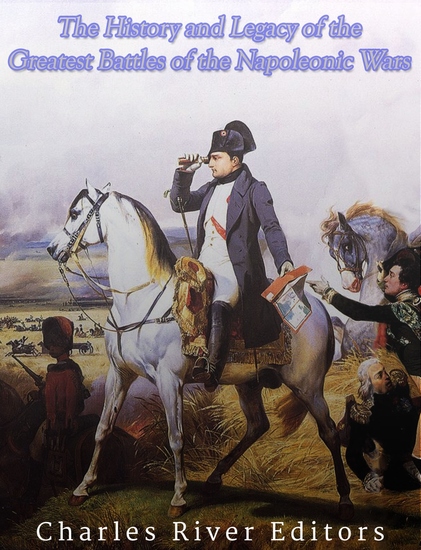
The History and Legacy of the Greatest Battles of the Napoleonic Wars - cover

The History and Legacy of the Greatest Battles of the Napoleonic Wars

Editors Charles River

Publisher: Charles River Editors

  • 0
  • 0
  • 0

Summary

Nearly 50 years after Napoleon met his Waterloo, generals across the West continued to study his tactics and engage their armies the same way armies fought during the Napoleonic Era. Despite advances in military technology and the advent of railroads for transportation, all of which made defensive warfare more effective, acclaimed military geniuses like Robert E. Lee used flank attacks and infantry charges against superior numbers in an effort to win decisive victories, and it would not be until World War I that concepts of modern warfare made the Napoleonic Era of the early 19th century outdated.
 
For those questioning why generals continued using tactics from the Napoleonic Era even as technology changed the battlefield, the Battle of Austerlitz may provide the best answer. Napoleon is regarded as one of history’s greatest generals, and Austerlitz was his greatest victory. In 1805, Britain, Austria, and Russia allied together to form the Third Coalition against the French, and the Third Coalition’s forces consisted of armies from Austria and Russia, with Britain providing naval support as well as its financial powers. Napoleon had already defeated and mostly destroyed an Austrian army in October at Ulm before it could link up with the Russians, setting the stage for the Battle of Austerlitz to be the culmination of the war against the Third Coalition as a whole in early December. Despite the smashing victory at Ulm, Napoleon’s French army would still be well outnumbered at Austerlitz by a joint Russo-Austrian army in a battle that would also come to be known as the Battle of Three Emperors.
 
The Battle of Austerlitz was a tactical masterpiece that saw Napoleon actually invite an attack on his army by the bigger Coalition army, and over the course of about 9 hours, the French successfully defended their right flank while counterattacking in the center and splitting the Russo-Austrian army in two, allowing the French to hit the flank of the advancing left wing of the enemy. The result was a decisive victory that virtually annihilated the Third Coalition’s army and made Napoleon the master of the European continent.
 
Over the course of its history, England has engaged in an uncountable number of battles, but a select few have been celebrated like the Battle of Trafalgar, one of the most important naval battles in history. Before the battle, Napoleon still harbored dreams of sailing an invasion force across the English Channel and subduing England, but that would be dashed on October 21, 1805 by a British fleet that was outnumbered and outgunned.
 
That morning, Admiral Horatio Nelson’s fleet, 27 strong, bore down on the Franco-Spanish fleet, approaching at right angles in two columns. French Admiral Pierre-Charles Villeneuve’s disposition was conventional - a single line of battle, ill formed due to the very light winds and the poor seamanship of many of the crews. Traditional naval warfare strategies called for approaching an enemy fleet in one line and then creating a parallel line that allowed as many guns as possible to fire. At the same time, that kind of line of battle allowed for admirals to signal during battle, and it made retreating in an orderly fashion easier. After all, if an enemy’s ships pursued during a retreat, they would break their own line. The problem with that strategy as Nelson saw it is that the ability to retreat meant fighting a decisive naval battle would be made much more difficult. Thus, at Trafalgar he employed a completely innovative strategy. The British plan was to punch straight through the enemy line with two approaching columns of ships, which would cut the Franco-Spanish fleet’s line in three, prompting the melee that they knew would capitalize on their tactical superiority.
Available since: 05/01/2025.
Print length: 188 pages.

Other books that might interest you

  • Bound for Canaan - The Underground Railroad and the War for the Soul of America - cover

    Bound for Canaan - The...

    Anonymous

    • 0
    • 0
    • 0
    An important book of epic scope on America's first racially integrated, religiously inspired movement for change. 
    The true story of the Underground Railroad is much more morally complex and politically divisive than even the myths suggest. Against a backdrop of the country's westward expansion arose a clash of values that evolved into a fierce fight for nothing less than the country's soul. Beginning six decades before the Civil War, freedom-seeking blacks and courageous whites worked together to save tens of thousands of lives, often at the risk of great physical danger to themselves. Not since the American Revolution had the country engaged in an act of such vast and profound civil disobedience that not only challenged prevailing mores but also subverted federal law. 
    Meticulously researched and uncommonly engaging, Bound for Canaan shows why it was the Underground Railroad and not the civil rights movement that gave birth to this country's first racially integrated, religiously inspired movement for social change. 
    Written and read by Fergus M. Bordewic
    Show book
  • British Empire The: An Enthralling Guide to the Rise and Fall of the World’s Largest Superpower in History - cover

    British Empire The: An...

    Billy Wellman

    • 0
    • 0
    • 0
    Dive into the epic saga of global dominance in The British Empire.  
    In this riveting journey, you’ll explore how a tiny island nation ascended to rule nearly a quarter of the globe. From the Age of Discovery to the poignant end of Queen Elizabeth II’s reign, this audiobook is a masterful tapestry of history, power, and ambition. 
    Discover Its Origins 
    Unearth the roots of the British Empire. How did a small island transform into a colossal titan of power and influence? 
    From Conquest to Collapse 
    Witness the breathtaking expanse of an empire on which the sun never set. Learn about the pivotal moments, the grand victories, and the stark realities of colonization and trade that sculpted the world. 
    Power and Downfall 
    Delve into the dual narratives of triumph and tragedy. Understand the complex interplay of historical events and internal dynamics that led to the zenith of British power and its inevitable decline. 
    A Story of Ambition 
    Grasp the consequences of imperial dreams. What did it mean for the world, and what were the lasting impacts of this colossal empire? 
    A Compact Chronicle 
    Designed as a quick yet comprehensive read, this audiobook is perfect for those seeking to grasp the essence of Britain’s imperial history without being overwhelmed. 
    Essential Learning 
    Whether you’re a history buff, a student, or simply curious, this guide offers a balanced, engaging perspective on one of history’s most influential empires. 
    Don’t miss the chance to unravel the story of one of the world’s greatest empires. Click the “add to cart” button to embark on a historical journey today!
    Show book
  • Cat Tales - A History - cover

    Cat Tales - A History

    Jerry D. Moore

    • 0
    • 0
    • 0
    Feared, revered, respected, and beloved, cats have left an indelible paw print on the histories and civilizations of humankind. Over the last two million years, cats and people have interacted in diverse and unexpected ways, but the predecessors of today's furry friends were predators, not pets. 
     
    Leading anthropologist Jerry Moore charts the cat's path from deadly enemy to improbable roommate. Moore journeys through our complicated history with these charismatic creatures. He travels along the Nile and across the Mediterranean, sailing on to South America, exploring pet cemeteries, cat mummies, and exquisite statuary across continents and centuries. 
     
    This book surveys our relationships with cats from the Paleolithic period to the present day, unlocking the mysteries of these remarkable creatures. While cats are now beloved members of families around the world, our attempts to bring cats in from the cold have not always had happy endings, as Moore explores through such famous feline fanciers as Joe Exotic, Siegfried Fischbacher, and Roy Horn. From incredible archaeological finds to cave paintings, and from classical statues to contemporary social media, Cat Tales surveys ancient and modern interactions between humans and cats, wild and domestic, to ask a simple question: who domesticated who?
    Show book
  • Ten Myths About Israel - cover

    Ten Myths About Israel

    Ilan Pappe

    • 0
    • 0
    • 0
    The myths and reality behind the state of Israel and the Israeli-Palestinian conflict—from "the most eloquent writer on Palestinian history" (New Statesman) 


    The outspoken and radical Israeli historian Ilan Pappe examines the most contested ideas concerning the origins and identity of the contemporary state of Israel. 


    The "ten myths"—repeated endlessly in the media, enforced by the military, and accepted without question by the world's governments—reinforce the regional status quo and include: Palestine was an empty land at the time of the Balfour Declaration; the Jews were a people without a land; there is no difference between Zionism and Judaism; Zionism is not a colonial project of occupation; the Palestinians left their Homeland voluntarily in 1948; the June 1967 War was a war of 'No Choice'; Israel is the only Democracy in the Middle East; the Oslo Mythologies; the Gaza Mythologies; and the Two-State Solution. 


    For students, activists, and anyone interested in better understanding the news, Ten Myths About Israel is another groundbreaking study of the Israel-Palestine conflict from the author of The Ethnic Cleansing of Palestine.
    Show book
  • The Shortest History of Music - From Bone Flutes to Synthesizers Hildegard of Bingen to Beyoncé―5000 Years of Instrument and Song - cover

    The Shortest History of Music -...

    Andrew Ford

    • 0
    • 0
    • 0
    No art form is as widely discussed—or as readily available—as music. With the click of just a few buttons, modern humans can decide what they think of the brand-new Beyoncé just as quickly as they can form opinions on Brahms or the Beatles or Bob Dylan. But things weren't always this way. In this brisk, breakneck history, award-winning musician and broadcaster Andrew Ford dives into the constant evolutions and reinventions that have led to the popularity and accessibility of modern music. Ford explores: 


    ● Why playing history's earliest example of notated music—clay tablets from 1400 BCE Syria—doesn't produce a consistent sound 


    ● How colonization and the slave trade led to one region in West Africa having an unparalleled influence on world music 


    ● How clerical and royal support allowed early composers to invent the symphony 


    ● What leads humans to make music in the first place—and why music plays such a massive role in our culture. 


    The Shortest History of Music takes us on a lively tour through several thousands of years of music history, tracing our relationship with this essential art and allowing us to freshly appreciate and understand music today.
    Show book
  • Vaccines and Bayonets - Fighting Smallpox in Africa amid Tribalism Terror and the Cold War - cover

    Vaccines and Bayonets - Fighting...

    Bee Bloeser

    • 0
    • 0
    • 0
    Step into the heart of a turbulent era with a gripping historical memoir that chronicles one woman’s extraordinary journey in Africa. In this vivid recounting—which one Pulitzer nominee says, “reads like a political thriller, women’s history, and African adventure rolled into one,”—Bee Bloeser unveils the raw reality of her family’s part in the mission to eradicate smallpox, revealing triumphs and trials faced along the way. 
    As a young wife with two young children, Bloeser follows her husband, Carl, to Africa, driven by ideals and a sense of duty. In Nigeria she witnesses the roots and ravages of civil war and the horrors of smallpox and leprosy, yet finds beauty in the vibrant local culture. 
    In Equatorial Guinea, a nation newly independent but plagued by the terror of a brutal dictatorship, secrecy shrouds the people, and Bloeser confronts a world far removed from her idealistic expectations. Forbidden from interacting with locals and surrounded by oppression and suspicion, she documents her experiences in hidden notes, capturing the essence of a desperate struggle. 
    Through her eyes, readers experience the intense battle against a relentless virus and against tyranny. This Amazon #1 Bestselling memoir is a story of medical triumph but also a poignant reflection on humanity’s capacity for courage—the indomitable spirit of those who risk everything for a better future.
    Show book