Join us on a literary world trip!
Add this book to bookshelf
Grey
Write a new comment Default profile 50px
Grey
Subscribe to read the full book or read the first pages for free!
All characters reduced
The History and Culture of Ancient Athens - cover

The History and Culture of Ancient Athens

Editors Charles River

Publisher: Charles River Editors

  • 0
  • 0
  • 0

Summary

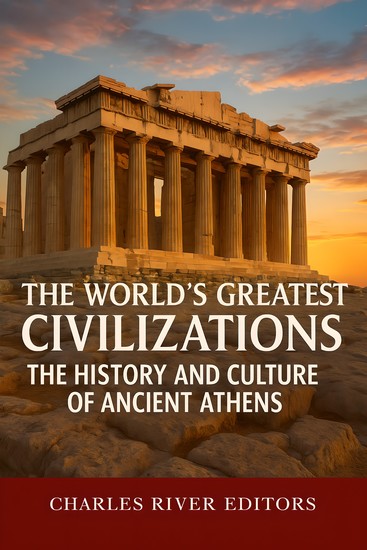
“What I would prefer is that you should fix your eyes every day on the greatness of Athens as she really is, and should fall in love with her. When you realize her greatness, then reflect that what made her great was men with a spirit of adventure, men who knew their duty, men who were ashamed to fall below a certain standard. If they ever failed in an enterprise, they made up their minds that at any rate the city should not find their courage lacking to her, and they gave to her the best contribution that they could.” – The Funeral Oration of Pericles, quoted by Thucydides
 
Dominated to this day by the sprawling white marble complex of the Acropolis, Athens is a city which is immensely and rightly proud of its past. For a period of roughly three centuries, the polis of Athens stood, if not in a position of unchallenged supremacy among the cities of Hellas, then at the very least among its three most important polities. Its fledgling Empire, though small by the standards later set by Alexander or the Romans, or even by those of its ancient enemy Persia, nonetheless encompassed cities as far afield as Asia Minor and Southern Italy, a remarkable fact considering such expansion was achieved by the inhabitants of a single city and its immediate surroundings, rather than by an entire nation.
 
For much of its history, the Athenian navy was the single mightiest force in the Mediterranean, having defeated the overwhelming might of Persia in pitched battle upon the open sea numerous times. The Athenian army itself, though subordinate to its naval power – a sop to the fact that it was trade and empire-building that had made Athens rich – was nothing to be sneered at, as it succeeded in meting out a humiliating defeat to Darius’s Persians at Marathon.
 
Yet despite a martial tradition that, if taken as a whole, was second to none save the Spartans, Athens is chiefly remembered for two reasons: its political system, which would in time form the nucleus of all Western democratic systems of government, and the remarkable number of outstanding individuals which, during the Golden Age of Athens, lived and flourished in the enlightened city-state. The Ancient Athenians formed the backbone of the West’s entire culture, from the arts to philosophy and everything inbetween.
 
In virtually all fields of human endeavor Athens was so much at the forefront of dynamism and innovation that the products of its most brilliant minds remain not only influential but entirely relevant to this day. In the field of medicine, the great physician Hippocrates not only advanced the practical knowledge of human anatomy and care-giving but changed the entire face of the medical profession. The great philosophers of Athens, men like Aristotle, Socrates, and Plato, interrogated themselves with startling complexity about the nature of good and evil, questioned the existence of divinity, advocated intelligent design, and went so far as to argue that all life was composed of infinitesimal particles. Great architects and sculptors such as Phidias produced works of art of such breathtaking realism and startling dynamism that they later formed the driving force behind the resurgence of sculpture during the Renaissance and served as masters to artists such as Michelangelo, Bernini, and Donatello. The plays of dramatists such as Aristophanes not only displayed an acerbic wit and a genius for political satire so pronounced that their works continue to be performed – and topical – to this day, but served as the inspiration for virtually all playwrights from Shakespeare to the present day. And this does not take into account the host of equally brilliant mathematicians, natural philosophers, historians, astronomers and politicians that the city’s great schools nurtured and produced.
Available since: 06/23/2025.
Print length: 42 pages.

Other books that might interest you

  • Prophesy Deliverance! - An Afro-american Revolutionary Christianity: 40th Anniversary Expanded Edition - cover

    Prophesy Deliverance! - An...

    Cornel West, Johnathan Lee Walton

    • 0
    • 0
    • 0
    In this, his premiere work, Cornel West challenges African Americans to consider the incorporation of Marxism into their theological perspectives, thereby adopting the mindset that it is class more so than race that renders one powerless in America. His work reflects political and cultural perspectives borne out of his own formative life experiences. Decades later, his arguments continue to capture the theological imagination of many and influence the critical engagement of generations of scholars. 


    In this fortieth anniversary edition, West invites six prominent scholars—whose respective work are grounded in various aspects of black political, cultural, and theological thought—into dialogue with this work, each writing one chapter plus a foreword by Jonathan Lee Walton. Continuing and expanding on the revolutionary discourses that West introduced in the first published work, each new essay provides nuanced lens for thinking about movements of liberation in today's African American communities.
    Show book
  • Black Slaves Indian Masters - Slavery Emancipation and Citizenship in the Native American South - cover

    Black Slaves Indian Masters -...

    Barbara Krauthamer

    • 0
    • 0
    • 0
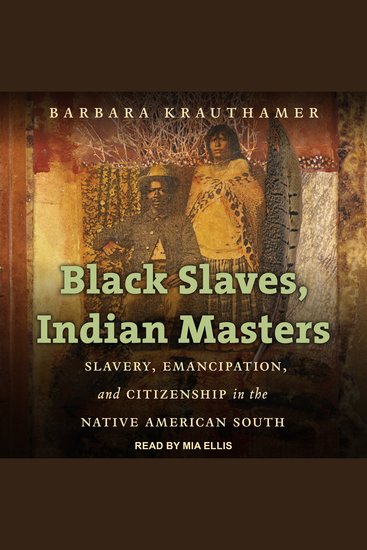
    From the late eighteenth century through the end of the Civil War, Choctaw and Chickasaw Indians bought, sold, and owned Africans and African Americans as slaves, a fact that persisted after the tribes' removal from the Deep South to Indian Territory. The tribes formulated racial and gender ideologies that justified this practice and marginalized free black people in the Indian nations well after the Civil War and slavery had ended. Through the end of the nineteenth century, ongoing conflicts among Choctaw, Chickasaw, and U.S. lawmakers left untold numbers of former slaves and their descendants in the two Indian nations without citizenship in either the Indian nations or the United States. In this groundbreaking study, Barbara Krauthamer rewrites the history of southern slavery, emancipation, race, and citizenship to reveal the centrality of Native American slaveholders and the black people they enslaved. 


    Krauthamer's examination of slavery and emancipation highlights the ways Indian women's gender roles changed with the arrival of slavery and changed again after emancipation and reveals complex dynamics of race that shaped the lives of black people and Indians both before and after removal.
    Show book
  • Calm Your Mind: Embrace Serenity in a Crazy World - "Unlock Peace: Embrace Our Audio Lessons for Ultimate Serenity in a Chaotic World!" - cover

    Calm Your Mind: Embrace Serenity...

    Silas Thornfield

    • 0
    • 0
    • 0
    Calm Your Mind: Embrace Serenity in a Crazy World 
    ⭐⭐ Simplified Audio Guide ⭐⭐ 
    Are you looking to transform stress into serenity with practical mindfulness techniques? 
    Seeking a comprehensive guide that provides all necessary elements to help you find peace in a chaotic world? 
    Your search ends here! 
    This guide serves as your definitive companion for deepening your understanding, applying mindfulness skills, and engaging in hands-on exercises. With this, you're geared for success in finding inner calm. 
    Updated for the latest mindfulness practices and techniques. 
    Key features of this enriched guide: 
    - Profound insights into transforming stress into serenity with practical mindfulness 
    - Detailed explanations of mindfulness concepts  
    - Fruitful strategies for incorporating mindfulness into daily life 
    Our guide distinguishes itself through comprehensive coverage, which is essential for your journey to inner peace. Concepts aren't merely skimmed; they are delved into with precision. 
    Please note that this guide is not affiliated with any official mindfulness organization and is purely an independent resource for your benefit. 
    Designed with a clear structure and easy-to-understand language, our Mindfulness Guide ensures smooth transitions between topics. Say goodbye to dense jargon and welcome clear, precise, and technically accurate content. 
    So, why wait? Click the BUY NOW button, secure your guide, and begin your journey to serenity and peace!
    Show book
  • A Pirate's Life For Me - A History of the Golden Age of Piracy - cover

    A Pirate's Life For Me - A...

    noah pollack

    • 0
    • 0
    • 0
    Have you ever wondered what life was like on a pirate ship? What were the everyday lives of pirates like, and what led them to such a perilous and difficult existence? "A Pirates Life For Me" gives a detailed and engaging look at all things pirates in the days of roaring cannons, deadly scurvy, raging storms at sea and unbridled passion!
    Show book
  • The Epic Saga Of Scotland - From Ancient Clans To Modern Nation - cover

    The Epic Saga Of Scotland - From...

    Catherine Million Day

    • 0
    • 0
    • 0
    Breathtaking “The Epic Saga of Scotland: From Ancient Clans to Modern Nation” beckons you on a journey across centuries of strife, resilience, and cultural brilliance. 
    Explore ancient Highland Clans forging their communities amid dramatic landscapes, relive pivotal battles like Bannockburn and Culloden, and witness how these defining conflicts shaped Scotland. Hear the stirring tale of Robert the Bruce, rise alongside the Jacobites beneath Bonnie Prince Charlie, and stand in the shadows of Scotland’s iconic Edinburgh Castle, where centuries of royalty and rebellion converge. In this enthralling tapestry, discover Mary, Queen of Scots, marked by intrigue and tragedy, unravel ambitions behind the Declaration of Arbroath, and uncover the significance of the Stone of Destiny—an ancient symbol of Scottish monarchy. 
    Delve into the darker side of history with the Highland Clearances, glimpse the intellectual brilliance of the Scottish Enlightenment, and observe the nation’s evolution through the Industrial Revolution and the Act of Union 1707, forging an age of transformation. Venture into mystical realms as Scottish folklore, the elusive Loch Ness Monster come alive, then travel to the sprawling Hebrides, soaking in the raw beauty that inspired poetry & song. 
    Marvel at the modern spirit of the Edinburgh Festival. Celebrate the worldwide footprint of the Scottish Diaspora, meet the Kelpies—towering sculptures that honor the nation’s heritage - and indulge in the essence of Scotland's soul through its whisky, its golf traditions, and the rousing anthem “Flower of Scotland.” From the birth of golf to the rise of modern political identity, this masterful narration reveals all. 
    Each chapter breathes life into towering monuments, vibrant festivals, and unwavering fight for autonomy. Embark on this audio voyage, and let the spirit of Scotland captivate you - secure your copy now!
    Show book
  • Jewish Language and Literature - The Impact of Yiddish Hebrew and Other Languages - cover

    Jewish Language and Literature -...

    Joseph Arston

    • 0
    • 0
    • 0
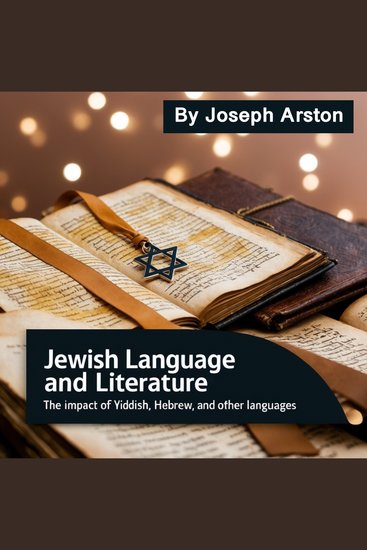
    The origins of Jewish language and literature are deeply intertwined with the history of the Jewish people, shaped by centuries of cultural exchange, migration, and adaptation. At the heart of Jewish literary tradition lies the Hebrew language, whose roots stretch back to the ancient world. Hebrew, as the language of the Bible, forms the foundation of Jewish thought, identity, and religious practice. The earliest examples of Hebrew literature can be found in the sacred texts of the Torah, where the stories, laws, and teachings of the Jewish people are recorded. These texts, passed down through generations, have remained central to Jewish life and continue to be a source of literary and theological inspiration. 
    In addition to Hebrew, other languages played an important role in the development of Jewish language and literature. Aramaic, a Semitic language closely related to Hebrew, became widespread during the Babylonian exile and remained influential for centuries. Aramaic is the language of significant portions of the Talmud and other rabbinic writings, shaping Jewish legal and philosophical thought. Over time, Jewish communities across the globe adopted the languages of the regions they inhabited, which further contributed to the diversity of Jewish literary expression. 
    The emergence of Yiddish, a language born in the Jewish communities of Eastern Europe, marked a significant shift in Jewish linguistic and literary culture. Yiddish, a Germanic language enriched with Hebrew, Aramaic, and Slavic elements, became the vernacular of millions of Ashkenazi Jews. It allowed for the creation of a vibrant body of literature, including plays, novels, and poetry, that expressed the daily lives, struggles, and aspirations of Jewish communities. Yiddish literature flourished in the 19th and early 20th centuries, with writers such as Sholem Aleichem, Isaac Bashevis Singer, and I.L. Peretz capturing the complexities of Jewish life through their works.
    Show book