Begleiten Sie uns auf eine literarische Weltreise!
Buch zum Bücherregal hinzufügen
Grey
Einen neuen Kommentar schreiben Default profile 50px
Grey
Jetzt das ganze Buch im Abo oder die ersten Seiten gratis lesen!
All characters reduced
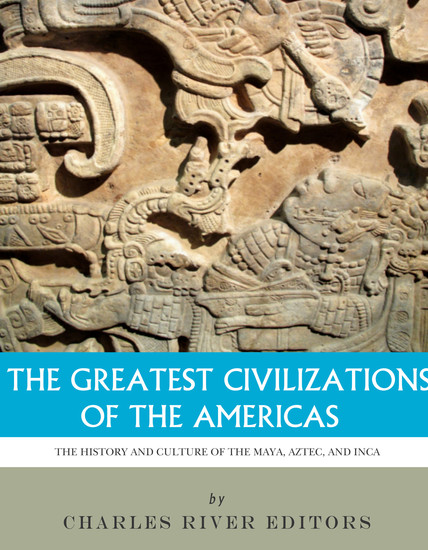
The Greatest Civilizations of the Americas - The History and Culture of the Maya Aztec and Inca - cover

The Greatest Civilizations of the Americas - The History and Culture of the Maya Aztec and Inca

Editors Charles River

Verlag: Charles River Editors

  • 0
  • 0
  • 0

Beschreibung

Many ancient civilizations have influenced and inspired people in the 21st century. The Greeks and Romans continue to fascinate the West today. But of all the world’s civilizations, none have intrigued people more than the Mayans, whose culture, astronomy, language, and mysterious disappearance all continue to captivate people.
 
In 2012 especially, there has been a renewed focus on the Mayans, whose advanced calendar has led many to speculate the world will end on the same date the Mayan calendar ends. The focus on the “doomsday” scenario, however, has overshadowed the Mayans’ true contribution to astronomy, language, sports, and art.
 
From the moment Spanish conquistador Hernan Cortes first found and confronted them, the Aztecs have fascinated the world, and they continue to hold a unique place both culturally and in pop culture. Nearly 500 years after the Spanish conquered their mighty empire, the Aztecs are often remembered today for their major capital, Tenochtitlan, as well as being fierce conquerors of the Valley of Mexico who often engaged in human sacrifice rituals.
 
Ironically, and unlike the Mayans, the Aztecs are not widely viewed or remembered with nuance, in part because their own leader burned extant Aztec writings and rewrote a mythologized history explaining his empire’s dominance less than a century before the Spanish arrived. Naturally, Cortes and other Spaniards depicted the Aztecs as savages greatly in need of conversion to Catholicism. While the Mayans are remembered for their astronomy, numeral system, and calendar, the Aztecs have primarily been remembered in a far narrower way, despite continuing to be a source of pride to Mexicans through the centuries.
 
As a result, even though the Aztecs continue to interest people across the world centuries after their demise, it has fallen on archaeologists and historians to try to determine the actual history, culture, and lives of the Aztecs from the beginning to the end, relying on excavations, primary accounts, and more.
 
During the Age of Exploration, Native American tribes fell victim to European conquerors seeking legendary cities made of gold and other riches, attempts that were often being made in vain. And yet, of all the empires that were conquered across the continent, the one that continues to be most intimately associated with legends of gold and hidden riches is the Inca Empire. The Inca Empire, which flourished in modern day Peru and along the west coast of South America, was the largest Native American empire in pre-Columbian America until Pizarro and the Spanish conquistadors conquered them in the 16th century. What ultimately sealed their doom was the rumor that huge amounts of gold were available in regions south of the Andes Mountains.
 
Though the Spanish physically conquered them in quick fashion, the culture and legacy of the Inca Empire has continued to endure throughout the centuries in both Europe and South America, due in no small part to the fact they were one of the most advanced and sophisticated cultures on the continent. Like the Aztecs, the Spanish burned much of the Inca’s extant writings, but it is estimated that as many as 35 million once fell under their banner, and the empire’s administrative skills were so sharp that they kept accurate census records. Their religion, organization, and laws were also effectively centralized and tied to the rulers of the empire, and their military mobilization would have made the ancient Spartans proud. After the Spanish conquest, several rebellions in the area attempted to reestablish the proud Inca Empire over the next two centuries, all while famous Europeans like Voltaire glorified the Inca Empire in optimistic artistic portrayals.
 
The mystique and aura of the Inca continue to fascinate the world today, and nowhere is this more prominent than at Macchu Picchu.
Verfügbar seit: 05.05.2025.
Drucklänge: 90 Seiten.

Weitere Bücher, die Sie mögen werden

  • Servitude: Part VII - Submit (Yaoi BDSM Erotica) - cover

    Servitude: Part VII - Submit...

    Kai Aubrey

    • 0
    • 0
    • 0
    A red sky hangs high above, a dim purple sun casting an eerie light on the landscape below. The land is a barren tundra, but it is bustling with life. 
    This is the realm of the incubi. This has been their prison for millennia. 
    As Alric travels with Heath and Caio through this land of sexual depravity, his anxiety only grows. 
    Why has Soren brought them here? What dark, perverse surprises is he hiding? 
    --- 
    CONTAINS EXPLICIT GAY SEXUAL CONTENT. 
    For more stories, visit www.KaiAubrey.com.
    Zum Buch
  • The American Operations in WW2: Ardennes-Alsace - 16 December 1944–25 January 1945 - cover

    The American Operations in WW2:...

    U.S. Army Center of Military...

    • 0
    • 0
    • 0
    World War II was the largest and most violent armed conflict in the history of mankind. Highly relevant today, World War II has much to teach us, not only about the profession of arms, but also about military preparedness, global strategy, and combined operations in the coalition war against fascism. This book follows military operations of the US Army in France from 16 December 1944 to 25 January 1945. 
    In his political testament Mein Kampf ("My Struggle") Adolf Hitler wrote, "Strength lies not in defense but in attack." Throughout World War II, attempts to gain or regain the initiative had characterized Hitler's influence on military operations. Thus, when the military situation in late 1944 looked darkest on the Western Front, an enemy offensive to redress the balance on the battlefield—and thereby cripple or delay the Allied advance—should have come as no surprise.
    Hitler's great gamble began during the nights of 13, 14, and 15 December, when the initial assault force of German armor, artillery, and infantry gradually staged forward to attack positions along the Belgian-German-Luxembourg border. This mustered force, with more than 200,000 men in thirteen infantry and seven panzer divisions and with nearly 1,000 tanks and almost 2,000 guns, deployed along a front of 60 miles—its operational armor holdings equaling that on the entire Eastern Front. Five more divisions moved forward in a second wave, while still others, equipped with at least 450 more tanks, followed in reserve.
    On the Allied side the threatened American sector appeared quiet. The 15 December daily situation report for the VIII Corps, which lay in the path of two of Hitler's armies, noted: "There is nothing to report." This illusion would soon be shattered.
    Zum Buch
  • Knights Templars at the priory of Sion - cover

    Knights Templars at the priory...

    Jean-Patrick Pourtal

    • 0
    • 0
    • 0
    The dissolution of the Order of the Temple and the persecution of the Knights Templar are still fresh in people's minds. Why did King Philip the Fair and Pope Clement V set out to destroy them? What secrets did the Knights Templar hold? Just as the Da Vinci Code revealed the existence of the Order of the Priory of Sion and left its mark on the world, Jean-Patrick Pourtal takes you on an investigative journey from the 14th century to the present day. The author develops his hypotheses on the historical implications of the Knights Templar, mixing royal dynasty and hidden messages. He returns to mythical sites such as Arginy, Gisors and Rennes-Le-Château, and meets the characters who were instrumental in bringing about the so-called Templar resurgence.
    Zum Buch
  • The Art of War - cover

    The Art of War

    Sun Tzu

    • 0
    • 0
    • 0
    The Art of War is an ancient Chinese military treatise dating from the Late Spring and Autumn Period. The work, which is attributed to the ancient Chinese military strategist Sun Tzu ("Master Sun"), is composed of 13 chapters. Each one is devoted to a different set of skills (or "art") related to warfare and how it applies to military strategy and tactics.
    Zum Buch
  • John Stuart Mill - A Very Short Introduction - cover

    John Stuart Mill - A Very Short...

    Gregory Claeys

    • 0
    • 0
    • 0
    John Stuart Mill (1806-73) is widely regarded as the leading liberal philosopher, economist, and political theorist of nineteenth century Britain. In his lifetime he was best known for his System of Logic (1843) and the Principles of Political Economy (1848). Today Mill is chiefly identified with On Liberty (1859), perhaps the definitive text of modern liberal statement of its subject, and probably the single most important work of modern political thought. Mill was also the first major male feminist thinker of the period (author of The Subjection of Women, 1869), and the first, as an MP, to introduce a bill for female enfranchisement before Parliament. 


    This Very Short Introduction offers a brief survey of the life and key ideas of this most influential Victorian British writer. Moving chronologically, Gregory Claeys outlines the philosophical background out of which Mill developed, chiefly through the ideas of Jeremy Bentham and James Mill. He demonstrates how Mill's personal life, especially his 'mental crisis' of 1827, and his relationship with Harriet Taylor, were integral to his intellectual development. Throughout Claeys considers Mill's key works set within the context of his lesser writings and correspondence, and discusses the more controversial aspects of his thought concerning religion, secularism, and birth control.
    Zum Buch
  • Sex Beyond "Yes" - Pleasure and Agency for Everyone - cover

    Sex Beyond "Yes" - Pleasure and...

    Quill R. Kukla

    • 0
    • 0
    • 0
    Every discussion of sexual ethics revolves around consent, but is this notion enough to help us understand good sex? How does the dominance of consent help or prevent us from negotiating the complexities of intimacy and pleasure? 


    Georgetown professor Quill R Kukla argues that the idea that consent is the gatekeeper between the realms of good and bad sex does not give us the tools we need to navigate pleasure and intimacy. They claim that traditional discussions of consent make no room for the reality that we can have good sex even though we may get drunk or high, or become forgetful with age, or be limited by social pressures and power relationships. 


    Kukla explores the ambiguous realms in which sexual agency requires much more than the ability to just say "yes" or "no" to sex. They confront moments of discomfort: How does consent work for people with dementia? Or in sex work, where sexual contracts challenge our traditional conceptions of ethical sex? How can we express our agency when exploring new kinks, where our hesitations and ambivalence are part of the thrill? Challenging listeners to think beyond reductive concepts of consent, gender, and freedom, Sex Beyond "Yes" reframes the communication and social support we need to establish sexual relationships founded on genuine respect, open discourse, and unhindered joy.
    Zum Buch