Join us on a literary world trip!
Add this book to bookshelf
Grey
Write a new comment Default profile 50px
Grey
Subscribe to read the full book or read the first pages for free!
All characters reduced
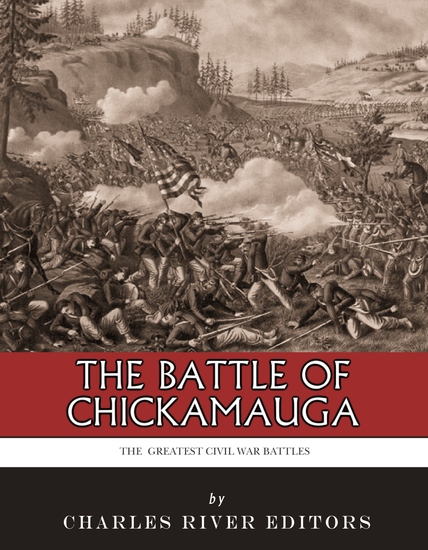
The Greatest Civil War Battles - The Battle of Chickamauga - cover

The Greatest Civil War Battles - The Battle of Chickamauga

Editors Charles River

Publisher: Charles River Editors

  • 0
  • 0
  • 0

Summary

“I know Mr. Davis thinks he can do a great many things other men would hesitate to attempt. For instance, he tried to do what God failed to do. He tried to make a soldier of Braxton Bragg.” – General Joseph E. Johnston
 
Americans have long been fascinated by the Civil War and its biggest battles, particularly Gettysburg, Antietam, and Shiloh, all of which involved Robert E. Lee or Ulysses S. Grant. But the second biggest battle of the entire war mostly gets overlooked among casual readers, despite the fact it represented the last great chance for the Confederates to salvage the Western theater.
 
In mid-September, the Union Army of the Cumberland under General William Rosecrans had taken Chattanooga, but rather than be pushed out of the action, Army of Tennessee commander Braxton Bragg decided to stop with his 60,000 men and prepare a counterattack south of Chattanooga at a creek named Chickamauga.  To bolster his fire-power, Confederate President Jefferson Davis sent 12,000 additional troops under the command of Lieutenant General James Longstreet, whose corps had just recently fought at Gettysburg in July.   
 
On the morning of September 19, 1863, Bragg's men assaulted the Union line, which was established in a wooded area thick with underbrush along the river.  That day and the morning of the next, Bragg continue to pummel Union forces, with the battle devolving from an organized succession of coordinated assaults into what one Union soldier described as “a mad, irregular battle, very much resembling guerrilla warfare on a vast scale in which one army was bushwhacking the other, and wherein all the science and the art of war went for nothing.”
 
Late that second morning, Rosecrans was misinformed that a gap was forming in his front line, so he responded by moving several units forward to shore it up.  What Rosecrans didn’t realize, however, was that in doing so he accidentally created a quarter-mile gap in the Union center, directly in the path of Longstreet’s men.  Described by one of Rosecrans’ own men as “an angry flood,” Longstreet's attack was successful in driving one-third of the Union Army off the field, with Rosecrans himself running all the way to Chattanooga, where he was later found weeping and seeking solace from a staff priest. 
 
As the Confederate assault continued, George H. Thomas led the Union left wing against heavy Confederate attack even after nearly half of the Union army abandoned their defenses and retreated from the battlefield, racing toward Chattanooga.  Thomas rallied the remaining parts of the army and formed a defensive stand on Horseshoe Ridge, with more units spontaneously rallying to the new defensive line. Thomas and his men managed to hold until nightfall, when they made an orderly retreat to Chattanooga while the Confederates occupied the surrounding heights, ultimately besieging the city. Dubbed “The Rock of Chickamauga”, Thomas’s heroics ensured that Rosecrans’ army was able to successfully retreat back to Chattanooga.
 
In the aftermath of the Battle of Chickamauga, several Confederate generals blamed the number of men lost during what would be the bloodiest battle of the Western Theater on Bragg’s incompetence, also criticizing him for refusing to pursue the escaping Union army. General Longstreet later stated to Jefferson Davis, “Nothing but the hand of God can help as long as we have our present commander.”   
 
The Greatest Civil War Battles: The Battle of Chickamauga comprehensively covers the campaign and the events that led up to the battle, the fighting itself, and the aftermath of the battle. Accounts of the battle by important participants are also included, along with maps of the battle and pictures of important people, places, and events. You will learn about the Battle of Chickamauga like you never have before, in no time at all.
Available since: 05/02/2025.
Print length: 51 pages.

Other books that might interest you

  • The Communication Guru 3-in-1 Collection - Supercharge Your Communication Skills for Personal and Professional Success - cover

    The Communication Guru 3-in-1...

    William Howard

    • 0
    • 0
    • 0
    Struggling to communicate effectively? Do you feel misunderstood or ignored when you speak? Ready to transform your communication skills for personal and professional success? The Communication Guru Collection is here to help. 
    This collection of three must-read books guides you through mastering effective communication, small talk, and empathic listening. Each book offers practical techniques that you can immediately apply to everyday conversations, leading to more meaningful connections, effective conflict resolution, and greater influence. 
    In How to Talk Effectively (Book 1), you'll learn:How to stop interrupting othersFiltering your thoughts before speakingThe difference between debate, dialogue, discourse, and diatribeTraits of a confident communicatorOvercoming speech obstacles and fearsRecovering conversations that have gone downhill 
    In How to Master Small Talk (Book 2), you'll discover:Ways to introduce yourself without awkwardnessEasy methods for starting conversationsReliable ice-breakers for networking and personal chatsKeeping conversations alive effortlesslyWays to captivate listenersThe proper role of emotion in personal connections 
    In The Empathic Listener (Book 3), you'll explore:The difference between active and passive listeningTuning into nonverbal cuesOvercoming barriers to active listeningCultivating a "listening mindset"Recognizing and thwarting biases and assumptionsTechniques for navigating difficult conversations
    Show book
  • The Classical Wisdom Collection - History’s Greatest Works on Philosophy Ethics and Political Thought - cover

    The Classical Wisdom Collection...

    Marcus Aurelius, Sun Tzu,...

    • 0
    • 0
    • 0
    What if you could access the very core of moral, philosophical, and political thought—spanning centuries and cultures—all in one place? 
    This expansive collection gathers monumental texts that have shaped global civilization. From the Stoic reflections of Marcus Aurelius to Aristotle’s ethical frameworks, from Nietzsche’s radical provocations to Kierkegaard’s existential depth, each volume has been adapted for modern readers, offering timeless wisdom for navigating life’s complexities. 
    What You’ll Discover in This Essential Anthology: 
    - Meditations – Marcus Aurelius – A Stoic guide to self-discipline and resilience. 
    - The Art of War – Sun Tzu – Strategic wisdom on leadership and success. 
    - The Book of Five Rings – Miyamoto Musashi – Samurai philosophy on discipline and mastery. 
    - Letters from a Stoic – Seneca – Profound insights on ethics and personal strength. 
    - Discourses & Enchiridion – Epictetus – Practical Stoic wisdom for everyday life. 
    - Tao Te Ching – Laozi – A guide to balance and harmonious living. 
    - Nicomachean Ethics – Aristotle – Foundational teachings on virtue and happiness. 
    - Politics – Aristotle – A blueprint for governance and justice. 
    - Poetics – Aristotle – An analysis of storytelling and artistic expression. 
    - Beyond Good and Evil – Friedrich Nietzsche – A bold challenge to conventional morality. 
    - Thus Spoke Zarathustra – Friedrich Nietzsche – A poetic exploration of human potential. 
    - Fear and Trembling – Søren Kierkegaard – A deep examination of faith and existential angst. 
    Imagine possessing a library of wisdom that sharpens your intellect and expands your worldview. The Classical Wisdom Collection is a guide for self-improvement and cultural understanding. 
    Open the door to humanity’s greatest ideas. Get your copy now and immerse yourself in a legacy of unmatched intellectual heritage.
    Show book
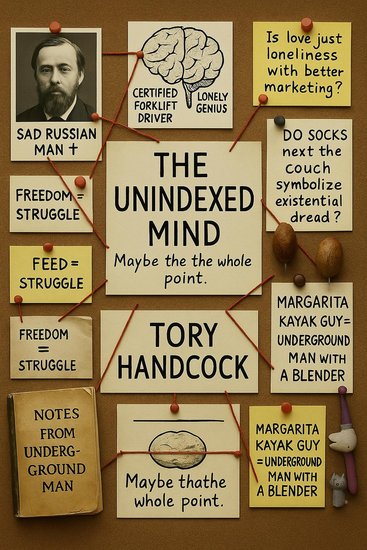
  • The Unindexed Mind - cover

    The Unindexed Mind

    Tory Handcock

    • 0
    • 0
    • 0
    This isn't a self-help book. It's a mental junk drawer — full of quotes, chaos, forklift wisdom, and a guy just trying to make sense of the noise. 
    No chapters. No index. No roadmap. You'll find meaning, then lose it again. And maybe that's the point. 
    It's part philosophy, part humor, part existential napkin scribble. 
    If you've ever argued with God in a break room or felt like socks next to the couch might symbolize existential dread... you're in the right place.
    Show book
  • Dark Psychology Mastery Vol 2 - (2 Books in 1) Unveiling the Secrets of Dark NLP & Covert Cognitive Behavioral Therapy (CBT) - cover

    Dark Psychology Mastery Vol 2 -...

    Michael Pace

    • 0
    • 0
    • 0
    "Dark Psychology Mastery Vol is a masterful combination of two profound books by Michael Pace, a trailblazer who introduced the world to "Dark Psychology" in 2014. This volume, bringing together two distinct yet complementary areas of psychological manipulation and influence, offers an in-depth exploration of the darker aspects of human interaction and mind control. 
    Michael Pace, following his seminal work "Dark Psychology 101" that sent shockwaves in 2015, continues to unravel the complex layers of the human psyche in this compelling compilation. The first part of the volume, "Dark NLP: How To Use Neuro-linguistic Programming For Self Mastery, Getting What You Want, Mastering Others And To Gain An Advantage Over Anyone," delves into the world of Neuro-Linguistic Programming (NLP), a tool so potent that its full potential has been shrouded in secrecy. Pace skillfully combines critical insights from both psychology and NLP, offering readers a unique opportunity to master their own lives before extending their influence over others. This book is a guide to harnessing the power of NLP, from creating deep connections instantly to achieving personal goals and mastering the art of influence. 
    The journey deepens with the second part, "Dark Cognitive Behavioral Therapy: How to Stealthily Use CBT Methods To Influence And Manipulate Anyone’s Mind." Here, Pace takes a familiar therapeutic approach – Cognitive Behavioral Therapy – and reveals its darker application. Dark CBT emerges as a powerful technique for personal success, enabling readers to subtly manipulate and influence others, molding situations and people to their advantage. This section of the book is not just a revelation; it's a strategy for personal empowerment, teaching you to heal and influence simultaneously.
    Show book
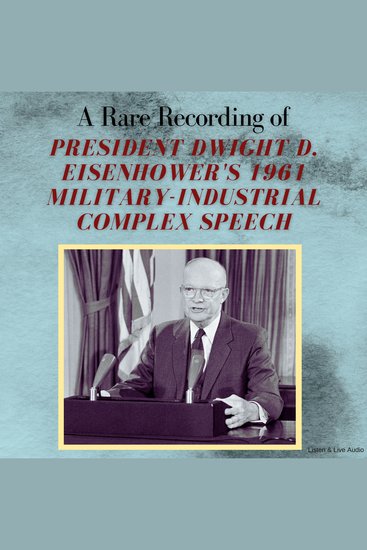
  • A Rare Recording of President Dwight D Eisenhower's 1961 Military-Industrial Complex Speech - cover

    A Rare Recording of President...

    President Dwight D. Eisenhower

    • 0
    • 0
    • 0
    On January 17, 1961, President Dwight Eisenhower delivered his political farewell to the American people on national television from the Oval Office of the White House. Those who expected the military leader and hero of World War II to depart his Presidency with a nostalgic, "old soldier" speech like Gen. Douglas MacArthur's, were surprised at his strong warnings about the dangers of the "military-industrial complex." As President of the United States for two terms, Eisenhower had slowed the push for increased defense spending despite pressure to build more military equipment during the Cold War’s arms race. Nonetheless, the American military services and the defense industry had expanded a great deal in the 1950s. Eisenhower thought this growth was needed to counter the Soviet Union, but it confounded him. Though he did not say so explicitly, his standing as a military leader helped give him the credibility to stand up to the pressures of this new, powerful interest group. He eventually described it as a necessary evil. The following is a transcript of the speech: 
     
    "Good Evening My Fellow Americans: 
     
    First, I should like to express my gratitude to the radio and television networks for the opportunities they have given me over the years to bring reports and messages to our nation. My special thanks go to them for the opportunity of addressing you this evening. 
     
    Three days from now, after half a century in the service of our country, I shall lay down the responsibilities of office as, in traditional and solemn ceremony, the authority of the Presidency is vested in my successor. 
     
    This evening I come to you with a message of leave-taking and farewell, and to share a few final thoughts with you, my countrymen. 
     
    Like every other citizen, I wish the new President, and all who will labor with him, Godspeed. I pray that the coming years will be blessed with peace and prosperity for all...
    Show book
  • Hostile Takeover - Aggressive Attempt to Gain Control of an Organization or Person - cover

    Hostile Takeover - Aggressive...

    Cito Harder

    • 0
    • 0
    • 0
    A hostile takeover is an aggressive maneuver in which one entity seizes control of another against its will. While the term is most commonly associated with corporate battles, hostile takeovers can occur in politics, criminal organizations, personal relationships, and even social groups. At its core, a hostile takeover is about power—gaining it, consolidating it, and using it to reshape an entity to serve the interests of the aggressor. Unlike consensual mergers or voluntary leadership transitions, hostile takeovers are marked by conflict, resistance, and strategic maneuvering. 
    In the corporate world, a hostile takeover typically occurs when one company seeks to acquire another without the consent of its board of directors. This is often done by purchasing a majority of shares on the open market, launching a tender offer to shareholders, or engaging in a proxy battle to replace leadership. The targeted company may attempt to defend itself using tactics such as poison pills, white knight rescues, or legal challenges, but once control is seized, the acquiring entity dictates the company's future direction. Corporate hostile takeovers are often driven by financial gain, market dominance, or strategic positioning, but they can also be fueled by personal vendettas or ideological shifts. 
    Beyond the business realm, hostile takeovers manifest in political settings as coups, regime changes, and leadership purges. Throughout history, governments have been overthrown through military force, manipulation of laws, or exploitation of public sentiment. Political leaders who rise to power through hostile means often implement sweeping changes, consolidating authority and eliminating opposition to solidify their control. These takeovers can reshape entire nations, alter global relations, and redefine ideologies, demonstrating the far-reaching consequences of power struggles.
    Show book