Join us on a literary world trip!
Add this book to bookshelf
Grey
Write a new comment Default profile 50px
Grey
Subscribe to read the full book or read the first pages for free!
All characters reduced
The Greatest Civil War Battles - The Atlanta Campaign - cover

The Greatest Civil War Battles - The Atlanta Campaign

Editors Charles River

Publisher: Charles River Editors

  • 0
  • 0
  • 0

Summary

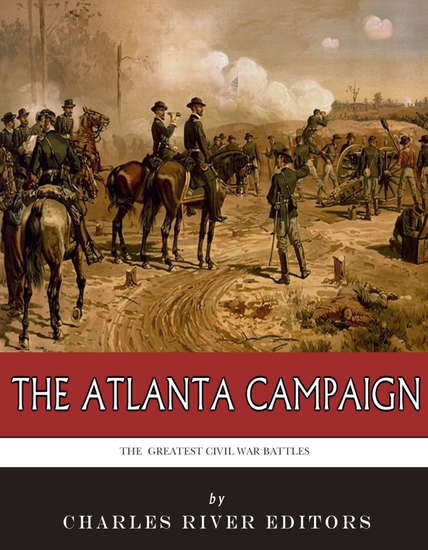
After successfully breaking the Confederate siege at Chattanooga near the end of 1863, William Tecumseh Sherman united several Union armies in the Western theater for the Atlanta Campaign, forming one of the biggest armies in American history. After detaching troops for essential garrisons and minor operations, Sherman assembled his nearly 100,000 men and in May 1864 began his invasion of Georgia from Chattanooga, Tennessee, where his forces spanned a line roughly 500 miles wide. 
 
. Sherman set his sights on the Confederacy’s last major industrial city in the West and General Joseph E. Johnston’s Army of Tennessee, which aimed to protect it. Atlanta’s use to the Confederacy lay in its terminus for three major railroad lines that traveled across the South: the Georgia Railroad, Macon and Western, and the Western & Atlantic.[1] U.S. Lieutenant General Ulysses S. Grant knew this, sending Major General William Tecumseh Sherman’s Division of the Mississippi towards Atlanta, with specific instructions, “get into the country as far as you can, inflicting all the damage you can against the war revenues.”[2] The city’s ability to send supplies to Lee’s Army of Northern Virginia made Atlanta all the more important.
 
The timing of the invasion was also crucial. Throughout May 1864, Robert E. Lee skillfully stalemated Ulysses S. Grant in a series of battles known as the Overland Campaign, inflicting nearly 50,000 casualties on the Army of the Potomac. The casualties were so staggering that Grant was constantly derided as a butcher, and his lack of progress ensured that anti-war criticism of the Lincoln Administration continued into the summer before the presidential election. The Democrats nominated George McClellan, the former leader of the Army of the Potomac. McClellan had not been as aggressive as Lincoln hoped, but he was still exceedingly popular with Northern soldiers despite being fired twice, and the Democrats assumed that would make him a tough candidate against Lincoln. At the same time, Radical Republicans were still unsure of their support for Lincoln, and many begun running their own campaign against Lincoln for not prosecuting the war vigorously enough, urging Lincoln to withdraw from the campaign. The people of Atlanta clearly identified their own role in the struggle, as the Atlanta Daily Appeal noted, “The greatest battle of the war will probably be fought in the immediate vicinity of Atlanta. Its results determines that of the pending Northern Presidential election. If we are victorious the Peace party will triumph; Lincoln’s Administration is a failure, and peace and Southern independence are the immediate results.”[3]
 
It would fall upon Sherman’s forces in the West to deliver the necessary victory. Johnston’s army of 50,000 found itself confronted by almost double its numbers, and General Johnston began gradually retreating in the face of Sherman’s forces, despite repulsing them in initial skirmishes at Resaca and Dalton. The cautious Johnston was eventually sacked and replaced by the more aggressive John Bell Hood once the Confederate army was back in Atlanta. Taking command in early July 1864, Hood lashed out at Sherman’s armies with several frontal assaults on various portions of Sherman’s line, but the assaults were repulsed, particularly at Peachtree Creek on July 20, where Thomas’s defenses hammered Hood’s attack. 
 
In August, Sherman moved his forces west across Atlanta and then south of it, positioning his men to cut off Atlanta’s supply lines and railroads. When the Confederate attempts to stop the maneuvering failed, the writing was on the wall. On September 1, 1864, Hood and the Army of Tennessee evacuated Atlanta and torched everything of military value. On September 3, 1864, Sherman famously telegrammed Lincoln, “Atlanta is ours and fairly won.” Two months later, so was Lincoln’s reelection. 
Available since: 05/02/2025.
Print length: 49 pages.

Other books that might interest you

  • Student Loan Leads - cover

    Student Loan Leads

    Esther Dotson

    • 0
    • 0
    • 0
    Student Loan Leads: The Essential Guide on How to Process Student Loan, Get Approved, and Have the Best Payment PlanFor most students, this can become a deciding factor in whether or not the student can attend college. A lot of newly graduated students don’t understand all of the costs and fees that are involved when they enroll to go to college. With college tuition, books, supplies, and many other costs involved in college, this can rack up a big debt for a student just wanting to higher their education.A lot of students hang up even the option of going to college due to the inability to pay the expenses of attending.In this audiobook, you will learn The Essential Guide on How to Process Student Loan, Get Approved, and Have the Best Payment Plan. So what are you waiting for, download a copy of the Student Loan Leads today!
    Show book
  • Love Loss & Life - Real Stories from the AIDS Pandemic by Rupert Everett Lord Fowler Jane Anderson and Many More - cover

    Love Loss & Life - Real Stories...

    Paul Coleman

    • 0
    • 0
    • 0
    A profound change in the world order becomes apparent within a pandemic. These are real life stories of the HIV and AIDS pandemic that reveal a truth. You cannot manage the future without knowing the past. The contributors to this book are experienced with the HIV and AIDS story as medical professionals, patients, family and friends. They are feisty individuals who have been prepared to discuss ideas and explore the social history of their lives. This book is about understanding and revealing the silence and secrets of the past 40 years and learning how a community stood together and built a better future even while it was being drained of life.
    Show book
  • Feminism is Queer - The Intimate Connection between Queer and Feminist Theory 2nd Edition - cover

    Feminism is Queer - The Intimate...

    Mimi Marinucci

    • 0
    • 0
    • 0
    In Feminism is Queer, Mimi Marinucci provides a valuable introduction to the intimately related disciplines of gender and queer theory, and develops the innovative concept of queer feminism, which treats queer theory as being continuous with feminist theory. While there were significant conceptual tensions between second-wave feminism and traditional lesbian and gay studies, queer feminism offers a paradigm for understanding gender, sex, and sexuality that overcomes this conflict in order to foster solidarity between those campaigning for women's rights and those for LGBTQ rights. 


    This updated and expanded edition engages with the latest developments in feminism and queer theory, including the new forms of both feminism and 'antifeminism' which have developed within online communities, the growing prominence of trans experiences in popular media, and the relevancy of queer feminism to a new generation of feminist activists. Feminism is Queer remains the indispensable guide for anyone with an interest in gender, sexuality, and the connections between feminism and queer issues.
    Show book
  • The Aeneid - cover

    The Aeneid

    Anonymous

    • 0
    • 0
    • 0
    Virgil’s The Aeneid is a Roman epic that tells the legendary journey of Aeneas, a Trojan hero destined to found a new civilization in Italy after the fall of Troy. Guided by fate and the gods, Aeneas sails through storms, battles, and heartbreak, including a tragic love affair with Dido, Queen of Carthage. Upon reaching Latium, he faces war with local tribes, led by Turnus, to fulfill his destiny. Blending Homeric adventure with Roman ideals of duty, piety, and empire, the poem glorifies Rome’s origins and the divine mission of its people. Rich in emotional depth and political vision, The Aeneid is both a national epic and a profound meditation on sacrifice, leadership, and the cost of destiny.
    Show book
  • Amos - The World English Bible Book 30 (Unabridged) - cover

    Amos - The World English Bible...

    Various Authors

    • 0
    • 0
    • 0
    Amos was one of the Twelve Minor Prophets. An older contemporary of Hosea and Isaiah, Amos was active c. 760-755 BCE during the rule of kings Jeroboam II of Israel and Uzziah of Judah. He was from the southern Kingdom of Judah but preached in the northern Kingdom of Israel. Amos wrote at a time of relative peace and prosperity but also of neglect of God's laws. He spoke against an increased disparity between the very wealthy and the very poor. His major themes of justice, God's omnipotence, and divine judgment became staples of prophecy. The Book of Amos is attributed to him.
    Show book
  • France in World War II: The History of Nazi Germany’s Conquest of France and Its Liberation By the Allies - cover

    France in World War II: The...

    Editors Charles River

    • 0
    • 0
    • 0
    One of the most famous people in the world came to tour the city of Paris for the first time on June 28, 1940. Over the next three hours, he rode through the city’s streets, stopping to tour L’Opéra Paris. He rode down the Champs-Élysées toward the Trocadero and the Eiffel Tower, where he had his picture taken. After passing through the Arc de Triomphe, he toured the Pantheon and old medieval churches, though he did not manage to see the Louvre or the Palace of Justice. Heading back to the airport, he told his staff, “It was the dream of my life to be permitted to see Paris. I cannot say how happy I am to have that dream fulfilled today.” Four years after his tour, Adolf Hitler would order the city’s garrison commander, General Dietrich von Choltitz, to destroy Paris, warning his subordinate that the city "must not fall into the enemy's hand except lying in complete debris." 
    Of course, Paris was not destroyed before the Allies liberated it, but it would take more than 4 years for them to wrest control of France from Nazi Germany after they took the country by storm in about a month in 1940. That said, it’s widely overlooked today given how history played out that as the power of Nazi Germany grew alarmingly during the 1930s, the French sought means to defend their territory against the rising menace of the Thousand-Year Reich. As architects of the most punitive measures in the Treaty of Versailles following World War I, France was a natural target for Teutonic retribution, so the Maginot Line, a series of interconnected strongpoints and fortifications running along much of France's eastern border, helped allay French fears of invasion. 
    After the fall of France, the Vichy Regime maintained a quasi-independent French nation for some time after the Third Reich invasion until the Germans decided to include it in their occupation zone.
    Show book