Join us on a literary world trip!
Add this book to bookshelf
Grey
Write a new comment Default profile 50px
Grey
Subscribe to read the full book or read the first pages for free!
All characters reduced
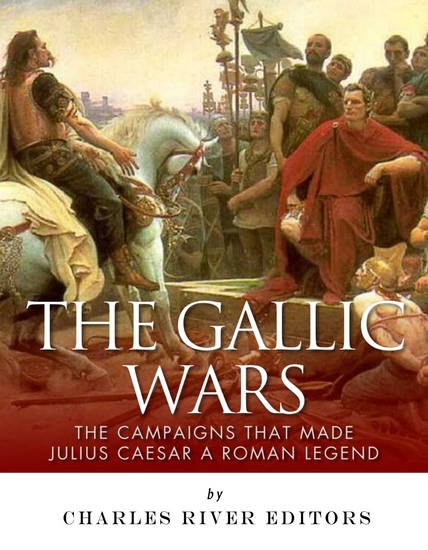
The Gallic Wars - The Campaigns That Made Julius Caesar a Roman Legend - cover

The Gallic Wars - The Campaigns That Made Julius Caesar a Roman Legend

Editors Charles River

Publisher: Charles River Editors

  • 0
  • 0
  • 0

Summary

The Gallic Wars, the series of campaigns waged by Julius Caesar on behalf of the Roman Senate between 58-50 BC, were among the defining conflicts of the Roman era. Not only was the expansion of the Republic’s domains unprecedented (especially when considering it was undertaken under the auspices of a single general), it had a profound cultural impact on Rome itself as well. The Roman Republic, so dynamic in the wake of the destruction of their ancient enemy, Carthage, had recently suffered a series of dramatic upheavals; from the great slave rebellion of Spartacus to the brutal and bloody struggle for power of Marius and Sulla. Rome had been shaken to its very core, and a victory was essential both to replenish the dwindling national coffers and to instill in the people a sense of civic pride and a certainty in the supremacy of the Republic.
 
Quite simply, in terms of scale, the Gallic Wars were unmatched by anything the Roman Republic had witnessed since the Punic Wars. By the end of the campaigns, ancient historians estimated that more than a million people had died, and still more displaced or enslaved. Even by the more conservative estimates of modern historians, a casualty count in the hundreds of thousands appears possible. Either way, the war was a cataclysm, involving tens of thousands of combatants, and it also marked the greatest displays of skill by one of the greatest battlefield generals history has ever known.
 
Caesar’s successful campaigns in Gaul have become the stuff of military legend, in part because he had the foresight to document them himself. Caesar himself wrote a famous firsthand account of the Gallic Wars, apparently from notes he had kept during the campaigns, and he wrote Commentarii de Bello Gallico (Commentaries on the Gallic War) in the third person. Caesar’s account described the campaigning and the battles, all as part of a propaganda campaign to win the popularity of the Roman people. As a result, he left out inconvenient facts, including how much of a fortune he made plundering, but the work still remains popular today, and it is still used to teach Latin.
 
The Gallic Wars: The Campaigns That Made Julius Caesar a Roman Legend comprehensively looks at the campaigns that subdued Gaul and led to Caesar’s conquest not just of the European continent but of Rome itself. Along with pictures, you will learn about the Gallic Wars like never before, in no time at all.
Available since: 05/02/2025.
Print length: 40 pages.

Other books that might interest you

  • The Duty of Civil Disobedience - cover

    The Duty of Civil Disobedience

    Henry David Thoreau

    • 0
    • 0
    • 0
    The Duty of Civil Disobedience by Henry David Thoreau, narrated by Marcus Locke, is a thought-provoking essay that explores the individual's moral responsibility to resist unjust government actions. Written in 1849, Thoreau's work has become a cornerstone of political philosophy, advocating for peaceful protest and nonviolent resistance to oppressive authority. Thoreau emphasizes the importance of following one's conscience over conforming to laws that violate fundamental human rights. 
    Narrator Marcus Locke brings Thoreau’s powerful message to life, delivering the essay with clarity and conviction. His narration invites listeners to reflect on their role in society and the power of individual action against injustice. Locke’s voice captures the calm yet resolute tone of Thoreau’s work, making this audiobook an engaging and inspiring experience for those interested in civil rights, social justice, and personal activism. 
    This audiobook is perfect for listeners drawn to philosophical works and the history of social movements, as well as anyone seeking inspiration for standing up for their beliefs. The Duty of Civil Disobedience remains a timeless call to action, encouraging peaceful resistance to unjust laws and policies.
    Show book
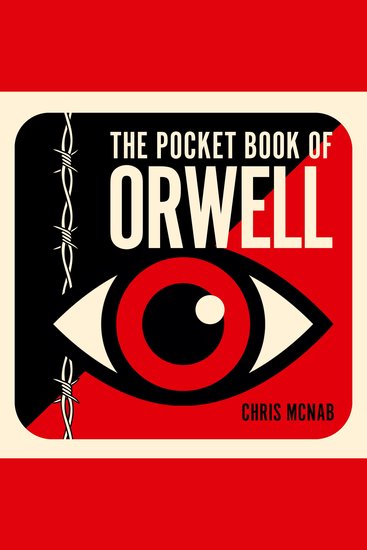
  • The Pocket Book of Orwell - A Concise Introduction to Orwell’s Writings and Ideas - cover

    The Pocket Book of Orwell - A...

    Chris McNab

    • 0
    • 0
    • 0
    Explore the writings and ideas of literary legend George Orwell with this handy hardback guide, complete with helpful summaries, diagrams and illustrations. 
     
    George Orwell is considered one of the greatest writers and thinkers of the 20th century, best known for his incisive political critiques in his celebrated novels Animal Farm and 1984. This comprehensive guide explores Orwell's position on the issues that truly mattered to him, including poverty, social class, nationalism, imperialism, political ideologies, and totalitarianism. 
     
    In this essential volume, Chris McNab explores these ideas and what light they can shed on the modern world. With each chapter featuring famous quotes from the writer followed by a broader discussion of the great writer's insights, The Pocket Book of Orwell provides an ideal introduction to one of the world's great thinkers.
    Show book
  • A Rare Recording of Pope Paul VI - cover

    A Rare Recording of Pope Paul VI

    Pope Paul VI

    • 0
    • 0
    • 0
    Pope Paul VI (born Giovanni Battista Enrico Antonio Maria Montini) lived from Sept. 26, 1897 to August 6, 1978. He reigned as Pope from June 21, 1963 to his death on August 6, 1978. After succeeding John XXIII, he continued the Second Vatican Council, which he closed in 1965. He then helped to oversee the numerous reforms and improved ecumenical relations with Eastern Orthodoxy and Protestants. This speech is delivered primarily in Latin, with a short message of prayer in English for American astronauts.
    Show book
  • The Erich Fromm Reader - cover

    The Erich Fromm Reader

    Erich Fromm

    • 0
    • 0
    • 0
    "Fromm crossed the boundaries of traditional disciplines to expound his view on the alienation of man in an increasingly technological world." —Newsweek 


    Erich Fromm's basic idea was to look at the individual as a social being, and to look at society as an ensemble of many individuals who have not only mutual ideas and convictions based on a common practice of life, but also a shared psychic structure. With his concept of "social character," Fromm created a new interdisciplinary thinking presented in this compendium. 


    The Erich Fromm Reader exhibits the true genius of an original thinker in seeing the connections between overlapping knowledge from many different fields. Here, interdisciplinarity is not only a lip service but the impact of Erich Fromm's unique social psychological notion.
    Show book
  • Father Forgive - First Time Gay - cover

    Father Forgive - First Time Gay

    Randy Manners

    • 0
    • 0
    • 0
    Graduation is tomorrow, and Alex will take his vows of priesthood Monday morning. 
      
    His friend takes him out for one last wild night on the town. Problem is, Alex has never been into the high octane lifestyle of dance clubs and fast women. He’s never been that into women at all. It’s exactly why he’s a good fit for the priesthood, right? 
      
    And then Hank showed up. He was every bit the man his old-school name warranted. And he understood. This wasn’t his kind of place, either. Hank takes the reigns and leads Alex down a new path. 
      
    Which calling will Alex follow?
    Show book
  • How to Abolish Prisons - Lessons from the Movement against Imprisonment - cover

    How to Abolish Prisons - Lessons...

    Rachel Herzing, Justin Piché,...

    • 0
    • 0
    • 0
    Critics of abolition sometimes castigate the movement for its utopianism, but in How to Abolish Prisons, long-time organizers Rachel Herzing and Justin Piché reveal a movement that has made the struggle for abolition as real as the institutions they are fighting against. 


    Drawing on extensive interviews with abolitionist crews all over North America, Herzing and Piché provide a collective reconstruction of what the grassroots movement to abolish prisons actually is, what initiatives it has launched, how it organizes itself, and how its protagonists build the day-to-day practice of politics. Listeners sit in on the Winnipeg rideshares of Bar None and the meetings of the Chicago Community Bail Fund as they assess the utility of politicized mutual aid. They follow the campaigns and coalitions of Critical Resistance in Oakland and San Francisco and Survived and Punished in New York City, and learn about the prisoner correspondence projects that keep activists behind bars and outside them in constant coordination. 


    Abolitionist campaigns are constructing on-the-ground initiatives across North America to deconstruct carceral society and build resistant communities. Through the words, deeds, and personalities of this beautifully peopled movement, How to Abolish Prisons emerges as a stunning snapshot of a movement's thinking in motion.
    Show book