

Join us on a literary world trip!
Add this book to bookshelf
Grey
Write a new comment Default profile 50px
Grey
Subscribe to read the full book or read the first pages for free!
All characters reduced
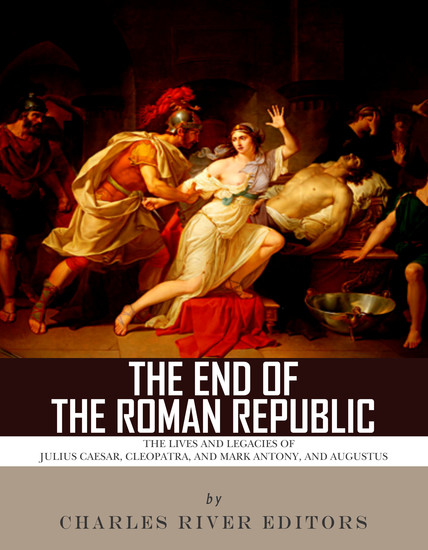
The End of the Roman Republic - The Lives and Legacies of Julius Caesar Cleopatra Mark Antony and Augustus - cover

The End of the Roman Republic - The Lives and Legacies of Julius Caesar Cleopatra Mark Antony and Augustus

Editors Charles River

Publisher: Charles River Editors

  • 0
  • 0
  • 0

Summary

Even in his time, Julius Caesar was in many ways larger than life, and because of his legacy as virtual founder of the Roman Empire, much of what was written about – and by – him during his life and immediately after his assassination was politically motivated. His successor, Octavian Augustus, had a strong interest in ensuring that Caesar’s life be painted in a favorable light, while Caesar’s political enemies attempted to paint him as a corrupt, undemocratic dictator who was destroying the old order of the Republic. This makes it exceedingly difficult to separate historical fact from apocryphal interjection, as the writings of Cicero (a rival of Caesar’s) and the later biographies of Suetonius and Plutarch can be misleading. Nonetheless, along with Caesar’s De Bello Gallico, his famous notes on his campaign against the Gauls, they remain our chief sources for Caesar’s life – a life everyone agreed was nothing short of remarkable and changed the course of history forever.
 
Cleopatra was a legendary figure even to contemporary Romans and the ancient world, as Plutarch’s quote suggests, and she was a controversial figure who was equally reviled and praised through the years, depicted as a benevolent ruler and an evil seductress, sometimes at the same time. Over 2,000 years after her death, everything about Cleopatra continues to fascinate people around the world, from her lineage as a Ptolemaic pharaoh, her physical features, the manner in which she seduced Caesar, her departure during the Battle of Actium, and her famous suicide. And despite being one of the most famous figures in history, there is still much mystery surrounding her, leading historians and archaeologists scouring Alexandria, Egypt for clues about her life and the whereabouts of her royal palace and tomb.
 
While Mark Antony’s relationships with Rome’s most famous leaders and history’s most famous woman were central components in his lives, the fact that his legacy has been intertwined with them belies the fact that he was a powerful man in his own right. Coming up as a capable and competent military man who Caesar trusted as his right hand, Antony parlayed that into governing Rome itself while Caesar fought Pompey. After Caesar’s assassination in 44 B.C., Antony deftly navigated from tenuous footing as a declared enemy of the state to become one of Rome’s two most powerful leaders, arguably its most powerful, in just a matter of years, outmaneuvering and getting the best of enemies like Brutus and Cicero. At the same time, Antony was notorious in his own time for his voracious appetite for vice, and the branding of him as a boor has persisted for over 2,000 years.
 
The importance of Gaius Julius Caesar Augustus (or as he was known from birth, Gaius Octavius “Octavian” Thurinus) to the course of Western history is hard to overstate. His life, his rise to power, his political, social and military achievements, all laid the foundations for the creation of an Empire which would endure for almost five centuries, and whose traditions, laws, architecture and art continue to influence much of Europe and the world today. Octavian was the first true Roman Emperor, and the first man since the Etruscan Tarquins, five centuries earlier, to establish a successful hereditary ruling dynasty in what had been a proud Republic for over half a millennium. He was a canny strategist, an excellent orator, a fine writer, a generous patron of the arts and enthusiastic promoter of public works, but above all he was a master politician. Octavian’s great-uncle (and adoptive father) Julius Caesar was a great general, his rival Mark Antony was a great soldier, but as a politician Octavian outmatched them all.
Available since: 05/06/2025.
Print length: 85 pages.


Other books that might interest you

  • Guy Gibson: The Life and Legacy of the Royal Air Force’s Most Distinguished Bomber Pilot during World War II - cover

    Guy Gibson: The Life and Legacy...

    Editors Charles River

    • 0
    • 0
    • 0
    Given the RAF’s importance, it should come as no surprise that some of the pilots ranked among Britain’s most recognized war heroes, and Guy Gibson remains one of the most famous and highly decorated British soldiers in World War II. His exploits in the RAF as the leader of the audacious raid to blow up German dams in May 1943 remain renowned, and for generations of British boys after the war, he served as the benchmark of a legendary hero. His tragic death at the young age of 26 only served to deepen his mythology, but his war record was impressive even before his most famous missions, with three operational tours of duty under his belt. 
    The mythmaking aside, Gibson was a complex and controversial character, probably caused, in part, by a turbulent and disrupted upbringing. Although his bravery, self-sacrifice, and leadership in battle were undeniable and highly impressive, he could be demanding and difficult to get along with. It is probably fair to say he was not universally loved by the crews and service personnel who served alongside him, and he after the Dam Busters raid, he embarked on a months-long tour of the United States and Canada that many (including Air Officer Commanding Bomber Commander Arthur “Bomber” Harris) felt had gone to his head slightly. After the raid and the fame, he drifted somewhat, having been forbidden from flying in further operations (which he bypassed in the end). He wrote a book about his exploits as a bomber pilot, Enemy Coast Ahead, and was interviewed on radio programs. He flirted with politics, applying for and succeeding in becoming the Conservative Party’s prospective candidate for Macclesfield in 1944 before withdrawing, claiming the war still required his attention. After D-Day on June 6, 1944, Gibson seemed to feel an urgent need to get back into operations for fear of missing out.
    Show book
  • The Ethics of Technology - Moral Challengers - cover

    The Ethics of Technology - Moral...

    Craig Dames

    • 0
    • 0
    • 0
    In an age where technology permeates nearly every aspect of our lives, understanding the ethical foundations behind its development and use has never been more critical. Tech ethics, at its core, explores the moral principles that guide our decisions regarding the design, implementation, and impact of technology. As digital tools become increasingly powerful and integrated into society, they bring with them profound questions about responsibility, fairness, and the human consequences of innovation. 
    The roots of technology ethics can be traced back to classical moral philosophy. Thinkers like Aristotle, Kant, and Mill laid the groundwork for how we approach right and wrong, justice, and duty. These age-old theories—virtue ethics, deontology, and utilitarianism—are still highly relevant in today's tech-driven world. For instance, when we ask whether a self-driving car should prioritize the life of a passenger over a pedestrian, we are invoking these very moral frameworks to guide the decision-making process. In this way, ethical theory provides a lens through which we can evaluate the choices we make as developers, users, and regulators of technology. 
    Modern concerns surrounding tech ethics often revolve around issues that were unimaginable even a few decades ago. Digital privacy, algorithmic bias, and autonomous systems challenge us to reinterpret traditional moral values in new contexts. This requires a dynamic understanding of ethics—one that can evolve alongside technological change. Unlike in the past, where tools were relatively neutral and required human operation, today's technologies often act with a degree of independence, raising the stakes of their ethical implications. Machines that learn, adapt, and decide are not just tools; they become agents of action whose behavior must be morally accountable.
    Show book
  • Karl Marx on Society and Social Change - With Selections by Friedrich Engels - cover

    Karl Marx on Society and Social...

    Karl Marx

    • 0
    • 0
    • 0
    This volume presents those writings of Marx that best reveal his contribution to sociology, particularly to the theory of society and social change. The editor, Neil J. Smelser, has divided these selections into three topical sections and has also included works by Friedrich Engels. 
     
    In his comprehensive Introduction to the selections, Professor Smelser provides a biography of Marx, identifies the various intellectual traditions which formed the background for Marx’s writings, and discusses the selections which follow. The editor describes Marx’s conception of society as a social system, the differences between functionalism and Marx’s theories, and the dynamics of economic and political change as analyzed by Marx.
    Show book
  • Nurturing - The Supportive Growth - Encouraging Development and Flourishing - cover

    Nurturing - The Supportive...

    Esther Jameson

    • 0
    • 0
    • 0
    Nurturing growth is a fundamental aspect of both personal and collective development. It is the process of creating an environment where individuals can flourish, reach their full potential, and thrive. The journey of growth involves not only the pursuit of external success but also the cultivation of inner strength, self-awareness, and a deep understanding of one’s purpose. By providing the right kind of support, encouragement, and guidance, it becomes possible to foster an atmosphere where growth is not only achievable but sustainable. 
    At its core, nurturing growth is about offering the necessary resources and fostering the right mindset for individuals to flourish. Growth is not something that happens by accident; it requires conscious effort and dedication. It involves creating the conditions that allow for personal transformation, whether that’s emotional, mental, or spiritual. The importance of growth is multifaceted; it helps individuals develop resilience, adapt to challenges, and become more effective in their endeavors. Encouragement plays a pivotal role in this process, as it can serve as a driving force, helping individuals overcome self-doubt, fear, and obstacles along their journey. 
    Understanding development and flourishing is crucial in the context of nurturing growth. Development refers to the continuous process of improvement, whether in skills, knowledge, or emotional well-being. It’s about evolving into a more capable version of oneself, and it’s a dynamic process that often requires introspection, learning, and self-compassion. Flourishing, on the other hand, is the state of thriving—living a life full of purpose, joy, and fulfillment. It represents not just the absence of difficulties but the active presence of well-being and meaning in life.
    Show book
  • Summary of Counter Gaslighting - A small manual of Counter-manipulation - cover

    Summary of Counter Gaslighting -...

    Dan Crown

    • 0
    • 0
    • 0
    In a world where psychological well-being is paramount, understanding the nuances of manipulative behaviors is crucial. One of the most insidious forms of manipulation is gaslighting. This chapter delves deep into the definition of gaslighting, aiming to equip you with the knowledge to identify and protect yourself from this covert form of emotional abuse. 
    What is Gaslighting? 
    Gaslighting is a form of psychological manipulation in which a person or a group covertly sows seeds of doubt in a targeted individual or group, making them question their own memory, perception, or judgment. It often leads to significant emotional distress, confusion, and a diminished sense of self-worth in the victim. 
    The Core Elements of Gaslighting 
    -Doubt: The manipulator's primary tool is doubt. By questioning the validity of the victim's memories or perceptions, the manipulator creates uncertainty. 
    -Denial: Despite evidence to the contrary, the gaslighter will deny behaviors or events, further confusing the victim. 
    -Discredit: The gaslighter may also discredit the victim to others, isolating the victim and undermining their support system. 
    -Dependency: Over time, the victim may become dependent on the gaslighter for their version of reality, eroding the victim's ability to trust their own judgment.
    Show book
  • Hollywood Tiki - Film in the Era of the Pineapple Cocktail - cover

    Hollywood Tiki - Film in the Era...

    Adam Foshko

    • 0
    • 0
    • 0
    Island Escapes, South Seas Adventures, and Musical Surf Parties of Midcentury CinemaTiki Culture arose as the defining expression of American pop culture during World War II and its influence continued through the 1960s. The essence of Tiki featured heavily in films of the era, depicting palm-tree and cocktail-laden escapes that captivated audiences nationwide. Films like South Pacific and The Man in the Gray Flannel Suit were a hodgepodge of jungle imagery and World War II Pacific theater memories. A fascination with the new State of Hawaii was reflected in Elvis's Blue Hawaii, while balmy youth flicks like Beach Blanket Bingo and Gidget showcased surf, sun and fun.Join authors Jason Henderson and Adam Foshko as they explore films about the experiences of war filtered through the tropical splendor that defined an era.
    Show book
