Join us on a literary world trip!
Add this book to bookshelf
Grey
Write a new comment Default profile 50px
Grey
Subscribe to read the full book or read the first pages for free!
All characters reduced
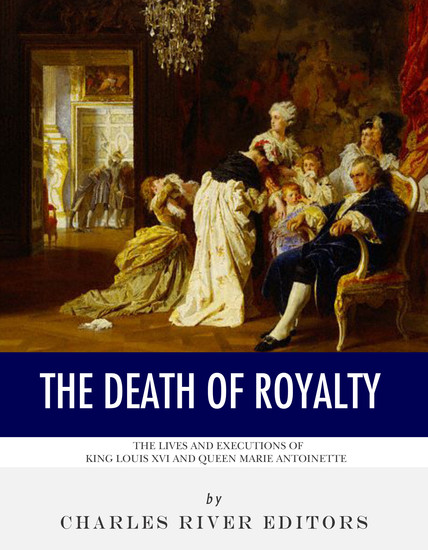
The Death of Royalty - The Lives and Executions of King Louis XVI and Queen Marie Antoinette - cover

The Death of Royalty - The Lives and Executions of King Louis XVI and Queen Marie Antoinette

Editors Charles River

Publisher: Charles River Editors

  • 0
  • 0
  • 0

Summary

“I die perfectly innocent of the so-called crimes of which I am accused. I pardon those who are the cause of my misfortunes.” – Louis XVI
 
Louis XVI is one of the most famous Kings of France, but for reasons he would have much rather avoided. Coming of age in the wake of the reign of the Sun King, Louis XIV, and his father, Louis XV, Louis XVI initially intended to be one of France’s most enlightened Kings. Instead, he was destined to be the only French King ever executed. Indeed, it is his death and his role in fomenting the French Revolution (along with his infamous Queen, Marie Antoinette) that continue to play the central role in Louis XVI’s legacy.   
 
The abrupt demise of Louis XVI and his reign capped a tumultuous but important historical period for both France and the rest of the world. It was Louis XVI’s wish to reform France in the mold of the Enlightenment and his failure to push those reforms against a reluctant aristocracy that emboldened and spurred those who would rebel against him. At the same time, his support for the American cause during the American Revolution in the 1770s was integral in securing that nation’s freedom and further adding to France’s financial woes. Ironically, France’s role in assuring the success of the American Revolution provided a hopeful example for those who would overthrow him less than 15 years later.
 
The same cautious conservatism that marred his reign in the eyes of so many ultimately led to the chain of events that made him a victim of the guillotine. With French society in open revolt by the late 1780s, the King appeared indecisive at a number of crucial moments, including during a famous attempted escape that was thwarted at Vergennes, and he had to literally run for his life when a mob stormed the royal palace at Tuileries. Soon after, he was stripped of his dignity and his royal name, convicted of high treason in a sham trial as Citizen Louis Capet. Ironically, in death, some historians have asserted that his execution and the sympathy it engendered helped bring about the Restoration a generation later.
 
Throughout history, a countless number of historical figures have had their lives overshadowed by the myths and legends that surround them to the extent that their legacy comes to define them. In French history, this is truer of Marie Antoinette than just about everyone else. Nearly 220 years after she was put to the guillotine, Marie Antoinette is more famous than ever, fairly or unfairly coming to epitomize royalty and everything that was wrong with it.  
 
As France slid toward its own Revolution, rumors and innuendo against the queen took hold, and she was accused of being promiscuous and even defrauding a jeweler in what became known as the “Diamond Necklace Affair”. Though the rumors had no basis in truth, they were widely accepted and eventually used as partial justification for her execution. By 1792, with the Revolution in full swing, the Royal Family’s attempt to escape Paris was thwarted, and in January 1793, Louis XVI lost his head at the hands of the Jacobins. With her own health failing, the Queen herself was tried the following October, accused of sexually abusing the sickly Dauphin. Given that she had spent the last few years of her life carefully doting on her children at the expense of almost everything else, it was a particularly heinous accusation. On October 16, 1793, Antoinette herself was executed at the guillotine.
 
Since her death, Marie Antoinette has been the subject of sharp historical debate over whether she was actually a catalyst in the French Revolution or simply an insignificant scapegoat who was unfairly made a target. At the same time, the one thing everybody associates with Antoinette is the phrase “Let them eat cake”, a spoiled and ignorant comment supposedly made in response to being informed that the peasants had no bread. 
Available since: 05/06/2025.
Print length: 71 pages.

Other books that might interest you

  • On Collective Memory - cover

    On Collective Memory

    Maurice Halbwachs

    • 0
    • 0
    • 0
    How do we use our mental images of the present to reconstruct our past? Maurice Halbwachs (1877-1945) addressed this question for the first time in his work on collective memory, which established him as a major figure in the history of sociology. This volume, the first comprehensive English-language translation of Halbwach’s writings on the social construction of memory, fills a major gap in the literature on the sociology of knowledge. 
    Halbwachs’ primary thesis is that human memory can only function within a collective context. Collective memory, Halbwachs asserts, is always selective; various groups of people have different collective memories, which in turn give rise to different modes of behavior. Halbwachs shows, for example, how pilgrims to the Holy Land over the centuries evoked very different images of the events of Jesus’ life; how wealthy old families in France have a memory of the past that diverges sharply from that of the nouveaux riches; and how working class construction of reality differ from those of their middle-class counterparts. 
     
    With a detailed introduction by Lewis A. Coser, this translation will be an indispensable source for new research in historical sociology and cultural memory.
    Show book
  • Little Girl Lost: Amelia just wants a home she feels safe in… - cover

    Little Girl Lost: Amelia just...

    Casey Watson

    • 0
    • 0
    • 0
    The new fostering memoir from the Sunday Times bestselling author Casey Watson 
    Six-year-old Amelie lives with her mother, Kelly, who suffers from bipolar disorder. After Kelly attempts to burn down their family house, it becomes clear that her daughter is in grave danger. Amelie is quickly taken into care. 
    When she arrives with foster carer Casey Watson, Amelie acts much younger than her age. Casey must get to the root of Amelie’s behaviour, while doing what she can to keep the family together. 
    Will Amelie ever find the safety of home? 
    Little Girl Lost is a Sunday Times bestselling book that delves into the social issues of child abuse and adoption. This non-fiction autobiography by Casey Watson is a compelling narrative of survival and the complexities of relationships within the foster care system. 
    For fans of Maggie Hartley (Battered, Broken, Healed), Linda Watson-Brown (Don't Say A Word), Katy Weitz (The Girl for the Job), and Veronica Clark (Enslaved). 
    HarperCollins 2024
    Show book
  • Managing Your Anxiety - cover

    Managing Your Anxiety

    Harvard Business Review

    • 0
    • 0
    • 0
    Make anxiety work for you. 


    Work is stressful: We race to meet deadlines. We extend ourselves to return favors for colleagues. We set ambitious goals for ourselves and our teams. We measure ourselves against metrics, our competitors, and sometimes, our colleagues. Some of us even go beyond tangible metrics to internalize stress and fear of missing the mark—ruminating over presentations that didn't go according to plan, imagining worst-case scenarios, or standing frozen, paralyzed by perfectionism. But hypervigilance, worry, and catastrophizing don't have to hold you back at work. When channeled thoughtfully, anxiety can motivate us to be more resourceful, productive, and creative. It can break down barriers and create new bonds with our colleagues. 


    Managing Your Anxiety will help you distinguish stress from anxiety, learn what anxiety looks like for you, understand it, and respond to it with self-compassion at work. With the latest psychological research and practical advice from leading experts, you'll learn how to recognize how your anxiety manifests itself; manage it in small, day-to-day moments and in more challenging times; experiment and find a mindfulness practice that works for you; and build a support infrastructure to help you manage your anxiety over the long term.
    Show book
  • Living From the Heart Jesus Gave You - cover

    Living From the Heart Jesus Gave...

    James G. Friesen, E. James...

    • 0
    • 0
    • 0
    The Life Model is a unifying approach to ministries of counseling, recovery, pastoral care, prayer ministry, deliverance, inner healing, child rearing, body life and health. Substance abuse recovery programs internationally are guided by the Life Model's five principles. Because the Life Model develops strong maturity, it is widely used as a church model, particularly where people must face suffering. Missions have adopted the Life Model for restoring hurt missionary children. Almost every major ministry dealing with trauma and abuse in the USA uses the Life Model as part of their teaching. This new version now includes study questions at the end of each chapter as well as many other bonuses. Written by James Friesen, E James Wilder, Anne Bierling, Rick Koepcke, and Maribeth Poole.
    Show book
  • Jane Austen's Little Book of Wisdom - Words on Love Life Society and Literature - cover

    Jane Austen's Little Book of...

    Jane Austen

    • 1
    • 0
    • 0
    The ultimate companion for the Jane Austen fan filled with her penetrating insights and humor on life, love, and death. Jane Austen is one of the most popular female writers in history, best known for her stories of love, loss, and hope, which are cleverly intertwined with her witty insights into the traits and expectations of English Georgian society.   Here, in this stunning little book, you will be able to read hundreds of individual quotes from her famous works—from Pride and Prejudice and Emma to Persuasion and Sense and Sensibility—each prompting an emotional response, thoughtful musing, or even a little snigger at the wise and shrewd perceptions that Austen had of the world around her.   Utterly charming and very profound, fans of Jane Austen can revel in these much-loved quotes, while a new audience will be introduced to the joys that her books have provided since their publication many years ago. With each chapter focusing on a different theme—from Love & Longing to Female Strength—this gorgeous gift book is the perfect compilation of Austen’s funny, moving, and thought-provoking words.   Content of themes:  Love & Longing  Friendship  Society  Female Strength  Life & Death  Faith  Art & Literature “The wit of Jane Austen has for a partner the perfection of her taste.” —Virginia Woolf   
    Show book
  • America Made Me a Black Man - A Memoir - cover

    America Made Me a Black Man - A...

    Boyah J. Farah

    • 0
    • 0
    • 0
    NAACP Image Award Nominee · NPR Best Book of 2022 
    A searing memoir of American racism from a Somalian-American who survived hardships in his birth country only to experience firsthand the dehumanization of Blacks in his adopted land, the United States. 
    “No one told me about America.”  
     Born in Somalia and raised in a valley among nomads, Boyah Farah grew up with a code of male bravado that helped him survive deprivation, disease, and civil war. Arriving in America, he believed that the code that had saved him would help him succeed in this new country. But instead of safety and freedom, Boyah found systemic racism, police brutality, and intense prejudice in all areas of life, including the workplace. He learned firsthand not only what it meant to be an African in America, but what it means to be African American. The code of masculinity that shaped generations of men in his family could not prepare Farah for the painful realities of life in the United States.  
    Lyrical yet unsparing, America Made Me a Black Man is the first book-length examination of American racism from an African outsider’s perspective. With a singular poetic voice brimming with imagery, Boyah challenges us to face difficult truths about the destructive forces that threaten Black lives and attempts to heal a fracture in Black men’s identity.
    Show book