Join us on a literary world trip!
Add this book to bookshelf
Grey
Write a new comment Default profile 50px
Grey
Subscribe to read the full book or read the first pages for free!
All characters reduced
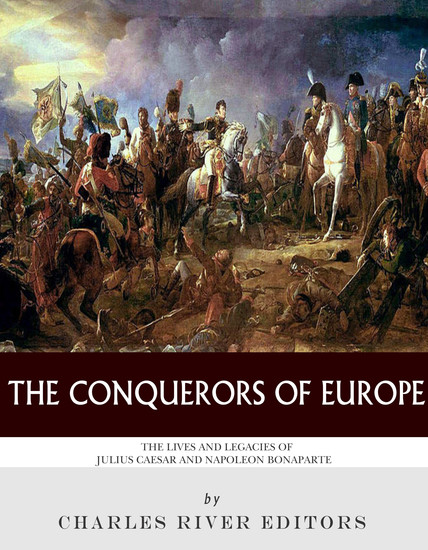
The Conquerors of Europe - The Lives and Legacies of Julius Caesar and Napoleon Bonaparte - cover

The Conquerors of Europe - The Lives and Legacies of Julius Caesar and Napoleon Bonaparte

Editors Charles River

Publisher: Charles River Editors

  • 0
  • 0
  • 0

Summary

“I would rather be the first man in a humble village, than the second man in Rome” – Caesar
 
Possibly the most important man of antiquity, and even all of history, was Julius Caesar. Alexander Hamilton, the famous American patriot, once remarked that “the greatest man who ever lived was Julius Caesar”. Such a tribute, coming from one of the Founding Fathers of the quintessential modern democracy in reference to a man who destroyed the Roman Republic, is testament to the enduring mark that Caesar left upon the world. The ultimate conqueror, statesman, dictator, visionary, and opportunist, during his time in power Caesar expanded the borders of Rome to almost twice their previous size, revolutionized the infrastructure of the Roman state, and destroyed the Roman Republic for good, leaving a line of emperors in its place. His legacy is so strong that his name has become, in many languages, synonymous with power: the Emperors of Austria and Germany bore the title Kaiser, and the Czars of Russia also owe the etymology of their title to Caesar. His name also crept further eastward out of Europe, even cropping up in Hindi and Urdu, where the term for “Emperor” is Kaisar.
 
Even in his time, Caesar was in many ways larger than life, and because of his legacy as virtual founder of the Roman Empire, much of what was written about – and by – him during his life and immediately after his assassination was politically motivated. His successor, Octavian Augustus, had a strong interest in ensuring that Caesar’s life be painted in a favorable light, while Caesar’s political enemies attempted to paint him as a corrupt, undemocratic dictator who was destroying the old order of the Republic. This makes it exceedingly difficult to separate historical fact from apocryphal interjection, as the writings of Cicero (a rival of Caesar’s) and the later biographies of Suetonius and Plutarch can be misleading. Nonetheless, along with Caesar’s De Bello Gallico, his famous notes on his campaign against the Gauls, they remain our chief sources for Caesar’s life – a life everyone agreed was nothing short of remarkable and changed the course of history forever.
 
When historians are asked to list the most influential people of the last 200 years, a handful of names might vary, but there is no question that the list will include Napoleon Bonaparte (1769-1821), the most successful French leader since Charlemagne and widely acknowledged as one of the greatest generals ever. Indeed, Napoleon was likely the most influential man of the 19th century, leaving an indelible mark on everything from the strategy and tactics of warfare to the Napoleonic Code that drafted laws across the continent. To defeat Napoleon, the Europeans had to form large coalitions multiple times, which helped bring about the entangling alliances that sparked World War I after Europe was rebuilt following Waterloo and the Congress of Vienna. Napoleon’s influence on the United States was also palpable. To finance his endeavors, he struck a deal with President Thomas Jefferson that became the Louisiana Purchase, and it was Napoleonic warfare that was used throughout the Civil War, leading to massive casualties because the weaponry of the 1860s was now more advanced than the tactics of 1815.
 
When Napoleon died at St. Helena, he still engendered fear and distaste among the Europeans, but the man and his legacy continued to be held in awe across the world. In Napoleon’s time, emperors and leaders still hoped to become the next Julius Caesar. After the Napoleonic Era, emperors and generals hoped to become the next Napoleon. For the next century, military leaders and even civilians struck Napoleonic poses when having their pictures taken, and phrases like “Napoleonic complex” and “meeting one’s Waterloo” are now common phrases in the English lexicon. 


Available since: 05/04/2025.
Print length: 76 pages.
Other books that might interest you

  • Summary: The Artist's Way - A Spiritual Path to Higher Creativity by Julia Cameron: Key Takeaways Summary & Analysis Included - cover

    Summary: The Artist's Way - A...

    Brooks Bryant

    • 0
    • 0
    • 0
    Disclaimer: This is not the official book; it is a summary & it does not accompany the official. 
    Drawing upon her own experiences as a writer, Cameron employs a compassionate and encouraging voice to guide readers through a transformative twelve-week program that aims to recover and unleash their creativity. Centered on the basic principle that creative expression is the natural direction of life, it embarks on a spiritual expedition into the self, urging readers to undertake a deep exploration to overcome the inner hurdles that impede their artistic journeys. 
    Each week unveils a new set of explorative tasks, thought-provoking questions, and exercises, all meticulously designed to ignite the dormant creativity in individuals. The journey is accompanied by the establishment of foundational routines such as “Morning Pages,” a practice involving daily free-writing that navigates one’s stream of consciousness, and “Artist Dates,” which encourage the exploration of stimulating activities to fuel one’s imagination. 
    As you delve into your summary of this revered handbook, consider accentuating the spiritual elements that intertwine with creativity. Showcase how Cameron bridges the gap between the creative self and the spiritual self, paving the way for an enriching journey that is not just about nurturing creativity but also about reclaiming the self.
    Show book
  • The Self - A Very Short Introduction - cover

    The Self - A Very Short...

    Marya Schechtman

    • 0
    • 0
    • 0
    'Know thyself' is said to have been one of the maxims carved into the Temple of Apollo at Delphi. On the face of it, this does not seem like a very difficult task. My self is with me at every moment of every day, I have access to its inner thoughts and feelings, and I am hardly liable to mistake someone else for me. At the same time, however, the self is surprisingly elusive and opaque. Our understanding of the self is replete with puzzles and paradoxes: I cannot be anyone but who I am, and yet everyone will acknowledge that there are circumstances in which being oneself is a difficult task. If I change enough, I can be said to have become a different person. I cannot get away from myself, and yet I can find and lose myself. 


    In this Very Short Introduction, Marya Schechtman uses insights from philosophy, psychology, psychiatry, sociology, and popular thought to consider some of the most compelling and puzzling questions about the self, including questions about what kind of object a self is if it is an object at all, what it means to be oneself and why it is important, what kinds of changes the self can and cannot survive, whether a self can be separated from its body, whether more than one self can exist in a single body, and what role engagement with the environment and with other selves plays in constituting and maintaining the self.
    Show book
  • Navy Gazette - A voyage into the turbulent events of the British Navy at Sea A full-cast audio - cover

    Navy Gazette - A voyage into the...

    Mr Punch

    • 0
    • 0
    • 0
    Experience first-hand the reality of life in the British Navy as we sail from the Viking invasion of Anglo Saxon England to a young sailor’s grief at the death of Lord Nelson, from the Spanish Armada to the Battle of Jutland and from organised press gangs to murderous mutinies. Told entirely in the words of those who were there. 
      
    Performed by an outstanding company of award-winning actors including Dame Eileen Atkins, Cheryl Campbell, Nigel Davenport, Alex Jennings, Richard Johnson OBE, Hugh Laurie CBE, Michael Maloney, Geoffrey Palmer OBE, Michael Pennington, Prunella Scales CBE, Samuel West, John Wood CBE & full supporting cast. 
        
    Also available as part of The Gazettes Box Set, a six-volume edition (Military, Sport & Travel) creating a vivid portrait of British life through the centuries. 
      
    It is a highly enjoyable collection. Some pieces are just dazzling. Independent on Sunday 
      
    An extraordinary series... deserves a medal. The readers are all excellent and many of them distinguished. The Spectator 
      
    From the same stable that produced The Chronicle, my favourite audio this year, I've just listened equally spellbound to a compilation of travellers' tales at home. The Guardian 
     
    ©2022 Mr Punch Audiobooks Ltd. (P)2022 Mr Punch Audiobooks Ltd
    Show book
  • History of Greece: An Enthralling Overview of Greek History - cover

    History of Greece: An...

    Billy Wellman

    • 0
    • 0
    • 0
    It’s really here: Greece’s entire history encapsulated in one volume!  
    This audiobook takes listeners on a succinct journey from Greece’s first settlements all the way to the 20th century. Its easy-to-follow yet meticulously-researched narrative will captivate history buffs, students, and anyone interested in learning more about Greece. 
    This concise overview covers Greece’s Stone Age and Bronze Age civilizations, its archaic and classical eras, its centuries under Roman rule, and the fascinating Byzantine Empire. It travels through Greece’s period under the Turkish Ottoman Empire, then its emancipation and formation of a parliamentary democracy that continued into the 20th century. 
    Here are some of the questions this audiobook will answer about Greece’s riveting history:     How did a catastrophic volcanic eruption impact Greece’s first advanced civilization?     Did the Trojan War really happen?     How did the Greeks defeat the Persians’ million-man army?     Which classical Greeks theorized that constantly moving atoms form all matter?     How did Alexander the Great conquer the Persian Empire in less than a decade?     Why was the New Testament first written in Koine Greek?     Why did the Byzantine Empire persist after the Western Roman Empire fell?     What Byzantine emperor’s daughter was a medical doctor and history writer?     How did a secret organization help free Greece from the Ottoman Empire?     Which Greek king died of a monkey bite? 
    To unpack the fascinating history of Greece, scroll up and click the “add to cart” button!
    Show book
  • Policing Gun Violence - Strategic Reforms for Controlling Our Most Pressing Crime Problem - cover

    Policing Gun Violence -...

    Philip J. Cook, Anthony A. Braga

    • 0
    • 0
    • 0
    In many US cities, gun violence is the most urgent crime problem. High rates of deadly violence make a city less livable, dragging down quality of life, economic development, and property values. 


    How can police departments find the right balance between over- and under-policing of high-violence areas? What are the best practices for police to preempt and deter gun violence, while engendering support and cooperation from the public? 


    Drawing on fifty years of research and practical experience, Policing Gun Violence argues that it is possible for the police to create greater public safety while respecting the rights of individuals and communities. While gun violence can be attributed to various systemic causes, Anthony A. Braga and Philip J. Cook make the case that violence is itself a root cause of social disparity and future violence. Effective law enforcement is a vital component of a just society. They review and synthesize the evidence in several key areas: enforcement of gun laws, policing hot spots, controlling high-risk groups through focused deterrence, enhancing investigations to increase the arrest and conviction rate, preventing officer-involved shootings, and disrupting underground gun markets. Policing Gun Violence serves as a guide to how the police can better utilize their considerable resources to make cities safer.
    Show book
  • Beyond Ethnic Loneliness - The Pain of Marginalization and the Path to Belonging - cover

    Beyond Ethnic Loneliness - The...

    Prasanta Verma

    • 0
    • 0
    • 0
    "So what are you? Go back where you belong!" 


    Majority white American culture has historically marginalized people of color, who at times feel invisible and alienated and at other times are traumatized by oppression and public discrimination. This reality leads to a particular kind of aloneness: ethnic and racial loneliness. 


    An Indian American immigrant who grew up in white Southern culture, Prasanta Verma names and sheds light on the realities of ethnic loneliness. She unpacks the exhausting effects of cultural isolation, the dynamics of marginalization, and the weight of being other. In the midst of disconnection and erasure, she points to the longing to belong, the need to share our stories, and the hope of finding safe friendships and community. Our places of exile can become places where we find belonging—to ourselves, to others, and to God.
    Show book