Join us on a literary world trip!
Add this book to bookshelf
Grey
Write a new comment Default profile 50px
Grey
Subscribe to read the full book or read the first pages for free!
All characters reduced
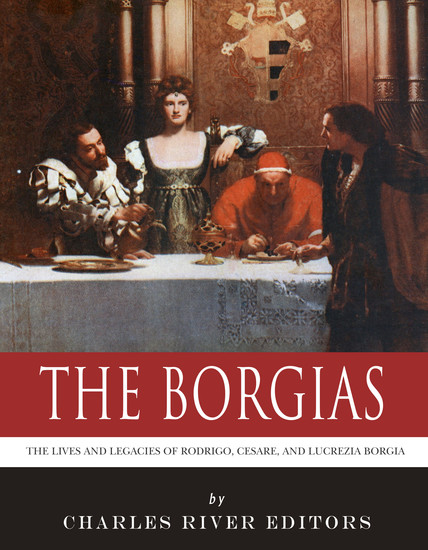
The Borgias - The Lives and Legacies of Rodrigo Cesare and Lucrezia Borgia - cover

The Borgias - The Lives and Legacies of Rodrigo Cesare and Lucrezia Borgia

Editors Charles River

Publisher: Charles River Editors

  • 0
  • 0
  • 0

Summary

There have been no shortage of controversial Popes who were accused by Catholics and other Christians of impropriety, but the most controversial of all was the Borgia Pope, Alexander VI. Born Rodrigo Borgia, the future Pope made his way up the ranks of the Catholic Church with an assist from nepotism, breaking his vows of chastity and fathering several illegitimate children along the way.
 
The stories and legends attributed to Rodrigo and his children, particularly Cesare and Lucrezia, have made the Borgias one of the most notorious families in history. 500 years after Rodrigo’s death, he and his family have come to be associated more with incest, political intrigue, murder and state-sponsored violence. While 21st century TV series have cast the Borgias as the first organized crime family, the rumors spread by the family’s political opponents in the late 15th century have taken hold among a fascinated public. Did Cesare really have an incestuous relationship with Lucrezia? Did he really throw lavish orgies?
 
While Rodrigo may not have been as colorful or criminal as the enduring legends, there is no question he was manipulative, ruthless and, ultimately, effective. From an administrative standpoint, Rodrigo was a success as Pope Alexander VI, with a big assist from son Cesare. To the extent that the Borgias are still associated with murder and mayhem, it was the father and son whose actions can be credited with the lion’s share of the perception. Not surprisingly, almost everything about Rodrigo’s life is still up for debate.
 
In many ways, Cesare has been characterized as the “prince” Machiavelli tells his readers to be. As one translator of The Prince put it, Cesare is “cited as a type of the man who rises on the fortune of others, and falls with them; who takes every course that might be expected from a prudent man but the course which will save him; who is prepared for all eventualities but the one which happens; and who, when all his abilities fail to carry him through, exclaims that it was not his fault, but an extraordinary and unforeseen fatality.”
 
500 years after Cesare’s death, he and his family have come to be associated more with crime, specifically murder and state-sponsored violence. While 21st century TV series have cast the Borgias as the first organized crime family, the rumors spread by the family’s political opponents in the late 15th century have taken hold among a fascinated public. Did Cesare really have an incestuous relationship with sister Lucrezia? Did he really kill his own brother Giovanni (Juan)? While Cesare may not have been as colorful or criminal as the enduring legends, there is no question he was manipulative, ruthless and, for a short time at least, effective. He helped make his father's papacy a success, but his rise was as dramatic as his fall. 
 
History remembers Lucrezia Borgia in unflattering terms. She has been portrayed as an incestuous adulteress and a murderer, but her contemporaries thought of her in very different terms. Lucrezia was a political pawn in her father and brother's plots and a political power in her own right. She was well-educated and well-respected during her lifetime. While she was, in all certainty, a part of multiple political plots, she was also considered to be pious, thoughtful, and mannerly.  
 
While these facts reveal a very contradictory nature, it may very well have been impossible for Lucrezia to have lived any other way given her gender and position within the Borgia family. But as the German historian Ferdinand Gregorovius so aptly notes in the introduction of his biography of Lucrezia, the positive characteristics attributed to Lucrezia by her contemporaries have gone largely forgotten.
Available since: 06/24/2025.
Print length: 79 pages.
Other books that might interest you

  • Where Was God When I Needed Him Most? - Mother’s Promise Led Me to Christ - cover

    Where Was God When I Needed Him...

    David R. Clark

    • 0
    • 0
    • 0
    This book illustrates the powerful effect David Clark´s mother, Jan Clark, had on her son. Her influence began even before David was born. Jan’s pregnancy with David was terrifyingly difficult. Her doctor, due to his grave concerns for Jan’s life, felt compelled to do everything he could to terminate the pregnancy. Amidst these extreme circumstances, Jan made a promise to her unborn child that changed everything! 
    Follow David Clark as he recounts experiences in which his mother kept this promise and led him to Christ. Notwithstanding that foundation in Christ, however, David years later, found himself feeling isolated and abandoned by God when he became 100% disabled and bedridden due to his military service in Iraq. He went from being an award-winning lawyer, a decorated military officer, and an Elder in his church to becoming completely dependent on others. It was only when David began remembering what his mother taught him about Jesus Christ years earlier that he finally found the peace and rest that comes solely through the Lord. 
    In this book, you will learn:God hears and answers prayers.We can find peace in Christ, especially in our most heart-wrenching trials.Jesus does not give up on us, nor will He ever abandon us!The truth found in Proverbs 22:6 (“Train up a child in the way he should go: and when he is old, he will not depart from it.” KJV).The power parents can have when they share why they believe in God, how their faith has blessed their own lives and provide opportunities for their children to gain that knowledge and experience for themselves. 
    Clark offers inspiration from his personal experiences bringing out how his mother’s influence led him to Christ even amidst trials and adversity. To find out more, get a copy now!
    Show book
  • The Art of Cooking - A Chef’s Life Story - cover

    The Art of Cooking - A Chef’s...

    Peter C. Brenner Jr. CEC

    • 0
    • 0
    • 0
    “Ever since I was a toddler and learned how to crawl, I would enter the kitchen…. I would pull open drawers and search through the cabinets.”- Peter C. Brenner.Not everyone finds their passion early in life. But as a child, Peter loved exploring new things, and one day he found his mother cooking a delicious meal in the kitchen. That’s when he decided to become a world class Chef.So, what is it like to be a Chef at a star-rated hotel? Certainly nothing less than a messy adventure! MESSY for real.As you read through the book, you will find Peter’s dramatic life taking various turns as he tries to steer clear of turbulent times. However, life as a Chef is never easy and he is not able to set his feet on the ground for a long time.Once he does, life challenges him to let go of the comfort and instead pursue his lifelong idea of opening his own restaurant. That’s some risky business! Will he be able to do it?Read through the pages as you find Peter breezing through his life as a successful chef and introducing some recipes that hardly anyone in America has ever heard of.
    Show book
  • The Essential Fromm - Life Between Having and Being - cover

    The Essential Fromm - Life...

    Erich Fromm

    • 0
    • 0
    • 0
    Essays on human alienation, mode of existence, consumerism, narcissism, and more from "both a psychologist of penetration and a writer of ability" (Chicago Tribune). 


    As Erich Fromm points out, ours is "a life between having and being"—between mere having and healthy being, between destructiveness and creativity, between narcissism and productive self-understanding, between passivity and the joy of positive activity. 


    The alternatives of having and being are basic orientations of our character and determine our behavior. The mostly unpublished and unknown texts featured in The Essential Fromm encapsulate the psychologist's views on the fulfilling life. To put down roots yet remain free is what the late Erich Fromm called the art of being. It is the secret of happiness.
    Show book
  • Crocker's Hole - From their pens to your ears genius in every story - cover

    Crocker's Hole - From their pens...

    R D Blackmore

    • 0
    • 0
    • 0
    Richard Doddridge Blackmore was born on 7th June, 1825 at Longworth in Berkshire (now part of Oxfordshire), where his father, John Blackmore, was Curate-in-charge of the parish. His mother died a few months after his birth the victim of an outbreak of typhus. With this loss the family moved to Bushey, Hertfordshire, then on to their native Devon.  His elder brother Richard (by a year), however, was taken by his aunt to live near Oxford. His father married again in 1831, whereupon Richard returned to live with them.  With much of his childhood spent in the lush and pastoral "Doone Country" of Exmoor, and along the Badgworthy Water, Blackmore came to love the very countryside he immortalised in Lorna Doone.  In November 1853 he married his wife Lucy.  And the following year, 1854, his literary career began with a collection of Poems and for the next 15 years he would write in the winters and garden in the summers.  In 1860 with inherited money he built a house in Teddington just outside of London and established a market garden for the cultivation of fruit.  He loved horticulture but having little business experience could never really exploit it.  However with the publication of Lorna Doone in 1869 he was catapulted to fame.  And although he continued to write extensively nothing caught the public imagination quite like Lorna Doone.  RD Blackmore died at Teddington on 20th January, 1900 after a long and painful illness, and was buried next to his wife in Teddington cemetery.
    Show book
  • Who is Warren Buffett? - The Story of a Man Whose Investment Strategies Made Him a World Famous Billionaire But Whose Wisdom Made Him a Legend - cover

    Who is Warren Buffett? - The...

    Phil Cooper

    • 0
    • 0
    • 0
    “Never invest in a business you cannot understand” is a timeless quote from the world-famous investor Warren Buffett.  
    From an early age, Warren understood that “Price is what you pay, value is what you get.” In many ways, that is the secret to his success. 
    In this book, you’ll learn the strategies he uses - and that you can use yourself in your investing journey - to get extraordinary returns, including:Invest in what you loveFear is your friendTime is moneyAnd many more strategies! 
    Distilled in this book is timeless investing wisdom you must know. So be ready to never look at investing the same way again.
    Show book
  • Stars Staterooms and Stowaways - anecdotes from a colourful career in cruising - cover

    Stars Staterooms and Stowaways -...

    Gary Glading

    • 0
    • 0
    • 0
    Gary Glading's fascinating career on luxury cruise chips has seen him circumnavigate the globe several times. Over the years he has entertained passengers, interviewed celebrities and tended stray and sick animals at ports around the world. His extraordinary adventures include quelling a passenger mutiny, surviving a hurricane in the Atlantic, spending Christmas with a Hollywood legend and being marooned on a tropical island. Stars, Staterooms and Stowaways is a collection of amusing and sometimes moving anecdotes that offer an irresistible glimpse into the world of cruising before and after 9/11.
    Show book