Join us on a literary world trip!
Add this book to bookshelf
Grey
Write a new comment Default profile 50px
Grey
Subscribe to read the full book or read the first pages for free!
All characters reduced
The Biggest Civil War Battles of 1863 - Stones River Chancellorsville Gettysburg Vicksburg Chickamauga and the Chattanooga Campaign - cover

The Biggest Civil War Battles of 1863 - Stones River Chancellorsville Gettysburg Vicksburg Chickamauga and the Chattanooga Campaign

Editors Charles River

Publisher: Charles River Editors

  • 0
  • 0
  • 0

Summary

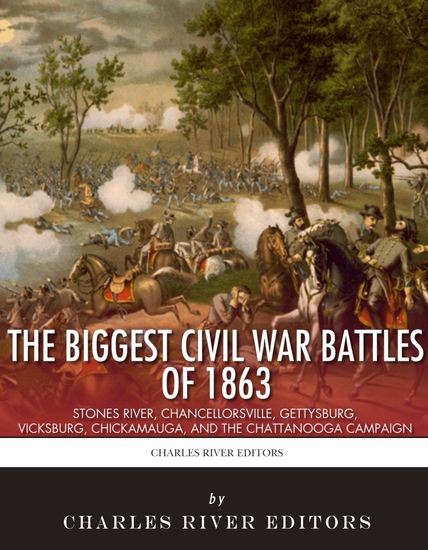
Americans have long been fascinated by the Civil War and its biggest battles, particularly Gettysburg, Antietam, and Shiloh, all of which involved Robert E. Lee or Ulysses S. Grant. But one of the 6 biggest battles of the war, and the one that took the heaviest toll by % on both armies was fought at the end of 1862 in Tennessee, and it involved neither of those generals.
 
In late December 1862, William Rosecrans’s Union Army of the Cumberland was contesting Middle Tennessee against Braxton Bragg’s Army of Tennessee, and for three days the two armies savaged each other as Bragg threw his army at Rosecrans in a series of desperate assaults. Bragg’s army was unable to dislodge the Union army, and he eventually withdrew his army after learning that Rosecrans was on the verge of receiving reinforcements. Though the battle was stalemated, the fact that the Union army was left in possession of the field allowed Rosecrans to declare victory and embarrassed Bragg.
 
Though Stones River is mostly overlooked as a Civil War battle today, it had a decisive impact on the war. The two armies had both suffered nearly 33% casualties, an astounding number in 1862 that also ensured Rosecrans would not start another offensive campaign in Tennessee until the following June.
 
Lee’s heavily outnumbered army won the most stunning victory of the war at Chancellorsville, but it cost them Stonewall Jackson. Moreover, the reorganization of the armies and the battle itself played an influential role in the way the Pennsylvania Campaign and the Battle of Gettysburg unfolded later that summer.
 
After the South had lost the war, the importance of Gettysburg as one of the “high tide” marks of the Confederacy became apparent to everyone, making the battle all the more important in the years after it had been fought. While former Confederate generals cast about for scapegoats, with various officers pointing fingers at Robert E. Lee, James Longstreet, and James Stuart, historians and avid Civil War fans became obsessed with studying and analyzing all the command decisions and army movements during the entire campaign. Despite the saturation of coverage, Americans refuse to grow tired of visiting the battlefield and reliving the biggest battle fought in North America.
 
At the start of 1863, Robert E. Lee’s Army of Northern Virginia had been frustrating the Union in the Eastern theater for several months, but the situation in the West was completely different. The Confederates had lost control of several important states throughout 1862, and after New Orleans was taken by the Union, the North controlled almost all of the Mississippi River, which Confederate general James Longstreet called “the lungs of the Confederacy”. By taking control of that vital river, the North would virtually cut the Confederacy in two, putting the South in a dire situation.
 
The only domino left to fall was the stronghold of Vicksburg, and both sides knew it. The Union Army of the Tennessee, led by Ulysses S. Grant, would spend months trying to encircle the army and eventually force John Pemberton’s Confederate army to surrender. Grant eventually succeeded on July 4, 1863, but since it came a day after the climactic finish of the Battle of Gettysburg, Vicksburg was (and still is) frequently overlooked as one of the turning points of the Civil War. In fact, had the Confederate’s military leadership listened to Longstreet, who advocated detaching soldiers from Lee’s army to head west and help the Confederates deal with Grant or Rosecrans in that theater, the Battle of Gettysburg might never have happened.
Available since: 05/02/2025.
Print length: 289 pages.

Other books that might interest you

  • The Harvey Girls - Women Who Opened the West - cover

    The Harvey Girls - Women Who...

    Lesley Poling-Kempes

    • 0
    • 0
    • 0
    The award-winning history of the women who went West to work in Fred Harvey's restaurants along the Santa Fe railway—and went on to shape the American Southwest 


    From the 1880s to the 1950s, the Harvey Girls went west to work in Fred Harvey's restaurants along the Santa Fe railway. At a time when there were "no ladies west of Dodge City and no women west of Albuquerque," they came as waitresses, but many stayed and settled, founding the struggling cattle and mining towns that dotted the region. Interviews and historical research help recreate the Harvey Girl experience. The accounts are personal, but laced with the history the women lived: the dust bowl, the depression, and anecdotes about some of the many famous people who ate at the restaurants—Teddy Roosevelt, Shirley Temple, Bob Hope, to name a few. 


    The Harvey Girls was awarded the winner of the 1991 New Mexico Press Women's ZIA award.
    Show book
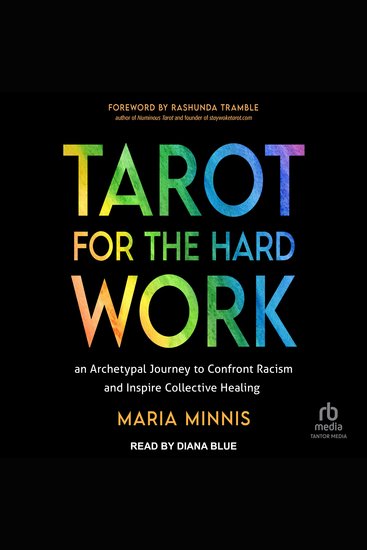
  • Tarot for the Hard Work - An Archetypal Journey to Confront Racism and Inspire Collective Healing - cover

    Tarot for the Hard Work - An...

    Maria Minnis, Rashunda Tramble

    • 0
    • 0
    • 0
    Tarot has always been a powerful guide for introspection and inner work, so what better tool to use when we're ready to do the really hard work? Author Maria Minnis takes a radical new look at the Major Arcana in this tarot workbook, which provides listeners a unique, personal understanding of systemic racism—and what steps we can take to begin to dismantle it. This book says tarot can be a tool for action, one that may offer great satisfaction as well as great difficulty, all while pushing you out of your comfort zone. 


    You'll explore the Major Arcana to uncover how each archetype can help cultivate a freer, anti-racist world. It will consider the upright, or benevolent, aspects of each card and how listeners can use those themes to dismantle internalized racism, racism in our relationships, and racism in our communities. As you move from the Fool to the World card, you'll discover that everything we do ripples beyond us, and that there are practical ways to change our actions and perspectives. 


    This is a book that speaks to both white and BIPOC audiences. The author addresses the human community as a whole and how racism affects our relationships to each other, to our communities, and to our institutions. This book addresses how the energy can be turned around into self-awareness, self-love, and positive action.
    Show book
  • Steve McQueen & Charles Bronson: The Lives and Careers of the Top Action Stars of the 1970s - cover

    Steve McQueen & Charles Bronson:...

    Editors Charles River

    • 0
    • 0
    • 0
    In the 1960s and 1970s, no actor personified cool, calm and collected like Steve McQueen, whose suave anti-hero protagonists made men jealous and women swoon. As actor Donald Logue puts it in The Tao of Steve, “Steve is the prototypical cool American male. He's the guy on his horse, the guy alone. He has his own code of honor, his own code of ethics, his own rules of living. He never, ever tries to impress the women, but he always gets the girl." And indeed, that was the case not only in movies like The Thomas Crown Affair, Bullitt, The Getaway, and Papillon, but also in real life. Actress Ali MacGraw, who later became one of his wives, described his effect on women: "I remember seeing him across the swimming pool and my knees were knocking. He radiated such macho energy. Men wanted to be like him. Uptight society ladies and biker molls wanted to be with him." But unlike many actors who become this type of heartthrob, McQueen seemed to have the bona fides.   
    To accompany the rough-hewn appearance of Charles Bronson’s new class of hero, the typical script gave his remarkably enduring persona little to say in terms of dialogue that would reveal his inner thoughts. With minimal text, even those he attempts to help are unsure of his intentions, and few clues are offered by which the viewer can come to know his mind. As the grotesqueness of his characters’ violent acts increased, so did the heinous deeds of the criminals he fought, upping the ante to an eager public in search of a simple cure for its social ills. In a career of almost eighty films and a total body of work totaling 160 appearances including television, Bronson pushed the envelope of what graphic action the studios were willing to offer, what the censors would accept, and what the sensibilities of movie-goers were able to endure more than anyone in his era.
    Show book
  • German and Allied Air Forces in World War I: The History and Legacy of the Rivals in the Sky during the Great War - cover

    German and Allied Air Forces in...

    Editors Charles River

    • 0
    • 0
    • 0
    One of the most important breakthroughs in military technology associated with World War I, and certainly the one that continues to capture the public imagination, was the use of airplanes, which were a virtual novelty a decade before. While the war quickly ground to a halt in its first few months, the skies above the Western Front became increasingly busy. The great powers had already been acquiring aircraft for potential uses, but given that aerial warfare had never been a major component of any conflict, it’s understandable that few on either side had any idea what the planes were capable of doing. Furthermore, at the start of the war, all sides’ aircraft were ill-equipped for combat mostly because the idea that planes might somehow fight was still a novel one, and the adaptations had not yet been developed that would allow the aerial battles later in the war.  
    	As a result, aircraft were used almost entirely for reconnaissance early on, allowing generals to gain unprecedented levels of information about enemy movements. Such intelligence allowed the French to counter German movements in what became the First Battle of the Marne, ending Germany’s hopes for victory through the Schlieffen plan. Similarly, in the east, German planes were vital in tracking, encircling and destroying Russian forces at Tannenberg. 
    	The Royal Air Force (RAF), Britain's legendary air arm, was born in the skies above the First World War. The British had previously used balloons for spotting and reconnaissance for decades, and in the years leading up to the war, planes started seeing military use. They mostly provided reconnaissance, though experiments were made in using them offensively. During the Boer War of 1899-1902, the British Army used the crews of helium-filled balloons to plot and help target artillery fire. But these were small, tentative steps. The first patent to fit a machine gun to a plane, taken out in 1910, had not yet led to active fighting vehicles.
    Show book
  • EMPATH HEALING - A Survival Guide for Sensitive People (130 Self-care Tips to Relieve Anxiety Recharge and Thrive in Life) - cover

    EMPATH HEALING - A Survival...

    Alison L. Alverson

    • 1
    • 1
    • 1
    Discover 130 Life-Changing Self-Care Practices to Protect Your Energy in This Overwhelming World! 
    Do you always find yourself in tune with the emotions of others? 
    Do you feel as if being an empath is more draining than it is rewarding? 
    Do you have trouble setting boundaries or speaking up for yourself when needed? 
    If you’ve answered “yes” to all of these questions, that means that you have the amazing gift of being an Empath — someone who is highly sensitive and attuned to the emotions of others. 
    It's hard enough dealing with our own emotions, but when we add the stress of other people's energy to the mix, it can be downright overwhelming. 
    Empath Healing is the survival guide written just for you! 
    This powerful guide is packed with 130 self-care tips to help relieve anxiety, recharge, and protect your energy.  
    You’ll also be able to protect yourself from the stressfulness of an overwhelming world and embrace your gift with open arms so you can finally become comfortable in your own skin. 
    You’ll discover:Natural ways to recharge your energy and stay balancedThe Secrets to True HealingThe best practices to deal with your emotions and healing traumaTried-and-tested methods to protect your energy from being taintedHow to keep your body in its best formTips and tricks to utilize the power of spiritual healing toolsplus, much more 
    Start your transformative journey towards emotional freedom and balance with Empath Healing today! 
    You’ll love this practical guide because this book will serve as your support system to help you become a compassionate, protected, and empowered empath. 
    Get It Now!
    Show book
  • Treatise of Human Nature A: Book Summary & Analysis - cover

    Treatise of Human Nature A: Book...

    Briefly Summaries

    • 0
    • 0
    • 0
    This is a concise summary and analysis of A Treatise of Human Nature, by David Hume.
    It is not the original book and is not affiliated with or endorsed by David Hume.
    Ideal those seeking a quick and insightful overview.
     
    An Inquiry into Human Nature offers a profound exploration of the foundations of human thought, emotions, and actions. This landmark work examines the principles of knowledge, morality, and human psychology, presenting a revolutionary perspective on reason, perception, and belief. Through sharp analysis and philosophical inquiry, it challenges traditional assumptions about the self, identity, and society, making it an enduring masterpiece in the study of philosophy. Ideal for anyone seeking to understand the origins of modern thought, this treatise delves into the complexities of human experience with unparalleled depth and clarity.
    Show book