Join us on a literary world trip!
Add this book to bookshelf
Grey
Write a new comment Default profile 50px
Grey
Subscribe to read the full book or read the first pages for free!
All characters reduced
The Battle of the Little Bighorn - The History and Controversy of Custer’s Last Stand - cover

The Battle of the Little Bighorn - The History and Controversy of Custer’s Last Stand

Editors Charles River

Publisher: Charles River Editors

  • 0
  • 0
  • 0

Summary

"When I was a boy the Sioux owned the world. The sun rose and set on their land; they sent ten thousand men to battle. Where are the warriors today? Who slew them? Where are our lands?   Who owns them? Is it wrong for me to love my own? Is it wicked for me because my skin is red?  Because I am Sioux? Because I was born where my father lived? Because I would die for my people and my country?” – Sitting Bull
 
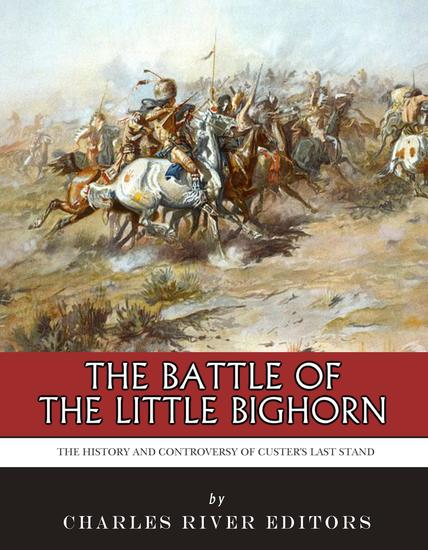
Since the Battle of the Little Bighorn, George Armstrong Custer has possessed one of the most unique places in American history. Although he was a capable cavalry officer who served honorably during the Civil War, he remains one of the most instantly identifiable and famous military men in American history due to the fact he was killed during one of the country’s most well known and ignominious defeats, the Battle of Little Bighorn. At the same time, this one relatively insignificant battle during America’s Indian Wars has become one of the country’s most mythologized events and continues to fascinate Americans nearly 140 years later.
 
On the morning of June 25, Custer’s scouts discovered a Native American village about 15 miles away in the valley of the Little Bighorn River.  Choosing to disregard his superiors’ orders to wait for a concerted effort, the grandstanding Custer intended to deliver his own decisive victory by dividing his command into three units, an extremely bold tactic when done in the face of a much larger force. Due to their belief in the inferiority of the Plains Indians, and mindful of previous Indian tactics that sought to avoid pitched battle, Custer and his men were most concerned with forcing the action and failed to understand the true nature of the situation they had entered. The Native American gathering, centered around the famous Sioux chief Sitting Bull, numbered roughly 8,000 individuals, and about 2,000 of them were warriors. Custer’s forces amounted to a mere 31 officers, 566 troopers, and 50 scouts and civilians, and they had been split into three columns in order to stop a possible retreat.
 
Before the battle, it is believed Custer thought he was facing a group of about 800, which was Sitting Bull’s strength in the weeks before the battle. However, the Army’s Native American scouts and civilian scouts had not adequately informed the Army of the reinforcements that arrived, and at Little Bighorn, Custer’s three-pronged attack was completely overwhelmed. How Custer met his fate, and whether there even was a Last Stand, remain subjects of debate, but what is known is that the Battle of the Little Bighorn was one of the U.S. military’s biggest debacles. All told, the 7th Cavalry suffered over 50% casualties, with over 250 men killed and over 50 wounded. The dead included Custer's brothers Boston and Thomas, his brother-in-law James Calhoun, and his nephew Henry Reed. Custer and his men were buried where they fell.  A year later, Custer’s remains (or more accurately, the remains found in the spot labeled with his name) were relocated to West Point for final interment.
 
The Battle of the Little Bighorn: The History and Controversy of Custer’s Last Stand comprehensively covers the entire campaign leading up to the decisive battle, analyzes the decisions made by the battle’s most important leaders, and explains the controversial aftermath and legacy of the fighting. Along with a bibliography and pictures of important people and places, you will learn about the Battle of the Little Bighorn like you never have before, in no time at all.
 
 
Available since: 05/02/2025.
Print length: 44 pages.

Other books that might interest you

  • Coronavirus Oppression - cover

    Coronavirus Oppression

    Raphael Terra

    • 0
    • 0
    • 0
    This audiobook has been recorded using Text to speech (TTS). 
     
    We have been terrified into submission. Words like pandemic and images of horror have been thrust upon us. It is all a scam. A lie. It is part of a long-term plot to control, manipulate and enslave mankind. 
     
    A divided world has been brought together under a common threat and it is just the beginning. 
     
    There are massive, global revolutions being created and fostered by a powerful, dark and sinister group that have directed the sheep for countless generations. Very soon you will be asked to do things you would never have contemplated before and you will do them gladly. 
     
    This is the story of how your freedoms and liberties are being taken away from you without you even caring. In fact you will be happy to lose them. And all because of a small virus created by that same elite group and let loose upon mankind for a very malevolent end. 
     
    George Orwell said: "Political language is designed to make lies sound truthful and murder respectable, and to give an appearance of solidity to pure wind." This book will prove that he was right all along...
    Show book
  • The Timeline of Intelligent Life on Earth - cover

    The Timeline of Intelligent Life...

    Martin K. Ettington

    • 0
    • 0
    • 0
    I’m fascinated with Ancient History because there are continuous new discoveries which push back the dawn of civilization by thousands of years. In the last couple of decades, the discoveries at Gobekli Tepe in eastern Turkey pushed back man-made structures to the time period of 9,000-11,000 B.C. Thousands of years before the next know civilizations existed.This book includes my research on ancient sites around the world, underground structures, giants, the destruction of civilization about 10,500 B.C., the real Atlantis, and out of place objects which can be millions of years old.With this collection of a wide variety of information I decided that what is needed is a full timeline of intelligent life on Earth from millions of years ago to the present. There are a lot of gaps in this information but enough records, findings, and discoveries exist to propose an initial timeline of intelligent life on Earth going back hundreds of millions of years.Yes-I’m saying intelligent life has existed on Earth that long, and since humanity and even primates don’t exist in those times at all, aliens must have lived on the Earth at that time. There are three parts to this book:Part One - Millions of Years AgoThis includes stories of aliens existing on Earth in our history, and many out of place objects made by intelligent beings, and the fossil record which provides supporting evidence that intelligent life did exist at those times.Part Two - The Unknown Civilizations of ManHere we have evidence of structures built by man but way before any accepted records that civilization or man made constructions existed. Some of these things may go back 100,000 years ago.Part Three – Post Ice Age CivilizationsThis part includes evidence that the Younger Dryas event was actually comets striking the Earth which caused major disasters and probably the destruction of civilizations about 10,500 B.C.My intention is that this timeline will provide a skeleton to be filled in.
    Show book
  • Ancient Egypt - Pharaohs Pyramids and the Cradle of Civilization - cover

    Ancient Egypt - Pharaohs...

    Rolf Hedger

    • 0
    • 0
    • 0
    The Nile River was the lifeblood of ancient Egypt, shaping its civilization, economy, and culture. Flowing over 4,000 miles from the heart of Africa to the Mediterranean Sea, the river provided a reliable source of water in an otherwise arid landscape. Without the Nile, Egypt as we know it would not have existed. 
    Each year, the river’s annual flooding deposited nutrient-rich silt onto the surrounding land, creating fertile soil ideal for agriculture. This natural cycle allowed the Egyptians to grow crops such as wheat, barley, and flax, sustaining a thriving population. The predictability of the flooding led to the development of an agricultural calendar, which played a crucial role in the organization of society. Farmers planted their crops after the waters receded and harvested them before the next flood, ensuring a steady food supply. 
    Beyond agriculture, the Nile was also Egypt’s main highway. With deserts on either side of the river, travel by land was difficult, but the Nile provided an efficient means of transportation. Boats carried goods, people, and even large stone blocks for temple and pyramid construction. Trade flourished as the Egyptians exchanged gold, papyrus, and linen for exotic products from neighboring regions, including spices from the east and cedarwood from Lebanon.
    Show book
  • Exemplary Jews and Christians who became Sahabah - cover

    Exemplary Jews and Christians...

    Gregory Heary

    • 0
    • 0
    • 0
    How did personal convictions lead to religious revolutions in the lives of the Sahabah? Explore the transformative power of belief through the lives of those who walked with the Prophet.The Sahabah are the Muslim companions of the Prophet Muhammad. This category of people are known as Ahl-Kitab Sahabah because they had previously believed in the previous Islamic prophets such as Moses and Jesus as well as books of divine revelation prior to meeting Muhammad and confirming his message as the God-given truth. These were the contemporary disciples of Muhammad who were Jews and Christians who met him and became Muslims.  In the heart of Islamic history, former Jews and Christians like Abdullah bin Salam and Salman al-Farsi changed their entire worldviews, embracing Islam after profound encounters with the Prophet Muhammad. The author, a former Christian who became Muslim himself, brings these stories to life, highlighting the themes of wisdom, humility, and the quest for truth. The narratives are embedded with historical contexts, showing how personal journeys of faith and conversion contributed to the spread and enrichment of Islam. By turning the pages of this book, you engage with stories that not only recount historical facts but also inspire personal reflection and societal understanding.
    Show book
  • Gettysburg Campaign The: The History and Legacy of the Civil War’s Most Famous Campaign - cover

    Gettysburg Campaign The: The...

    Editors Charles River

    • 0
    • 0
    • 0
    “The failure to crush the Federal army in Pennsylvania in 1863, in the opinion of almost all of the officers of the Army of Northern Virginia, can be expressed in five words: the absence of the cavalry.” – Confederate General Henry Heth 
    Without question, the most famous battle of the American Civil War took place outside of the small town of Gettysburg, Pennsylvania, which happened to be a transportation hub, serving as the center of a wheel with several roads leading out to other Pennsylvanian towns. From July 1-3, Robert E. Lee’s Confederate Army of Northern Virginia tried everything in its power to decisively defeat George Meade’s Union Army of the Potomac, unleashing ferocious assaults that inflicted nearly 50,000 casualties in all. 
    Day 1 of the battle would have been one of the 25 biggest battles of the Civil War itself, and it ended with a tactical Confederate victory. But over the next two days, Lee would try and fail to dislodge the Union army with attacks on both of its flanks during the second day and Pickett’s Charge on the third and final day. Meade’s stout defense held, barely, repulsing each attempted assault, handing the Union a desperately needed victory that ended up being one of the Civil War’s turning points. 
    After the South had lost the war, the importance of Gettysburg as one of the “high tide” marks of the Confederacy became apparent to everyone, making the battle all the more important in the years after it had been fought. While former Confederate generals cast about for scapegoats, with various officers pointing fingers at Robert E. Lee, James Longstreet, and James Stuart, historians and avid Civil War fans became obsessed with studying and analyzing all the command decisions and army movements during the entire campaign. Despite the saturation of coverage, Americans refuse to grow tired of visiting the battlefield and reliving the biggest battle fought in North America.
    Show book
  • Imagination - A Manifesto - cover

    Imagination - A Manifesto

    Ruha Benjamin

    • 0
    • 0
    • 0
    A world without prisons? Ridiculous. Schools that foster the genius of every child? Impossible. Work that doesn't strangle the life out of people? Naive. A society where everyone has food, shelter, love? In your dreams. Exactly. 


    We have the power to use our imaginations to create a world in which everyone can thrive. But obstacles abound. We have inherited destructive ideas that trap us inside a dominant imagination. Consider how racism, sexism, and classism make hierarchies, exploitation, and violence seem natural and inevitable—but all emerged from the human imagination. 


    The most effective way to disrupt these deadly systems is to do so collectively. Ruha Benjamin highlights the educators, artists, activists, and many others who are refuting powerful narratives that justify the status quo, crafting new stories that reflect our interconnection, and offering creative approaches to seemingly intractable problems. 


    Imagination: A Manifesto offers visionary examples and tactics to push beyond the constraints of what we think, and are told, is possible. This book is for anyone who is ready to take to heart Toni Morrison's instruction: "Dream a little before you think."
    Show book