Join us on a literary world trip!
Add this book to bookshelf
Grey
Write a new comment Default profile 50px
Grey
Subscribe to read the full book or read the first pages for free!
All characters reduced
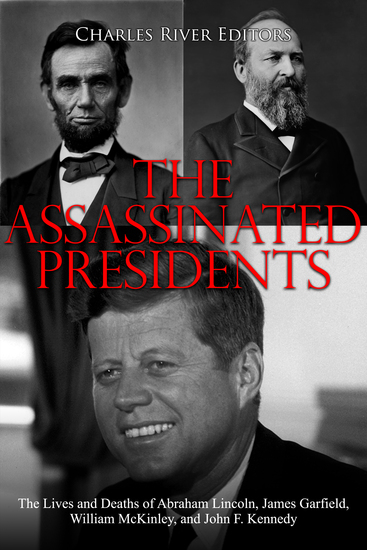
The Assassinated Presidents - The Lives and Deaths of Abraham Lincoln James Garfield William McKinley and John F Kennedy - cover

The Assassinated Presidents - The Lives and Deaths of Abraham Lincoln James Garfield William McKinley and John F Kennedy

Editors Charles River

Publisher: Charles River Editors

  • 0
  • 0
  • 0

Summary

Until April 14, 1865, John Wilkes Booth was one of the most famous actors of his time, and President Abraham Lincoln had even watched him perform. But his most significant performance at a theater did not take place on the stage. That night, Booth became one of history’s most infamous assassins when he assassinated President Lincoln at Ford's Theatre in Washington, D.C. 
 
After the shooting, during which it is believed he broke his leg, Booth fled south on horseback, with authorities hot on his tail. 12 days later, while he was at a farm in rural northern Virginia, Booth was tracked down and shot by Boston Corbett, a Union soldier who acted against orders. Eight others were tried for their alleged involvement in the plot and convicted, and four were hanged shortly thereafter as a result of some of the nation’s most famous trials.
 
In 1880, Garfield ran as a Republican for president, and one of his supporters was a man named Charles Guiteau, who wrote and circulated a speech called “Garfield vs. Hancock” that aimed to rally support for the Republican candidate. Though few knew it, Guiteau’s family had already deemed him insane and attempted to keep him committed in an asylum, only to have him manage an escape from confinement. 
 
Despite lobbying around Republican headquarters in New York City and even approaching Cabinet members, no post was forthcoming for the troubled man. Eventually, in May 1881, Secretary of State James Blaine told him to never show up again. Enraged by the perceived slight, Guiteau bought a revolver and plotted to kill the president. He got his chance on July 2, 1881 at a railroad station, shooting Garfield in the back twice and bragging to the authorities, "I am a Stalwart of the Stalwarts...Arthur is president now!"
 
President James Garfield had been assassinated just 20 years earlier, but McKinley didn’t worry about presidential security or his own safety, and that was the case in Buffalo. McKinley’s insistence on greeting the public and shaking hands allowed Czolgosz to walk up to him on September 6, 1901 at a public reception in the Temple of Music on the expo grounds and shoot him point blank, with one bullet grazing the president and another lodging in his abdomen. In the aftermath of the shooting, as Czolgosz was beaten and seized by the crowd, he uttered, "I done my duty." For his part, McKinley said, “He didn't know, poor fellow, what he was doing. He couldn't have known."
 
Despite being president, McKinley’s medical services were shoddy, and given the still primitive medical standards of the early 20th century, gunshots to the abdomen often brought death. One of the best known aspects of the assassination is that Thomas Edison’s x-ray machine was on hand and may have been used to try to locate the bullet that doctors couldn’t find, but for reasons that remain unknown, the x-ray machine was not used.
 
In many ways, John Fitzgerald Kennedy and his young family were the perfect embodiment of the ‘60s. The decade began with a sense of idealism, personified by the attractive Kennedy, his beautiful and fashionable wife Jackie, and his young children. Months into his presidency, Kennedy exhorted the country to reach for the stars, calling upon the nation to send a man to the Moon and back by the end of the decade. In 1961, Kennedy made it seem like anything was possible, and Americans were eager to believe him. The Kennedy years were fondly and famously labeled “Camelot,” by Jackie herself, suggesting an almost mythical quality about the young President and his family.
 
As it turned out, the ‘60s closely reflected the glossy, idealistic portrayal of John F. Kennedy, as well as the uglier truths. The country would achieve Kennedy’s goal of a manned moon mission, and the landmark Civil Rights Act of 1964 finally guaranteed minorities their civil rights and restored equality, ensuring that the country “would live out the true meaning of its creed.” 
Available since: 05/01/2025.
Print length: 299 pages.

Other books that might interest you

  • The Way They Were - How Epic Battles and Bruised Egos Brought a Classic Hollywood Love Story to the Screen - cover

    The Way They Were - How Epic...

    Robert Hofler

    • 0
    • 0
    • 0
    It's one of the greatest movie romances of all time. Yet the friction and controversy surrounding The Way We Were was so enormous, the movie was nearly never made at all. 


    Screenwriter Arthur Laurents wrote the role of Katie with Barbra Streisand in mind. Casting Hubbell was another matter. Robert Redford, already a superstar, was reluctant to play what he perceived as the "Ken doll" to Streisand's lead, and demanded his role be changed and expanded. Laurents resisted, telling director Sydney Pollack, "You'll ruin the movie if it ends up being about two people. It's Katie's story, not Hubbell's." Despite his protests, ten writers were brought on to rework the script. 


    Laurents's fears were well founded, and the first preview was disastrous. Producer Ray Stark and Pollack cut several scenes, upsetting Streisand and Laurents. Yet the edits worked. Such was the movie's success that Redford was open to making a sequel, though the script was never greenlit. 


    Drawing on Laurents's and Pollack's unpublished writings, as well as interviews with Streisand, Redford, and other key players, this is the definitive account of a film that changed the rules of moviemaking and defined romance ever since.
    Show book
  • Best Life After - An Ex Jehovah's Witness Memoir - cover

    Best Life After - An Ex...

    Correen Hardin

    • 0
    • 0
    • 0
    Jehovah’s Witnesses promised me they could offer the best life ever. 
    A life where every question had an answer. Every pain had a purpose. Every flaw had a fix. 
    They told me that if I stayed faithful, followed the rules, suppressed my doubts, and endured the shame, I’d be rewarded with paradise, with peace, with love. 
    And I believed them. Because I was already carrying the weight of not being enough. I thought obedience could earn me love. That being good could make me worthy. I wasn’t born into the religion, but I was born into the conditions that made it feel like salvation. 
    What they offered felt familiar: conditional love dressed as truth. 
    A place to belong… as long as I didn’t become too much. 
    So I tried. I gave them my voice, my body, my mind, and the years I’ll never get back. I submitted. I silenced myself. I followed the rules. 
    And still, it was never enough. 
    This book is not just about leaving Jehovah’s Witnesses. 
    It’s about untangling the lie that love must be earned. 
    It’s about the painful, beautiful, messy process of learning how to belong to myself. 
    They promised me the best life ever. 
    But what I found was something they couldn’t offer. 
    I found the best life after.
    Show book
  • You Will Find Your People - How to Make Meaningful Friendships as an Adult - cover

    You Will Find Your People - How...

    Lane Moore

    • 0
    • 0
    • 0
    From Lane Moore, the critically acclaimed author of How to Be Alone, comes an intimate yet achingly funny guide on how to make meaningful friendships as an adult. 
     
    Like many people navigating adulthood, Lane Moore thought she would have friends by now.  
     
    Movies, books, and TV shows tell us we should’ve already found our people by the time we’re adults, or there must be something wrong with us. But where do you find these close friends once you’ve left high school or college? Is it even possible? 
     
    You Will Find Your People is the groundbreaking guide to making—and keeping—the friends we’ve all been desperately waiting for. In this unflinching, poignant follow-up to her book Ho w to Be Alone, Moore shows us how to make real friends as an adult, cope with friend breakups, navigate  
    friendships with coworkers, roommates, and family members, and provides real tools on how to create healthy boundaries with friends to deepen your bonds. Through hilarious personal anecdotes and hard-won wisdom, Moore teaches us how to finally work through our fears and past hurts  
    to bravely cultivate and maintain the lifelong friendships we deserve. 
     
    This audiobook includes a bonus chapter written by the author exclusively for the audio edition!
    Show book
  • Understanding Sartre - cover

    Understanding Sartre

    Véronique Bergen

    • 0
    • 0
    • 0
    How can we interrogate Sartre's thought, which embraced philosophy, the novel, theater and the century, and tied conceptual adventure to political commitment? How can we dust off Sartre's clichés? In what way are we heirs to the new way of philosophizing that he instigated, to this new way of posing problems? In other words, in what way is Sartre our contemporary? This essay sets out to answer these questions through an original line of inquiry, confronting Sartre's philosophy of the opposition between man and the world with the thoughts of Spinoza, Nietzsche and Deleuze, to envisage the possibility of a politics resolutely turned towards a post-humanist ecology.
    Show book
  • Montesquieu - The Spirit of Laws Revisited - cover

    Montesquieu - The Spirit of Laws...

    Hector Davidson

    • 0
    • 0
    • 0
    Montesquieu, a French philosopher of the Enlightenment, is best known for his seminal work The Spirit of Laws (De l’esprit des lois), published in 1748. His insights into the relationship between law, society, and government laid the foundations for modern political science and deeply influenced subsequent political thought, particularly in the development of constitutional design and theory. Montesquieu’s work was groundbreaking, challenging prevailing ideas about governance, liberty, and the rule of law, offering a complex framework that would shape political thought for centuries. 
    Born in 1689, Montesquieu came from a noble family and was educated in law. His early career included service as a magistrate, which exposed him to the workings of the legal system and provided firsthand experience with the exercise of power. This practical knowledge informed his later philosophical work, as he sought to understand the connections between law and society, as well as the impact of political structures on individual liberty. 
    In The Spirit of Laws, Montesquieu examined a wide variety of political systems, including republics, monarchies, and despotisms, and their corresponding legal frameworks. His most famous contribution to political thought was his theory of the separation of powers, in which he argued that to prevent tyranny, government power should be divided into distinct branches—executive, legislative, and judicial—each with separate functions and the ability to check the other branches. This framework has become a central tenet of modern democratic systems, including the U.S. Constitution.
    Show book
  • Top 10 Short Stories The - The English - The top ten Short Stories of all time written by English authors - cover

    Top 10 Short Stories The - The...

    Charles Dickens, George Eliot, D...

    • 0
    • 0
    • 0
    Short stories have always been a sort of instant access into an author’s brain, their soul and heart.  A few pages can lift our lives into locations, people and experiences with a sweep of landscape, narration, feelings and emotions that is difficult to achieve elsewhere. 
     
    In this series we try to offer up tried and trusted ‘Top Tens’ across many different themes and authors. But any anthology will immediately throw up the questions – Why that story? Why that author?  
     
    The theme itself will form the boundaries for our stories which range from well-known classics, newly told, to stories that modern times have overlooked but perfectly exemplify the theme.  Throughout the volume our authors whether of instant recognition or new to you are all leviathans of literature. 
     
    Some you may disagree with but they will get you thinking; about our choices and about those you would have made.  If this volume takes you on a path to discover more of these miniature masterpieces then we have all gained something. 
     
    An impossible choice.  An endless feast of talents.  Within these 10 stories are all the glory, the ambition and talent of authors that are now known and beloved by us all.  Genius in every name. 
     
    01 - The Top Ten - The English - An Introduction 
    02 - The Signalman by Charles Dickens 
    03 - The Lifted Veil - Part 1 by George Eliot 
    04 - The Lifted Veil - Part 2 by George Eliot 
    05 - They by Rudyard Kipling 
    06 - An Unwritten Novel by Virginia Woolf 
    07 - The Mortal Immortal by Mary Shelley 
    08 - The Rocking Horse Winner by D H Lawrence 
    09 - The Interlopers by Saki the pseudonym for H H Munro 
    10 - The Informer by Joseph Conrad 
    11 - The Old Nurses Story by Elizabeth Gaskell 
    12 - The Fiddler of the Reels by Thomas Hardy
    Show book