Join us on a literary world trip!
Add this book to bookshelf
Grey
Write a new comment Default profile 50px
Grey
Subscribe to read the full book or read the first pages for free!
All characters reduced
Symbols of Defiance - The Lives and Legacies of Geronimo Sitting Bull and Crazy Horse - cover

Symbols of Defiance - The Lives and Legacies of Geronimo Sitting Bull and Crazy Horse

Editors Charles River

Publisher: Charles River Editors

  • 0
  • 0
  • 0

Summary

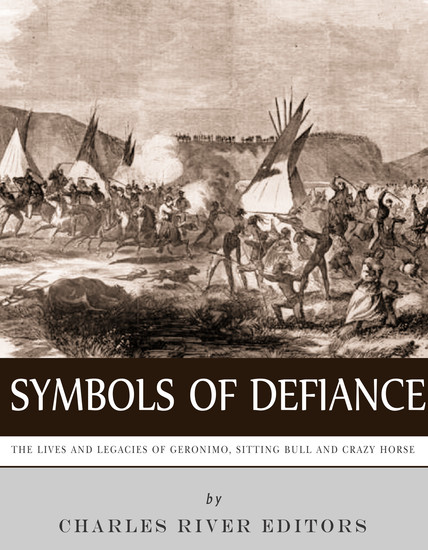
The name “Geronimo” evokes a number of different emotions. Those who believed in 19th century America’s “Manifest Destiny” viewed Geronimo and all Native Americans as impediments to God’s will for the nation. Descendants of people killed by “hostile” Natives certainly considered warriors like Geronimo to be murderers and thieves whose cultures and societies held no redeeming values. Even today, many Americans associate the name Geronimo with a war cry, and the name Geronimo itself only came about because of a battle he fought against the Mexicans.
 
Over time, however, the historical perception of the relationship between America and Native tribes changed drastically. With that, Geronimo, or Goyahkla, was viewed in a far different light. Those who empathized with the fate of the Native Americans saw Geronimo as one of a number of Native American leaders who resisted the U.S. and Mexican governments as their lands were being appropriated, often eluding large numbers of soldiers pursuing them. Unfortunately, Geronimo’s story and that of his people is very similar to those of the majority of Native American peoples. It is a history of theft, murder, and misunderstanding that eventually led to the complete domination of Native Americans throughout both North and South America.
 
Sitting Bull ensured he would become a legend at the Battle of the Little Bighorn, during which an estimated 2,000 Lakota and Cheyenne warriors inspired by one of his visions routed and then annihilated the 7th U.S. Cavalry led by George Custer. That disaster led the American government to double down on its efforts to “pacify” the Sioux, and by the end of the decade many of them had surrendered and been moved onto a reservation. Sitting Bull defiantly refused to surrender, instead heading with a smaller band into Canada and remaining exiled.
 
When he finally surrendered to the U.S. in 1881, he was a celebrity of sorts, and Sitting Bull went on to appear in Buffalo Bill Cody’s Wild West Show during the decade. Not surprisingly, his death was as controversial as his life; in 1890 Sitting Bull was killed on a reservation after plans to arrest him went terribly awry, leading to fighting in the aftermath that left over a dozen dead.
 
Crazy Horse may have fervently wished to avoid white settlers, but he’s a Native American icon today because of the inability to do so. Like Geronimo in the Southwest and Sitting Bull on the Plains, Crazy Horse was a chief who fought in several skirmishes against settlers and U.S. forces during the 1860s, and he became one of the most famous Native Americans in American history because of one fateful confrontation with whites: the legendary Battle of the Little Bighorn, during which an estimated 2,000 Lakota and Cheyenne warriors routed and then annihilated the 7th U.S. Cavalry led by George Custer. That disaster led the American government to double down on its efforts to “pacify” the Plains, and by the end of the decade many of them had surrendered and been moved onto a reservation. Like Sitting Bull, Crazy Horse tried to avoid surrendering for as long as he could, and both suffered a controversial death.  
 
Symbols of Defiance looks at the famous warrior who led at Little Bighorn, but it also humanizes the man who became one of the most famous symbols of defiance in American history. Along with pictures of important people, places, and events, you will learn about Crazy Horse like you never have before, in no time at all.
Available since: 06/21/2025.
Print length: 86 pages.


Other books that might interest you

  • Foreign Invaders of Ancient Egypt The: The History of the Hyksos Sea Peoples Nubians Babylonians and Assyrians - cover

    Foreign Invaders of Ancient...

    Editors Charles River

    • 0
    • 0
    • 0
    From approximately 3100 BCE until around 1075 BCE, ancient Egypt was ruled by 20 different dynasties. The length of the dynasties varied: some, such as those during the First and Second Intermediate periods could be quite short, while the Thirteenth and 18th Dynasties each contained more a one dozen kings and ruled over the Nile Valley for around 200 years each. Although the first 20 Egyptian dynasties varied in number of rulers and length, most shared one important attribute: they were all native Egyptian dynasties. The one important exception came during Egypt’s Second Intermediate Period, when a mysterious foreign group of people, known as the Hyksos, conquered Egypt and established the Fifteenth and Sixteenth Dynasties some time shortly after 1700 BCE. For centuries, the Hyksos rule over Egypt was an enigma shrouded in half-truths and myth. It was only in the mid-20th century that Egyptologists, using newly discovered and translated texts, shed fresh light on the Hyksos to reveal details about their origins and rule in Egypt. 
    The transition from the Bronze to the Iron Age during the late 13th and early 12th centuries BCE arguably changed the structure and course of world history more fundamentally than any period before or since. During this period, numerous wealthy and enduring kingdoms of the eastern Mediterranean Sea region collapsed, and new ones rose in their places. At the center of this period of turmoil was a group of people known today as the Sea Peoples, the English translation of the name given to them by the Egyptians. Despite their prominent role in history, however, the Sea Peoples remain as mysterious as they were influential; while the Egyptians documented their presence and the wars against them, it has never been clear exactly where the Sea Peoples originated from, or what compelled them to invade various parts of the region with massive numbers.
    Show book
  • The Backstage of the Care Economy - Transnational Perspectives on the Commercialisation of Care - cover

    The Backstage of the Care...

    Helma Lutz

    • 0
    • 0
    • 0
    What is it like to care for another family, while yours remains in a different country? In today's capitalist society, migrant women performing care work in private households experience the painful tension of caring for both, often under precarious conditions. 


    Characterized as the "backstage" family, the carer's remote relationship with their loved ones at home is often purely digital, with the double dilemmas of migrant motherhood and stay-behind fathers—exposing the pitfalls of transnational employment relations and the growth of social inequality. 


    Here, Helma Lutz explores the debates around this issue, focusing on carers from Eastern Europe working in the West. She unpacks questions around feminist critiques of capitalism and the commodification of emotional labor, exploring how gender justice and the search for socialist feminist utopias can shape how we see a future—not only for the improvement of the carers' working and living conditions but also for a new way of dealing with care work.
    Show book
  • Familiar Violence - A History of Child Abuse - cover

    Familiar Violence - A History of...

    Heather Montgomery

    • 0
    • 0
    • 0
    Child abuse casts a long shadow over the history of childhood. Across the centuries there are numerous accounts of children being beaten, neglected, sexually assaulted, or even killed by those closest to them. This book explores this darker side of childhood history, looking at what constituted cruelty towards children in the past and at the social responses towards it. Focusing primarily on England, it is a history of violence against children in their own homes, covering a large timeframe which extends from medieval times to the present. 


    Undeniably, the experience of children in the past was often brutal, and children were treated with, what seems to contemporary mores, callousness and cruelty. However, historians have paid far less attention to how the mistreatment of children was understood within its contemporary context. Most parents, both now and in the past, loved their children and there have always been widely shared understandings of the boundaries that separate the acceptable treatment of children from the intolerable and morally wrong. This book will examine how these boundaries have changed and been contested over time and, in doing so, provides a context to the many forms of violence experienced by children in the past.
    Show book
  • Fort Sumter's Flame - How Secession and Lincoln's Election Lit the Civil War - cover

    Fort Sumter's Flame - How...

    Davis Truman

    • 0
    • 0
    • 0
    "Fort Sumter's Flame: How Secession and Lincoln's Election Lit the Civil War" delves deep into the turbulent months leading up to the American Civil War, when the nation teetered on the edge of destruction. This meticulously researched book traces the chain of events that began with Abraham Lincoln's election in 1860, which sent shockwaves through the Southern states, igniting their cries for secession. As tensions escalated, the focus of the nation's turmoil turned to Fort Sumter, a small federal outpost in Charleston Harbor. Here, the first shots of the Civil War were fired, sparking a conflict that would define the nation's future. 
    Authoritative and compelling, "Fort Sumter's Flame" explores the political and social factors that fueled the secessionist movement and brings to life the key figures whose decisions set the stage for war. The book vividly portrays a divided nation where compromise seemed impossible and conflict inevitable. From the bitter debates in Congress to the anxious uncertainty of everyday Americans, this book captures the passion, fear, and resolve that led to the Civil War. 
    Through gripping narratives and insightful analysis, "Fort Sumter's Flame" offers readers a front-row seat to the events that transformed the United States forever. It's an essential read for anyone seeking to understand the origins of America's most devastating conflict and the enduring legacy of the Civil War.
    Show book
  • Churn - The Tension That Divides Us and How to Overcome It - cover

    Churn - The Tension That Divides...

    Claude M. Steele

    • 0
    • 0
    • 0
    With Malcolm Gladwell–like clarity, Churn captures the most commonplace tensions of life in a multifaceted democracy and how to minimize their corrosive effects in everyday life. 
    A pioneer of social psychology, Claude M. Steele is renowned for Whistling Vivaldi, a runaway bestseller that analyzed societal stereotypes—from beliefs about racial and gender test score gaps to the athletic prowess of Black men—and how to mitigate these “stereotype threats.” In Churn, he coins a new term to identify “the agitation we can feel in diverse settings,” such as everyday exchanges between teachers and students; police and the public; managers and employees; parents and children; and strangers, or even friends, of different sexes and races. Steele braids together psychological research with his own biracial life story, demonstrating how initial wariness between people of different identities is as much a product of our history as of our biases. Through brilliant analysis Churn reveals how trust building can be a fresh and surprisingly powerful strategy for mitigating these tensions in the real–life settings of our lives and for realizing the full potential of our multiracial, multiethnic, multiclassed democracy.
    Show book
  • Flight First A: Orville Wright's Life: A Love Story - by Jane Healy - cover

    Flight First A: Orville Wright's...

    Jane Healey

    • 0
    • 0
    • 0
    He worked to bring to the world the freedom of flight, freedom from the limitation of Bondage. 
    Her work and her assistance was monumental and her love made all the difference – for 37 years. 
    He made the first flight and both brothers were in love with her. 
    The definitive story of how they fought the government for decades – and won. 
    A brief history of aviation for the first part of the 19th century. 
    A Flight First – a novel.
    Show book