Join us on a literary world trip!
Add this book to bookshelf
Grey
Write a new comment Default profile 50px
Grey
Subscribe to read the full book or read the first pages for free!
All characters reduced
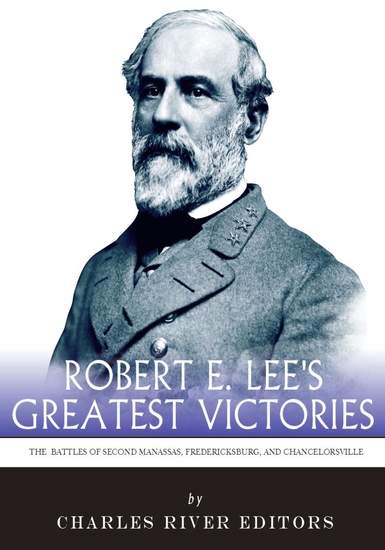
Robert E Lee’s Greatest Victories - cover

Robert E Lee’s Greatest Victories

Editors Charles River

Publisher: Charles River Editors

  • 0
  • 0
  • 0

Summary

The Second Battle of Bull Run (August 28-30, 1862) was one of the most decisive battles fought during the Civil War, and it was also one of the most unlikely. Less than three months before the battle, Joseph E. Johnston’s Army of Northern Virginia had been pushed back nearly all the way to Richmond by George B. McClellan’s Army of the Potomac, so close that Union soldiers could see the church steeples of the Confederate capital. And yet, at the end of Second Manassas, Robert E. Lee’s Army of Northern Virginia found itself in the field unopposed about 20 miles away from the Union capital of Washington D.C. How could such a remarkable reversal of fortunes take place so quickly?
 
After Lee succeeded the wounded Johnston, he pushed McClellan’s Army of the Potomac away from Richmond and back up the Peninsula in late June, only to then swing his army north to face a second Union army, John Pope’s Army of Virginia. Needing to strike out before the Army of the Potomac successfully sailed back to Washington and linked up with Pope’s army, Lee daringly split his army to threaten Pope’s supply lines, forcing Pope to fall back to Manassas to protect his flank and maintain his lines of communication. At the same time, it left half of Lee’s army (under Stonewall Jackson) potentially exposed against the larger Union army until the other wing (under James Longstreet) linked back up. Thus, in late August 1862, the Army of Northern Virginia and the Army of Virginia found themselves fighting over nearly the exact same land the South and North fought over in the First Battle of Bull Run 13 months earlier.
 
When Pope’s army fell back to Manassas to confront Jackson, his wing of Lee’s army dug in along a railroad trench and took a defensive stance. The battle began with the Union army throwing itself at Jackson the first two days. But the concentration on Stonewall’s men opened up the Union army’s left flank for Longstreet’s wing, which marched 30 miles in 24 hours to reach the battlefield by the late afternoon of August 29. Lee used Longstreet’s wing on August 30 to deliver a devastating flank attack before enough reinforcements from the retreating Army of the Potomac reached the field, sweeping Pope’s Army from Manassas and forcing the Union soldiers into yet another disorderly retreat from Manassas to Washington D.C., a scene all too reminiscent of the First Battle of Bull Run.
 
With Washington urging Burnside to advance against Lee, Burnside launched an ill fated operation across the Rappahannock River near Fredericksburg in December 1862. From December 12-13, Burnside struggled to get his army across the river while it was under fire from Confederates in Fredericksburg, and things only got worse when they did. Although the Union almost broke the Confederate lines in the south on December 13, they were ultimately repulsed, and the battle is mostly remembered for the piecemeal attacks the Union army made on heavily fortified positions Longstreet’s men took up on Marye’s Heights. As they threw themselves at Longstreet’s heavily fortified position along the high ground, the Northern soldiers were mowed down again and again. General Longstreet compared the near continuous fall of soldiers on the battlefield to “the steady dripping of rain from the eaves of a house.” During the battle, Lee turned to Longstreet and commented, “It is well that war is so terrible, otherwise we should grow too fond of it.”
 
The Battle of Chancellorsville is one of the most famous of the Civil War, and the most famous part of the battle was Stonewall Jackson’s daring march across the Army of the Potomac’s flank, surprising the XI Corps with an attack on May 2, 1863. Having ignored warnings of Jackson’s march, the XI Corps was quickly routed. The surprise was a costly success, however, as Jackson was mortally wounded after being mistakenly fired upon by his own men.
Available since: 05/02/2025.
Print length: 137 pages.

Other books that might interest you

  • Transform for Lasting Impact: Secrets to Empowering Every Child - "Elevate your approach! Discover transformative audio lessons that empower every child for lifelong success!" - cover

    Transform for Lasting Impact:...

    Malcolm Arkwright

    • 0
    • 0
    • 0
    Transform for Lasting Impact: Secrets to Empowering Every Child 
    ⭐⭐ Simplified Guide & Explanations Included ⭐⭐ 
    Are you eager to advance your career and enhance your understanding of educational practices to empower future generations?  
    Are you in search of a comprehensive resource that encompasses all the essential components for effective educational strategies? 
    Your quest ends here! 
    This guide is your ultimate resource for deepening your insights, applying your techniques, and engaging in meaningful exercises. With this book, you are set for success. 
    Updated for the latest educational practices. 
    Key features of this enriched guide: 
    - In-depth insights about empowering future generations through thoughtful education practices 
    - Comprehensive explanations of various educational methodologies 
    - Effective strategies for successful implementation and engagement with children 
    Our guide stands out with its thorough exploration, which is vital for your success. Concepts are not merely touched upon; they are examined with clarity and depth. 
    Crafted with a structured approach and user-friendly language, our guide on empowering future generations provides smooth transitions between topics. Say goodbye to complicated jargon and embrace clear, concise, and accurately presented content. 
    So, why wait? Click the BUY NOW button, secure your guide, and embark on your journey to empower future generations through transformative educational practices! 
    Transform for Lasting Impact and make a difference today!
    Show book
  • Born Under a Lucky Star - A Red Army Soldier's Recollections of the Eastern Front of World War II - cover

    Born Under a Lucky Star - A Red...

    Ivan Philippovich Makarov,...

    • 0
    • 0
    • 0
    As a Russian recruit in World War II, Ivan Makarov witnessed General Chuikov pull out his pistol and shoot their regimental commander as a traitor. That was on his first day at the front. Thrown into an open field to face German tanks and artillery fire, with only rifles and machine guns to defend themselves with, almost 2,000 men of his regiment were wiped out in only six days at the Eastern Front. At this rate, Ivan struggled to comprehend how he would survive the hundreds of battles that lay before him, with death seeming to be the only certainty. 


    In his raw and trenchant memoir, Ivan recounts the terror and despair faced by a Red Army soldier on the Eastern Front. He has no sympathy for Stalin and his incompetent commanders, who sought awards and recognition at the expense of their soldiers' lives. He simply wanted to serve his country. 


    It is rare to find first-hand accounts of the Great Patriotic War from Red Army soldiers, as many did not survive to tell the tale. For the first time, Ivan reveals his gripping recollections of battles, times, places, and people encountered throughout World War II, from when he was drafted in 1941 until their victory in 1945. These recollections he dared not put on paper until 1992.
    Show book
  • A Rare Recording of Bertrand Russell on Lenin Hegel Gladstone Tennyson and Browning - cover

    A Rare Recording of Bertrand...

    Bertrand Russell

    • 0
    • 0
    • 0
    Bertrand Russell (May 18, 1872 - February 2, 1970) was born in Monmouthshire, into one of the most prominent aristocratic families in Britain. Russell was a philosopher, logician, mathematician, historian, prominent anti-war activist, and an outspoken opponent of nuclear weapons. In 1950, Russell was awarded the Nobel Prize in Literature.
    Show book
  • Harry Potter and the Chamber of Secrets by JK Rowling (Book Analysis) - Detailed Summary Analysis and Reading Guide - cover

    Harry Potter and the Chamber of...

    Bright Summaries

    • 0
    • 0
    • 0
    Unlock the more straightforward side of Harry Potter and the Chamber of Secrets with this concise and insightful summary and analysis!This engaging summary presents an analysis of Harry Potter and the Chamber of Secrets by J.K. Rowling, which follows the Boy Who Lived during his second year at Hogwarts School of Witchcraft and Wizardry. Harry is looking forward to returning to school, but he is warned by a house-elf called Dobby that he will face grave danger when he arrives. Sure enough, the students are soon beset by a series of mysterious attacks carried out by the heir of Slytherin. It is up to Harry to delve into the past in order to discover the heir's identity, find the Chamber of Secrets and defeat the monster that lurks within it. Harry Potter and the Chamber of Secrets is the second novel in J.K. Rowling's bestselling seven-book series, which has inspired films, video games, board games and even a theme park. Rowling is now a household name around the world, and her other books include The Casual Vacancy (2012) and The Cuckoo's Calling (2013), which was published under the pseudonym Robert Galbraith.Find out everything you need to know about Harry Potter and the Chamber of Secrets in a fraction of the time!This in-depth and informative reading guide brings you:• A complete plot summary• Character studies• Key themes and symbols• Questions for further reflectionWhy choose BrightSummaries.com?Available in print and digital format, our publications are designed to accompany you on your reading journey. The clear and concise style makes for easy understanding, providing the perfect opportunity to improve your literary knowledge in no time.See the very best of literature in a whole new light with BrightSummaries.com!
    Show book
  • Communication between Parents and Children - All the Effective Tips and Techniques You Absolutely Must Know to Help Foster Dialogue with Children and Preteens - cover

    Communication between Parents...

    Bonnie Feron

    • 0
    • 0
    • 0
    A parent must have a functioning and stable channel of communication with their child because this will allow the child to develop emotional intelligence that will accompany him for all of his life, making him able to express himself constructively without outbursts of anger or frustration and without closing in on himself: he will feel that he can fearlessly turn to his parents for anything, whether it is small or big challenges. 
    In fact, in this book, you will find targeted advice based on neurological knowledge of the child's brain.  
    In this handbook, you will find practical tips and advice for everyday life tried by other parents, for example:6 common mistakes to avoid when communicating with your child4 steps to open a communication channel with your children7 strategies to improve FATHER-CHILD communication 
      
    But every age has its difficulties and needs: you cannot speak the same way to a 3-, 5-, 7-, or 12-year-old child. This book will help you build an effective and functioning communication channel for childhood and preadolescence, a difficult time for both parents and children (especially children). During preadolescence, the relationship between parents and children changes, and communication can deteriorate drastically. To communicate with them, it is necessary to know their needs and what is going on in their lives. 
    Yes, now is the time to take action: click on Buy Now!
    Show book
  • From Barbycu to Barbecue - The Untold History of an American Tradition - cover

    From Barbycu to Barbecue - The...

    Joseph R. Haynes

    • 0
    • 0
    • 0
    An award-winning barbecue cook boldly asserts that barbecuing is a unique American tradition that was not imported. 


    The origin story of barbecue is a popular topic with a ravenous audience, but commonly held understandings of barbecue are often plagued by half-truths and misconceptions. From Barbycu to Barbecue offers a fresh new look at the story of southern barbecuing. Award winning barbecue cook Joseph R. Haynes sets out to correct one of the most common barbecue myths, the "Caribbean Origins Theory," which holds that the original southern barbecuing technique was imported from the Caribbean to what is today the American South. Rather, Haynes argues, the southern whole carcass barbecuing technique that came to define the American tradition developed via direct and indirect collaboration between Native Americans, Europeans, and free and enslaved people of African descent during the seventeenth century. Haynes's barbycu-to-barbecue history analyzes historical sources throughout the Americas that show that the southern barbecuing technique is as unique to the United States as jerked hog is to Jamaica, and barbacoa is to Mexico. A recipe in each chapter provides a contemporary interpretation of a historical technique.
    Show book