¡Acompáñanos a viajar por el mundo de los libros!
Añadir este libro a la estantería
Grey
Escribe un nuevo comentario Default profile 50px
Grey
Suscríbete para leer el libro completo o lee las primeras páginas gratis.
All characters reduced
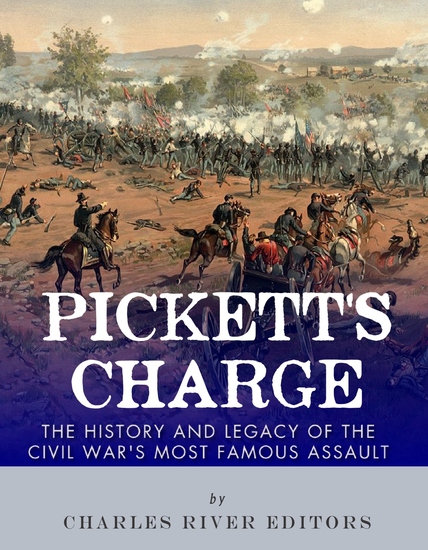
Pickett’s Charge - cover

Pickett’s Charge

Editors Charles River

Editorial: Charles River Editors

  • 0
  • 0
  • 0

Sinopsis

Despite the fact that the Civil War began over 150 years ago, it remains one of the most widely discussed topics in America today, with Americans arguing over its causes, reenacting its famous battles, and debating which general was better than others. Americans continue to be fascinated by the Civil War icons who made the difference between victory and defeat in the war's great battles.
 
The most famous attack of the Civil War was also one of its most fateful and fatal. Pickett’s Charge, the climactic assault on the final day of the Battle of Gettysburg, has become the American version of the Charge of the Light Brigade, and it is one of the most famous events of the entire Civil War.
 
Having been unable to break the Army of the Potomac’s lines on the left and right flank during Day 2 of the Battle of Gettysburg, Confederate Army of Northern Virginia commander Robert E. Lee decided to make a thrust at the center of the Union’s line with about 15,000 men spread out over three divisions. The charge required marching across an open field for about a mile, with the Union artillery holding high ground on all sides of the incoming Confederates.
 
Though it is now known as Pickett’s Charge, named after division commander George Pickett, the assignment for the charge was given to General James Longstreet, whose 1st Corps included Pickett’s division. Longstreet had serious misgivings about Lee’s plan and tried futilely to talk him out of it. Longstreet later wrote that he said to his commander, “General Lee, I have been a soldier all my life.  It is my opinion that no fifteen thousand men ever arrayed for battle can take that position.”
 
Aware of the insanity of sending 15,000 men hurtling into all the Union artillery, Lee planned to use the Confederate artillery to try to knock out the Union artillery ahead of time. Although old friend William Pendleton was the artillery chief, the artillery cannonade would be supervised by Edward Porter Alexander, Longstreet’s chief artillerist, who would have to give the go-ahead to the charging infantry because they were falling under Longstreet’s command. Alexander later noted that Longstreet was so disturbed and dejected about ordering the attack that at one point he tried to make Alexander order the infantry forward, essentially doing Longstreet’s dirty work for him.
 
Unfortunately for Porter Alexander and the Confederates, the sheer number of cannons belched so much smoke that they had trouble gauging how effective the shells were. As it turned out, most of the artillery was overshooting the target, landing in the rear of the Union line. Reluctant to order the charge, Longstreet commanded Porter Alexander to order the timing for the charge. As Longstreet and Alexander anticipated, the charge was an utter disaster, incurring a nearly 50% casualty rate and failing to break the Union line.
 
Pickett’s Charge: The History and Legacy of the Civil War’s Most Famous Assault profiles the history, context, and command decisions that all culminated in the most famous charge in American history. It also includes analysis of what went right and wrong, as well as what the major participants wrote about the charge. Along with maps and pictures of important people and places, you will learn about Pickett’s Charge like you never have before, in no time at all.
Disponible desde: 02/05/2025.
Longitud de impresión: 69 páginas.
Otros libros que te pueden interesar

  • The Poignant Being - The Interplay of Vulnerability Existence and Meaning - cover

    The Poignant Being - The...

    Mamoon Jahan

    • 0
    • 0
    • 0
    Life is full of contradictions-love and loss, creation and destruction, tradition and progress. We spend our days searching for meaning, for connection, for something that makes the struggle worthwhile. But in that search, we often overlook the very things that shape us: the quiet sacrifices, the unspoken fears, the relationships that both define and challenge us. 
    Either you munch on life, or you get munched by life. While we share similarities with previous generations, clinging to outdated beliefs no longer serves us. The world has changed, and what we need today is more kindness, more genuine care for one another-rather than allowing ourselves to be hollowed out by the digital age. This book is an exploration of those forces: the raw, unfiltered experience of being human. It delves into the love of a mother that shapes a child's world, the weight of family expectations, and the tension between who we are and who we hope to become. 
    It asks tough questions: What does it mean to truly love? How do we balance ambition with responsibility? And in a world that demands constant change, how do we hold on to what really matters? Through deeply personal reflections, philosophical musings, and a brutally honest look at life's paradoxes, this work challenges the idea that peace is the ultimate goal. Instead, it dares to argue that greatness-however we define it-is found in embracing struggle, in choosing action over comfort, and in accepting that the journey is never meant to be simple. 
    This book explores philosophy, modern values, and the often-overlooked aspects of life-the things we neglect because giving them attention no longer feels like a priority. But perhaps, in paying attention, we reclaim something essential. 
    For those who find themselves questioning, searching, or simply trying to make sense of it all-this book is for you.
    Ver libro
  • Oregon Moonshine - Bootleggers Busts & Brawls - cover

    Oregon Moonshine - Bootleggers...

    Mr. Bruce Haney

    • 0
    • 0
    • 0
    Moonshining is deep-rooted in the history of Oregon.   In 1844, when it was still Oregon Territory, one of the first moonshiners, James Conner, challenged a lawman to a duel for busting his illegal operation. The McKenzie River Bandits had better luck hiding from the law and produced bootleg booze for nearly five years before their arrest. It wouldn't be the last time they were caught. Over the years, outlaw moonshiners engaged in car chases, shootouts and even attempted an assassination to protect their hidden distilleries--and way of life.   Join author Bruce Haney as he chronicles the intoxicating history of Oregon Moonshine.
    Ver libro
  • The Incas - The Expansion Growth and Decline of the The Ancient Inca Civilization - cover

    The Incas - The Expansion Growth...

    Will Forrest

    • 0
    • 0
    • 0
    Travel back in time to explore an amazing culture that changed our world forever!  
    Our book guides you through every corner of the Inca civilization. 
    - From their Land of the Four Quarters to Machu Picchu. - The Forgotten City. 
    Trace their astounding rise to power and follow them into battle against Spanish Conquistadors. 
    Learn about the Inca's secrets buried beneath centuries of dust. 
    Buy this book Now! And experience a part of history like never before. 
    Ver libro
  • Our Ghosts Were Once People - Stories on Death and Dying - cover

    Our Ghosts Were Once People -...

    Bongani Kona (ed)

    • 0
    • 0
    • 0
    ‘I would get out of the car at every shopping centre and want to ask the stranger walking by with their trolley: “Why are you still shopping? Someone I love has died.”’ – Dela Gwala 
    Death is a fact of life, but the experience of grief is unique to each of us. This timely collection brings together a range of voices to offer reflections on death and dying, from individual losses to large scale catastrophes. 
    	Karin Schimke revisits her troubled relationship with her late father, a Second World War survivor ‘whose brain had been broken by violence’. Madeleine Fullard, the head of South Africa’s Missing Persons Task Team, draws us into the search for activists who were ‘disappeared’ or went missing in political circumstances between 1960 and 1994. Caine Prize winner Lidudumalingani remembers his childhood in a small village in the Eastern Cape, and how his mother always listened to death notices read over the radio as a way of bearing witness to the grief of strangers. 
    	The other contributors in this poignant and thought-provoking anthology turn their minds to subjects as varied as the ritual of washing the body of the deceased before burial, the ethics of killing small animals, and the extinction of humankind. 
    	In a time of relentless grief, Our Ghosts Were Once People reminds us that one of the small consolations of literature is that all sorrows can be borne.
    Ver libro
  • The Basis of Everything - cover

    The Basis of Everything

    Anónimo

    • 0
    • 0
    • 0
    Before the Manhattan Project, before nuclear warfare and the horrors of Hiroshima and Nagasaki, there was the twentieth century's great scientific quest to fathom the secrets of the atom.The unlikely story of an Antipodean friendship that changed the world forever. 
      
    Centered on the inter-war years - within the ivy clad walls of Cambridge University's famed Cavendish Laboratory, amid the windswept valleys of north Wales, and in the industrial heartland of Birmingham - The Basis of Everything is the story of the coming of the atomic bomb, and how the unlikely union of two scientists - Ernest Rutherford, the son of a New Zealand farmer, and Mark Oliphant, a peace-loving vegetarian from a tiny Australian hills village - would change the world. 
    The story that bonds Ernest Rutherford and Mark Oliphant is as extraordinary as it is unlikely. They were kindred souls, schooled and steeped in the furthest frontiers of Britain's empire, whose restless intellect and tireless conviction fused in the crucible of discovery at Cambridge University's celebrated Cavendish Laboratory, at a time when nature's deepest secrets were being revealed. Their brilliance illuminated the sub-atomic recesses of the natural world and, as a direct result, set loose the power of nuclear fusion. 
    It was a heartfelt, enduring partnership, born at the University of Adelaide's modest physics department and then flourishing further in the confines of the Cavendish before ultimately driving the famed Manhattan Project, which produced the world's first nuclear weapons, unleashed to such devastating effect on Hiroshima and Nagasaki. 
    Rutherford and Oliphant were men with a shared devotion to pure science, who, through circumstance and necessity, found themselves betrayed as instruments of wars they detested but were duty-bound to prosecute. Consequently, their influence was pivotal in the last great global conflict the world witnessed and in engendering the thermonuclear threat that has held the planet hostage ever since. Yet their pioneering work also lives on in a vast array of innovations seeded by nuclear physics, from radiocarbon dating and TV screens to life-saving diagnostic-imaging devices. 
    PRAISE FOR THE BASIS OF EVERYTHING 
    ""In The Basis of Everything, journalist Andrew Ramsey has succeeded in telling a story so detailed and compelling that even knowing where it leads does not distract from the journey."" The Sydney Morning Herald
    Ver libro
  • Mystic Experiences Tales of Yoga and Vedanta - FROM YOGA VASISHTHA With Notes By Dr Annie Besant - cover

    Mystic Experiences Tales of Yoga...

    Bhagavan Das

    • 0
    • 0
    • 0
    The Maha Ramayana, Greater Book, and it describes the inner life of Rama, telling how he triumphed over foes within himself, and so prepared to fight and conquer, for the helping of the world, the outer evil forces rampant in that time. The story of this Greater Book is here essayed in brief
    Ver libro