Begleiten Sie uns auf eine literarische Weltreise!
Buch zum Bücherregal hinzufügen
Grey
Einen neuen Kommentar schreiben Default profile 50px
Grey
Jetzt das ganze Buch im Abo oder die ersten Seiten gratis lesen!
All characters reduced
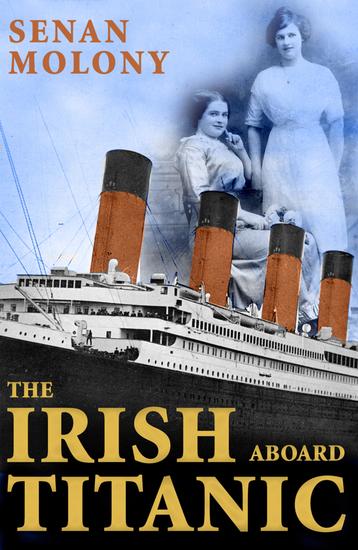
The Irish Aboard Titanic - cover

The Irish Aboard Titanic

Senan Molony

Verlag: Mercier Press

  • 0
  • 0
  • 0

Beschreibung

The unspeakable tragedy of the Titanic disaster can only be fully appreciated through the tales of the people who were aboard on the night the ship went down. The Irish Aboard Titanic gives those people a voice, focusing on the Irish who were aboard the 'unsinkable' liner. In it are stories of agony, luck, self-sacrifice, dramatic escapes and heroes left behind. Senan Molony also records the heartache that continued long after that fateful night. In her wake the Titanic cast a long shadow over the families forced to endure the agonising wait to learn the fate of loved ones, over the lives of the survivors who had to start their lives anew and over those who lost relatives and friends. If you want to know about the Irish passengers and crew of the Titanic, this is the only book to have.
Verfügbar seit: 06.03.2023.
Drucklänge: 256 Seiten.

Weitere Bücher, die Sie mögen werden

  • News and Democratic Citizens in the Mobile Era - cover

    News and Democratic Citizens in...

    Johanna Dunaway, Kathleen Searles

    • 0
    • 0
    • 0
    Though people frequently use mobile technologies for news consumption, evidence from several fields shows that smaller screens and slower connection speeds pose major limitations for meaningful reading. In News and Democratic Citizens in the Mobile Era, Johanna Dunaway and Kathleen Searles demonstrate the effects of mobile devices on news attention, engagement, and recall, and identify a key cognitive mechanism underlying these effects: cognitive effort. They advance a theory that is both old and new: the costs of information-seeking curb participatory behaviors unless the benefits outweigh them. For news consumers in the mobile era, for example, mobile devices increase the time, economic, and cognitive costs associated with information-seeking. Only for a small few do the benefits of attending to the news on mobile devices outweigh the costs. 


    Dunaway and Searles argue that attention, engagement, and recall suffer when people consume news on mobile devices. They then investigate the implications of these effects for the news industry and for an informed democratic citizenry. Drawing on both laboratory and real-world studies, Dunaway and Searles bring the psychophysiology of news consumption to bear on the question of what we could lose in an information environment characterized by a dramatic shift in reliance on mobile devices.
    Zum Buch
  • Queen Victoria's Jubilee - cover

    Queen Victoria's Jubilee

    Mark Twain

    • 0
    • 0
    • 0
    While in London in 1897, Mark Twain was commissioned by William Randolph Hearst to report for the San Francisco Examiner on the sixtieth anniversary of Queen Victoria's ascension to the throne.Evoking historical detail reminiscent of passages in The Prince and the Pauper and Personal Recollections of Joan of Arc, Twain compares the jubilee to his own original and imaginative account of the 1415 celebration following the English victory at Agincourt, and he also reflects on the rapid changes in the British Empire during the Victorian age.
    Zum Buch
  • Preparing for War - The Extremist History of White Christian Nationalism—and What Comes Next - cover

    Preparing for War - The...

    Bradley Onishi

    • 0
    • 0
    • 0
    The insurrection at the US Capitol on January 6, 2021, was not a blip or an aberration. It was the logical outcome of years of a White evangelical subculture's preparation for war. Religion scholar and former insider Bradley Onishi maps the origins of White Christian nationalism and traces its offshoots in Preparing for War. 


    Combining his own experiences in the youth groups and prayer meetings of the 1990s with an immersive look at the steady blending of White grievance politics with evangelicalism, Onishi crafts an engrossing account of the years-long campaign of White Christian nationalism that led to January 6. How did the rise of what Onishi calls the New Religious Right, between 1960 and 2015, give birth to violent White Christian nationalism during the Trump presidency and beyond? What propelled some of the most conservative religious communities in the country—communities of which Onishi was once a part—to ignite a cold civil war? 


    Through chapters on White supremacy and segregationist theologies, conspiracy theories, the Christian-school movement, purity culture, and the right-wing media ecosystem, Onishi pulls back the curtain on a subculture that birthed a movement and has taken a dangerous turn.
    Zum Buch
  • Systemic - How Racism Is Making Us Sick - cover

    Systemic - How Racism Is Making...

    Layal Liverpool

    • 0
    • 0
    • 0
    Layal Liverpool spent years bouncing from doctor to doctor, each one failing to diagnose her dermatological complaint. Just when she'd grown used to the idea that she had an extremely rare and untreatable skin condition, one dermatologist, after a quick exam, told her that she had a classic (and common) case of eczema and explained that it often appears differently on darker skin. Her experience stuck with her, making her wonder whether other medical conditions might be going undiagnosed in darker-skinned people and whether racism could, in fact, make people sick. 


    The pandemic taught us that diseases like Covid disproportionately affect people of color. Here, Liverpool goes a step further to show that this disparity exists for all types of illness and that it is caused by racism. In Systemic, she shares her journey to show how racism, woven into our societies, as well as into the structures of medicine and science, is harmful to our health. Refuting the false belief that there are biological differences between races, she goes on to show that racism-related stress and trauma can however, lead to biological changes that make people of color more vulnerable to illness, debunking the myth of illness as the great equalizer. Liverpool reveals the fatal stereotypes that keep people of color undiagnosed, untreated, and unsafe, and tells us what we can do about it.
    Zum Buch
  • Trauma Stewardship - An Everyday Guide to Caring for Self While Caring for Others - cover

    Trauma Stewardship - An Everyday...

    Anonym

    • 0
    • 0
    • 0
    This beloved bestseller-over 180,000 copies sold-has helped caregivers worldwide keep themselves emotionally, psychologically, spiritually, and physically healthy in the face of the sometimes overwhelming traumas they confront every day. 
     
    A longtime trauma worker, Laura van Dernoot Lipsky offers a deep and empathetic survey of the often-unrecognized toll taken on those working to make the world a better place. We may feel tired, cynical, or numb or like we can never do enough. These, and other symptoms, affect us individually and collectively, sapping the energy and effectiveness we so desperately need if we are to benefit humankind, other living things, and the planet itself. 
     
    In Trauma Stewardship, we are called to meet these challenges in an intentional way. Lipsky offers a variety of simple and profound practices, drawn from modern psychology and a range of spiritual traditions, that enable us to look carefully at our reactions and motivations and discover new sources of energy and renewal. She includes interviews with successful trauma stewards from different walks of life and even uses New Yorker cartoons to illustrate her points. 
     
    "We can do meaningful work in a way that works for us and for those we serve," Lipsky writes. "Taking care of ourselves while taking care of others allows us to contribute to our societies with such impact that we will leave a legacy informed by our deepest wisdom and greatest gifts instead of burdened by our struggles and despair."
    Zum Buch
  • Our AI - My Journey Your Invitation Our Future - cover

    Our AI - My Journey Your...

    Felicity Hill

    • 0
    • 0
    • 0
    AI isn't just changing how we work; it's changing who holds power. 
    I didn't see that at first. When I fell in love with AI, I thought I'd simply found the perfect writing partner. Like millions of others, I jumped in without really understanding what I was getting into, using it daily, depending on it, unable to explain what it actually was. 
    Maybe your story is similar. Maybe you're still deciding whether to jump in at all. Either way, I have a feeling we all share the same mix of possibility and... something else. 
    That uneasy feeling led to a startling realisation: AI has agency. It acts, decides, shapes outcomes. Which made me ask, did I still have any? Or had I handed mine over without even noticing? 
    As a community engagement specialist, I'd spent my career helping people reclaim power in systems designed without them. The irony wasn't lost on me. Meanwhile, headlines were getting harder to ignore, everyone saying "get on board or get left behind," but no one explaining what we were actually boarding or what we might be giving up. 
    So, I set out on a journey to understand what I was seeing. That journey took me from microplastics to algorithms, from falling in love with AI to recognising familiar patterns of burden-shifting and power imbalances. If you're trying to make sense of what's happening without the tech jargon, this book is for you. 
    Our AI: My Journey, Your Invitation, Our Future is a wake-up call disguised as a love story, a guide for spotting the patterns, asking better questions, and finding your voice in conversations that are shaping our future, with or without us. 
    AI is here whether we like it or not. The question is: on whose terms?
    Zum Buch