Join us on a literary world trip!
Add this book to bookshelf
Grey
Write a new comment Default profile 50px
Grey
Subscribe to read the full book or read the first pages for free!
All characters reduced
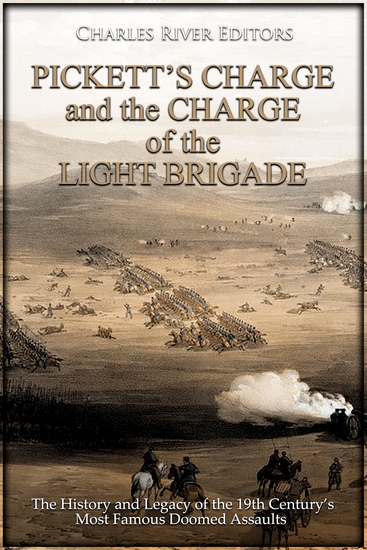
Pickett’s Charge and the Charge of the Light Brigade - The History and Legacy of the 19th Century’s Most Famous Doomed Assaults - cover

Pickett’s Charge and the Charge of the Light Brigade - The History and Legacy of the 19th Century’s Most Famous Doomed Assaults

Editors Charles River

Publisher: Charles River Editors

  • 0
  • 0
  • 0

Summary

Despite the fact that the Civil War began over 150 years ago, it remains one of the most widely discussed topics in America today, with Americans arguing over its causes, reenacting its famous battles, and debating which general was better than others. Americans continue to be fascinated by the Civil War icons who made the difference between victory and defeat in the war's great battles.
 
The most famous attack of the Civil War was also one of its most fateful and fatal. Pickett’s Charge, the climactic assault on the final day of the Battle of Gettysburg, has become the American version of the Charge of the Light Brigade, and it is one of the most famous events of the entire Civil War.
 
Having been unable to break the Army of the Potomac’s lines on the left and right flank during Day 2 of the Battle of Gettysburg, Confederate Army of Northern Virginia commander Robert E. Lee decided to make a thrust at the center of the Union’s line with about 15,000 men spread out over three divisions. The charge required marching across an open field for about a mile, with the Union artillery holding high ground on all sides of the incoming Confederates.
 
Though it is now known as Pickett’s Charge, named after division commander George Pickett, the assignment for the charge was given to General James Longstreet, whose 1st Corps included Pickett’s division. Longstreet had serious misgivings about Lee’s plan and tried futilely to talk him out of it. Longstreet later wrote that he said to his commander, “General Lee, I have been a soldier all my life.  It is my opinion that no fifteen thousand men ever arrayed for battle can take that position.”
 
Aware of the insanity of sending 15,000 men hurtling into all the Union artillery, Lee planned to use the Confederate artillery to try to knock out the Union artillery ahead of time. Although old friend William Pendleton was the artillery chief, the artillery cannonade would be supervised by Edward Porter Alexander, Longstreet’s chief artillerist, who would have to give the go-ahead to the charging infantry because they were falling under Longstreet’s command. Alexander later noted that Longstreet was so disturbed and dejected about ordering the attack that at one point he tried to make Alexander order the infantry forward, essentially doing Longstreet’s dirty work for him.
 
Unfortunately for Porter Alexander and the Confederates, the sheer number of cannons belched so much smoke that they had trouble gauging how effective the shells were. As it turned out, most of the artillery was overshooting the target, landing in the rear of the Union line. Reluctant to order the charge, Longstreet commanded Porter Alexander to order the timing for the charge. As Longstreet and Alexander anticipated, the charge was an utter disaster, incurring a nearly 50% casualty rate and failing to break the Union line.
 
The Charge of the Light Brigade is the most famous British cavalry charge in history, possibly also eclipsing the renown of any other mounted attack conducted by the armed forces of other nations in the general imagination. This cavalry action is certainly remembered far more vividly than the 1854 Battle of Balaclava during which it occurred, and even the wider Crimean War that led to the battle.
 
Of course, the prominence of the Charge in popular and historical memory is due primarily to Alfred, Lord Tennyson's poem describing the events of that distant late October afternoon. The bearded Poet Laureate crafted a powerful, gripping poetic narrative that fixed the encounter firmly in both the popular imagination and in the English literary oeuvre. Millions of people who know nothing else of the Crimean War between Great Britain and the Russian Empire are familiar with Tennyson's memorable verses.
Available since: 05/01/2025.
Print length: 116 pages.

Other books that might interest you

  • Spreading Hate - The Global Rise of White Supremacist Terrorism - cover

    Spreading Hate - The Global Rise...

    Daniel Byman

    • 0
    • 0
    • 0
    The modern white power movement is now a global, transnational phenomenon. 
     
    In this sweeping, authoritative account, Daniel Byman traces the key moments in the white power movement’s evolution in the United States and around the world and then details its many facets today. Using a wide range of sources, Byman explodes several myths about  
    white power terrorism and identifies dangerous gaps in current policies. 
     
    For almost two decades since 9/11, white supremacist terrorism has been relegated to a secondary concern in the US and Europe despite shocking episodes of violence from New Zealand to Norway to South Carolina. Because white power terrorists’ grievances echo  
    mainstream debates and their violence often exacerbates polarization, their political impact can be inordinately high even if the body count is low. As Byman stresses, they are not a hidebound movement seeking to turn back the clock, but are dynamic, drawing on  
    ideas from around the world and exploiting the most cutting-edge technologies, especially social media. 
     
    White power terrorists, however, have many weaknesses. They are divided, with poor leadership, and often attract the incompetent and the criminal as well as the dangerous and deluded. If governments act decisively and treat white power terrorism with the same  
    urgency they use to manage jihadist violence, then the threat can be reduced. This will require aggressive law enforcement, international intelligence cooperation, crackdowns by technology companies, and other forceful steps. Spreading Hate will be essential reading  
    for anyone worried about this increasingly networked movement that threatens to grow more dangerous in the years to come.
    Show book
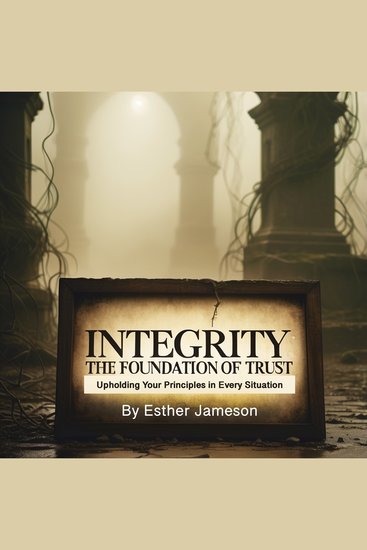
  • Integrity - The Foundation of Trust: Upholding Your Principles in Every Situation - cover

    Integrity - The Foundation of...

    Esther Jameson

    • 0
    • 0
    • 0
    Integrity is the cornerstone of trust, and trust is essential in every aspect of our lives. Whether in personal relationships, the workplace, or society as a whole, integrity is what binds us together and ensures that we can rely on one another. Without integrity, trust is compromised, and relationships become fragile, leading to misunderstandings, broken bonds, and lost opportunities. It is the foundation upon which all other virtues are built, and it is a key element that defines who we are as individuals and how we are perceived by others. 
    At its core, integrity is about being true to one’s principles and values, regardless of the circumstances. It means doing the right thing, even when no one is watching, and maintaining consistency between one’s beliefs, actions, and words. Integrity is not about perfection; rather, it is about being honest, transparent, and committed to doing what is right, even when it’s difficult or inconvenient. 
    One of the most powerful aspects of integrity is its ability to build trust. When we demonstrate integrity, others come to rely on our word and actions. Trust is built over time through repeated demonstrations of honesty, consistency, and reliability. Integrity fosters an environment where people feel safe, respected, and valued. It is the glue that holds relationships together, whether in families, friendships, or workplaces. People with integrity are seen as dependable, ethical, and authentic, making them natural leaders and role models.
    Show book
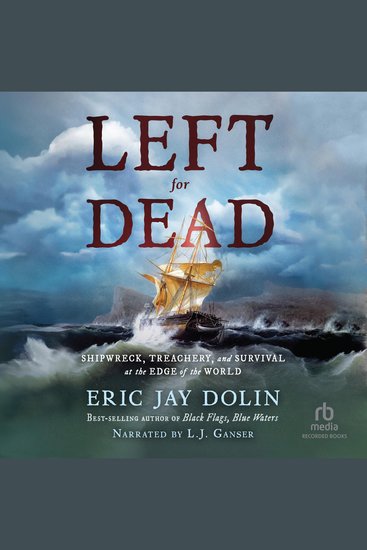
  • Left for Dead - Shipwreck Treachery and Survival at the Edge of the World - cover

    Left for Dead - Shipwreck...

    Eric Jay Dolin

    • 0
    • 0
    • 0
    In Left for Dead, Eric Jay Dolin—“one of today’s finest writers about ships and the  
    sea” (American Heritage)—tells the true story of a wild and fateful encounter  
    between an American sealing vessel, a shipwrecked British brig, and a British  
    warship in the Falkland archipelago during the War of 1812. 
    Fraught with misunderstandings and mistrust, the incident left three British sailors  
    and two Americans, including the captain of the sealer, Charles H. Barnard,  
    abandoned in the barren, windswept, and inhospitable Falklands for a year and a  
    half. With deft narrative skill and unequaled knowledge of the very pith of the  
    seafaring life, Dolin describes in vivid and harrowing detail the increasingly  
    desperate existence of the castaways during their eighteen-month ordeal—an alltoo-common fate in the Great Age of Sail. 
    A tale of intriguing complexity, with surprising twists and turns throughout— 
    involving greed, lying, bullying, a hostile takeover, stellar leadership, ingenuity,  
    severe privation, endurance, banishment, the great value of a dog, the birth of a  
    baby, a perilous thousand-mile open-ocean journey in a seventeen-foot boat, an  
    improbable rescue mission, and legal battles over a dubious and disgraceful  
    wartime prize—Left for Dead shows individuals in wartime under great duress  
    acting both nobly and atrociously, and offers a unique perspective on a pivotal era  
    in American maritime history. 
    “An absorbing adventure that explores the dark shadows of instinct and self-preservation, and the hardships and stress that stretch the bonds of humanity.  
    Fascinating reading.”—Stephen R. Bown, author of Island of the Blue Foxes:  
    Disaster and Triumph on the World’s Greatest Scientific Expedition
    Show book
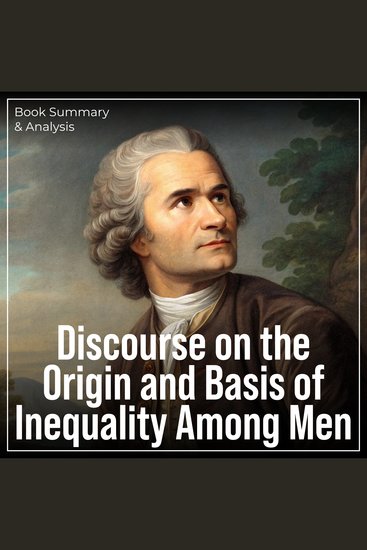
  • Discourse on the Origin and Basis of Inequality Among Men: Book Summary & Analysis - cover

    Discourse on the Origin and...

    Briefly Summaries

    • 0
    • 0
    • 0
    This is a concise summary and analysis of Discourse on the Origin and Basis of Inequality Among Men, by Jean-Jacques Rousseau.
    It is not the original book and is not affiliated with or endorsed by Jean-Jacques Rousseau.
    Ideal those seeking a quick and insightful overview.
     
    Discourse on the Origin and Basis of Inequality Among Men is a profound philosophical exploration of human society, its structures, and the roots of inequality. This classic text examines the natural state of man, contrasting it with the complexities and disparities introduced by civilization. With compelling arguments and insights, it challenges readers to reflect on the consequences of societal development and the moral implications of inequality. A foundational work in political philosophy and social thought, this discourse continues to inspire debates on justice, freedom, and human nature.
    Show book
  • Walking Through the Fire - My Fight for the Heart and Soul of America - cover

    Walking Through the Fire - My...

    Steve King

    • 0
    • 0
    • 0
    Just two weeks after winning reelection to his ninth term in Congress, Steve King was stunned to learn the “Swamp” was poised to unleash a treacherous media blitzkrieg designed to kill his Congressional political career on the spot. The words “They believe they can force you to resign” still ring in his ears today. He knew Democrats and the media would pile on. Unfortunately, the threat was from within his party, and it was far more dangerous. The Republican establishment, RINOs, elitists, globalists, and NeverTrumpers needed him out of the way. This is the full story.
    Show book
  • Timeless Wisdom of Epictetus The: Philosophy for Modern Life [Illustrated and Annotated] - cover

    Timeless Wisdom of Epictetus...

    Andrew Weston, Epictetus

    • 0
    • 0
    • 0
    Get ready to immerse yourself in the enduring power of Epictetus’ Stoic philosophy, brought to life by the strong, masculine voice of a rugged outdoors philosopher, also known as "the rucking philosopher." This audiobook isn’t just a recitation—it’s a bold journey into the timeless lessons of resilience, inner strength, and true freedom. 
    Epictetus’ wisdom offers profound guidance for today’s turbulent world. This modernized version makes his teachings more accessible, while preserving the depth of his philosophy. As you listen, you’ll feel as though you’re trekking alongside a philosopher through life’s rocky and rough terrain—listening to the wisdom of the ancients. All the while rekindling your connection with your civilizational origins and gaining insight from the teachings of Epictetus on how to navigate life’s challenges with a steadfast mind. 
    This audiobook bridges ancient wisdom with modern struggles, guiding you through life’s complexities with clarity and conviction. Whether you’re dealing with personal loss, professional hurdles, or seeking purpose, Epictetus’ guidance becomes a practical toolkit for living well. 
    Let the commanding, grounded narration inspire you to find peace, power, and purpose—no matter what life throws your way.
    Show book