

Join us on a literary world trip!
Add this book to bookshelf
Grey
Write a new comment Default profile 50px
Grey
Subscribe to read the full book or read the first pages for free!
All characters reduced
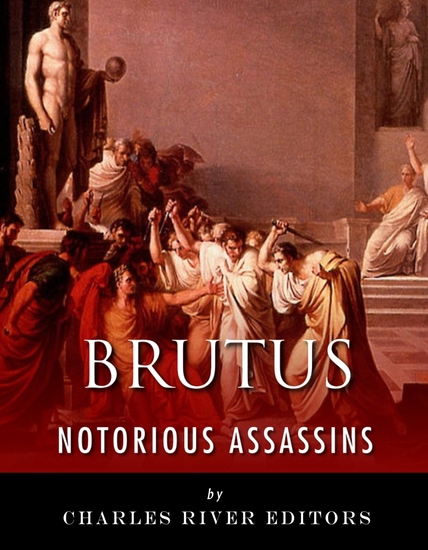
Notorious Assassins - The Life and Legacy of Marcus Brutus - cover

Notorious Assassins - The Life and Legacy of Marcus Brutus

Editors Charles River

Publisher: Charles River Editors

  • 0
  • 0
  • 0

Summary

“Sic semper tyrannis!” (“Thus, always, to tyrants!”) – attributed to Brutus
 
Throughout the annals of history, there have been few men as reviled as Marcus Junius Brutus the Younger. To this day, he is associated with murder, betrayal, violence and infamy, so much so that in modern English his name provides the root for the words “brute” and “brutal”, as it does in several other Romance languages. Indeed, Brutus’s reputation was so infamous that when Dante composed his timeless Divine Comedy, he relegated Brutus to the very nethermost depths of Hell. In the Inferno, Dante reaches the pit of the Ninth Circle of Hell, where he finds the Fallen Angel, Lucifer, himself. Lucifer is described as a giant, three-faced demon whose three mouths are perpetually gnashing upon three sinners, widely regarded as being the three most despicable individuals in history. According to Dante, the deepest circle of Hell is reserved for traitors, including Traitors against Kin, Traitors against Homeland, Traitors against Guests, and Traitors against Benefactors. The three men being devoured by Satan in Dante’s Inferno are Judas, the greatest traitor of all, and the two conspirators whose knives cut down Julius Caesar: Gaius Cassius Longinus and Brutus.
 
By Dante’s logic, Brutus had betrayed both his kin and benefactor, because Caesar had been as a father to him and always treated him with leniency and benevolence. Similarly, he also betrayed his homeland, because his actions helped bring about the downfall of the Republic. Since his appearance in the Inferno, Brutus has proven himself to be a resilient fictional character, naturally appearing as the main antagonist in Shakespeare’s Julius Caesar, as well as turning up in places as diverse as contemporary novels, the Asterix comic books, and video games. This is hardly surprising, since Brutus was said to be the orchestrator and main perpetrator of the plot against Caesar, and legend had it that it was Brutus himself who dealt the final blow that struck Caesar down. Shakespeare’s “Et tu, brute?” (“And you, Brutus?”) is widely recognized as one of the most iconic lines in theatre, further cementing Brutus’s lurid notoriety, although most of the chronicles dispute whether Caesar actually said anything at all as he died.
 
Brutus has been history’s most notorious assassin since the Ides of March in 44 B.C., but aside from his conspiracy, the rest of his life is often overlooked, especially his role in the subsequent civil war. In fact, forces loyal to Brutus and the other main conspirator, Cassius, fought one of the biggest battles in Roman history against Octavian and Antony, and it was one that they very nearly won. However, by the end of the decisive battle, Brutus and Cassius had lost, and Brutus had taken his own life. After Octavian rose to power by defeating Antony in yet another civil war, he was able to establish himself as Caesar Augustus, and the Republic that Brutus had hoped to save was truly finished.
 
Naturally, Augustus ensured that Brutus was universally despised during his reign, and Brutus’s negative reputation mostly persevered over the centuries. But in more modern times, Brutus has undergone something of a rehabilitation. As Western political thought shifted away from the Divine Right of Kings and towards democracy, Brutus began to be viewed in a far more sympathetic light. In Shakespeare’s Julius Caesar itself, Brutus is praised as the best of the conspirators, because his motives were described not as being for personal gain but a genuine desire to act for the good of the Republic, however misguided. Later, he became viewed as something of a populist hero, the man who had stood up in defense of a democratic government against a tyrant who wished to seize power for himself alone. Brutus achieved a particularly positive public portrayal in the fledgling United States.
Available since: 05/02/2025.
Print length: 32 pages.

Other books that might interest you

  • Sound N’ Fury - Rock N’ Roll Stories - cover

    Sound N’ Fury - Rock N’ Roll...

    Alan Niven

    • 0
    • 1
    • 0
    Most rock ’n’ roll books are a bore. They all have the same narrative arc and are aimed at the dwindling following that now follows an artist that has long passed their AARP date. 
    		 
    Sound N’ Fury does not have a story arc. It is a collection of anecdotes, like a record comprised of various tracks — each one has its point and purpose. Alan Niven, who guided Guns N’ Roses from the gutter of Los Angeles to Wembley Stadium, shares stories from his remarkable life as a manager with an immediacy delivered by an extraordinary recall of dialogue. Readers will encounter not just Guns N’ Roses (who have sold almost 10 million tickets to their shows) but The Rolling Stones, Aerosmith, Clarence Clemons, Whitesnake, Elton John, and others who came from humble origins and experienced fame known only to few. Small-town minds collided with worldwide adulation, expectations, and demands. The results are amusing, affirming, and, predictably, disastrous. Keep in mind that rock ’n’ roll is God’s occupation for the unemployable.
    		 
    Written with a crisp and fluid style, the magnificence and idiocy of the music world will dance off the pages and engross even those who are not rock fans.
    Show book
  • Twelve Years a Slave - cover

    Twelve Years a Slave

    Solomon Northup

    • 0
    • 1
    • 0
    "They can take your freedom, but they cannot take your identity."
    
    In 1841, Solomon Northup was a professional violinist and family man living in Saratoga Springs, New York. After being lured to Washington D.C. with the promise of work, he was drugged, shackled, and stripped of his name. For the next twelve years, he was passed from master to master in the bayous of Louisiana, enduring the sadistic cruelty of men like Edwin Epps while witnessing the quiet heroism of his fellow enslaved people. Twelve Years a Slave is a visceral, unflinching look at the "peculiar institution" through the eyes of a man who knew both the dignity of liberty and the agony of the lash. It remains a foundational text of American history and a testament to the endurance of the human spirit.
    
    The Mechanics of Oppression: Northup provides a meticulous, almost journalistic description of the economics and daily operations of the slave trade. He details the cultivation of cotton and sugar, the social hierarchies of the plantation, and the psychological warfare used to keep human beings in subjection.
    
    A Quest for Justice: The narrative is propelled by Northup's secret attempts to communicate with his family in the North. His eventual rescue is a heart-stopping moment of tension and triumph, highlighting the legal and social complexities of a divided nation where a man's status as "property" or "person" could depend entirely on the color of his skin and the geography of his location.
    
    Why It Is a Vital Classic: While many narratives were edited to suit political agendas, Northup's account is praised for its stark realism and descriptive power. It provides names, dates, and locations that were later verified by historians, making it one of the most credible and devastating indictments of slavery ever written.
    
    Bear witness to the truth. Purchase "Twelve Years a Slave" today.
    Show book
  • The Boy Who Survived Auschwitz - cover

    The Boy Who Survived Auschwitz

    Adriana Lerman

    • 1
    • 1
    • 0
    Levi Lerman was a cheerful and lively boy from the town of Ostrowiec. He was only fourteen years old when his life took an unimaginable turn with the outbreak of World War II in 1939, when the Nazi forces invaded Poland and occupied his hometown.
    Over a painful six-year period, Levi endured a harsh life in the Ostrowiec ghetto, suffered devastating losses, performed exhausting forced labor, and survived countless transfers to concentration camps, including the extermination camp of Auschwitz-Birkenau.
    In the middle of this torment, a single light guided him through the darkness: his unbreakable determination to live and to protect his father—a strength that helped him survive against all odds.
    Show book
