Join us on a literary world trip!
Add this book to bookshelf
Grey
Write a new comment Default profile 50px
Grey
Subscribe to read the full book or read the first pages for free!
All characters reduced
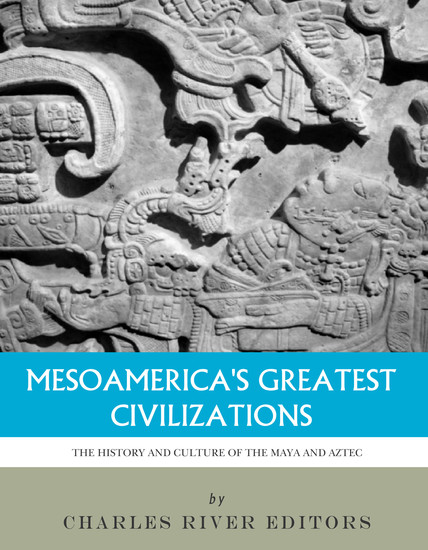
Mesoamerica’s Greatest Civilizations - The History and Culture of the Maya and Aztec - cover

Mesoamerica’s Greatest Civilizations - The History and Culture of the Maya and Aztec

Editors Charles River

Publisher: Charles River Editors

  • 0
  • 0
  • 0

Summary

Many ancient civilizations have influenced and inspired people in the 21st century. The Greeks and Romans continue to fascinate the West today. But of all the world’s civilizations, none have intrigued people more than the Mayans, whose culture, astronomy, language, and mysterious disappearance all continue to captivate people.
 
In 2012 especially, there has been a renewed focus on the Mayans, whose advanced calendar has led many to speculate the world will end on the same date the Mayan calendar ends. The focus on the “doomsday” scenario, however, has overshadowed the Mayans’ true contribution to astronomy, language, sports, and art.
 
Mesoamerica’s Greatest Civilizations discusses the Mayan calendar within the larger context of their astronomical advances, while also providing a comprehensive analysis of their history, empire, and culture. Along with a description of Mayan life and pictures of Mayan ruins and art, the mystique of the Maya is traced from the height of their empire to the present day, in an attempt to understand a civilization often been best described as an enigma.
 
From the moment Spanish conquistador Hernan Cortes first found and confronted them, the Aztecs have fascinated the world, and they continue to hold a unique place both culturally and in pop culture. Nearly 500 years after the Spanish conquered their mighty empire, the Aztecs are often remembered today for their major capital, Tenochtitlan, as well as being fierce conquerors of the Valley of Mexico who often engaged in human sacrifice rituals.
 
Ironically, and unlike the Mayans, the Aztecs are not widely viewed or remembered with nuance, in part because their own leader burned extant Aztec writings and rewrote a mythologized history explaining his empire’s dominance less than a century before the Spanish arrived. Naturally, Cortes and other Spaniards depicted the Aztecs as savages greatly in need of conversion to Catholicism. While the Mayans are remembered for their astronomy, numeral system, and calendar, the Aztecs have primarily been remembered in a far narrower way, despite continuing to be a source of pride to Mexicans through the centuries.
 
As a result, even though the Aztecs continue to interest people across the world centuries after their demise, it has fallen on archaeologists and historians to try to determine the actual history, culture, and lives of the Aztecs from the beginning to the end, relying on excavations, primary accounts, and more.
Available since: 05/05/2025.
Print length: 57 pages.


Other books that might interest you

  • White Poverty - How Exposing Myths about Race and Class Can Reconstruct American Democracy - cover

    White Poverty - How Exposing...

    Reverend Dr. William Barber II,...

    • 0
    • 0
    • 0
    A generational work with far-ranging social and political implications, White Poverty promises to be one of the most influential books in recent years. 


    One of the most pernicious and persistent myths in the United States is the association of Black skin with poverty. Though there are forty million more poor white people than Black people, most Americans, both Republicans and Democrats, continue to think of poverty—along with issues like welfare, unemployment, and food stamps—as solely a Black problem. Why is this so? What are the historical causes? And what are the political consequences that result? 


    These are among the questions that the Reverend Dr. William J. Barber II, a leading advocate for the rights of the poor and the "closest person we have to Dr. King" (Cornel West), addresses in White Poverty, a groundbreaking work that exposes a legacy of historical myths that continue to define both white and Black people, creating in the process what might seem like an insuperable divide. Analyzing what has changed since the 1930s, when the face of American poverty was white, Barber, along with Jonathan Wilson-Hartgrove, addresses white poverty as a hugely neglected subject that just might provide the key to mitigating racism and bringing together tens of millions of working class and impoverished Americans.
    Show book
  • Admiral Horatio Nelson’s Greatest Victories - cover

    Admiral Horatio Nelson’s...

    Editors Charles River

    • 0
    • 0
    • 0
    Over the course of its history, England has engaged in an uncountable number of battles, but none of her military heroes has had a greater military legacy than Admiral Lord Horatio Nelson, 1st Viscount Nelson, 1st Duke of Bronté. Whether traveling to Trafalgar Square or one of the hundreds of pubs named after him, seemingly it becomes easy to believe that no Briton has cast as long a shadow. Nelson is known across the world for his decisive victory at Trafalgar, made all the more legendary by the fact that he was mortally wounded at the height of his greatest feat. And it is understandable that any man who could thwart Napoleon’s ambitions as well as Nelson did would earn a place in the history books. But Nelson embodied every virtue of his homeland as a dashing, courageous military officer who was impeccably cultured, and the best at what he did. Indeed, as the personification of the supremacy of the Royal Navy, the man and his life had a powerful resonance well before his death. 
    Before Trafalgar, Nelson had already earned enduring fame for the British victory at the Battle of the Nile. In 1798, he was given command of a small squadron and sent ahead to Gibraltar, and eventually given instructions to hunt down and destroy Napoleon’s fleet. Indeed, the coming battle was the battle of annihilation Nelson had sought – of 13 French battleships engaged, 2 were destroyed and 9 were captured. British losses were negligible, with no ships lost and about 900 killed or wounded. French casualties were at least 2,000, with thousands more captured. The French Mediterranean fleet had been wiped out, and Napoleon’s expeditionary force was now stranded. 
    With Nelson’s decisive victory, the Royal Navy had once again asserted itself as the dominant power in the Mediterranean. At the same time, Nelson’s inability to intercept Napoleon at sea allowed the French transports and ground forces to survive unscathed, and they eventually made their way back to France.
    Show book
  • Who Really Owns Ireland - How we became tenants in our own land - and what we can do about it - cover

    Who Really Owns Ireland - How we...

    Matt Cooper

    • 0
    • 0
    • 0
    Through centuries of oppression, we were tenants in our own land.
    Today, despite our independence and new-found affluence, we are in the midst of a crisis.
    The question of who owns Ireland is once again taking on a sense of urgency. Is the land of Ireland still for the people of Ireland?
    In a deep and far-reaching investigation, journalist, broadcaster and No. 1 bestselling author Matt Cooper examines the power wielded by those who control the land where we live, work and play. Who are they, how did they acquire so much and what does it mean for ordinary citizens when the ownership of key resources like shopping centres, wind farms, forestry and data centres comes from outside?
    This is a story about how power and money influence and control the present and the future of Ireland … sometimes for good and sometimes for bad. Filled with riveting detail, this compelling story of who really owns Ireland is an essential account of the issues that affect every single one of us living on this island.
    Show book
  • Meditations - A New Translation for Today's Readers - cover

    Meditations - A New Translation...

    Anonymous

    • 0
    • 0
    • 0
    Discover the timeless wisdom of a Roman emperor—now translated with clarity and power for the modern mind. 
    For nearly two millennia, Meditations has guided leaders, thinkers, and everyday seekers toward inner strength, discipline, and peace. This newly crafted translation preserves Marcus Aurelius’s profound Stoic insights while making them accessible, relevant, and deeply resonant for today’s listeners. 
    Whether you’re pursuing personal growth, seeking emotional balance, or striving to lead with integrity, Aurelius’s reflections offer a framework for living with purpose in an ever-changing world. Paired with the rich, engaging narration, this audiobook delivers both the essence of the original text and the clarity modern readers value. 
    What’s Inside:A fresh, contemporary translation designed for today’s listenerThe enduring Stoic principles of resilience, virtue, and mindful self-leadershipThought-provoking meditations arranged for easy listening and reflectionA bridge between classic philosophy and modern personal developmentIdeal for anyone seeking calm, clarity, and wisdom in daily life 
    This audiobook is more than philosophy—it’s a companion for every stage of life. Let the reflections of Marcus Aurelius help you rise above challenges, think more clearly, and cultivate a resilient, grounded spirit. 
    Step into the mind of a philosopher-king. Start listening to Meditations today and transform the way you live, think, and lead.
    Show book
  • The Meditations - cover

    The Meditations

    Marcus Aurelius

    • 0
    • 0
    • 0
    "The Meditations" by Marcus Aurelius, is one of the greatest philosophical works of all time. And what better way to experience this masterpiece than through the audio book version? 
     
    Narrated by skilled voice actors, this audio book will take you on a journey through the thoughts and musings of one of history's greatest minds. As you listen, you'll discover valuable insights and wisdom on how to find inner peace and happiness in the midst of chaos. 
     
    Marcus Aurelius, the Roman Emperor, wrote "The Meditations" as a personal journal to reflect on his own life and to help him cope with the challenges he faced. But his words are just as relevant today as they were nearly 2,000 years ago. Through his timeless wisdom, you'll learn how to navigate the trials and tribulations of life, find meaning and purpose, and cultivate a deep sense of inner peace.
    Show book
  • The Interfaith Alternative - Embracing Spiritual Diversity - cover

    The Interfaith Alternative -...

    Steven Greenebaum

    • 0
    • 1
    • 0
    There is no them — there is only us, celebrating our common humanityWhatever your spiritual path, chances are that the primary tenets of your faith include universal love, acceptance, and compassion. Yet three thousand years after Moses, twenty-five hundred years after the Buddha, two thousand years after Jesus, and fifteen hundred years after Muhammad, we are still divided by our differences. Religious intolerance, discrimination, even persecution and violence make up the not-so-golden rule.The Interfaith Alternative shows us how we can celebrate each other without fear of losing our own identity. It illuminates the path to creating a nurturing spiritual community that honors and includes all religious languages—an alternative to Jews worshiping only with Jews, Christians with Christians, and Muslims with Muslims. In doing so, it demonstrates that through coming together in a mutually supportive environment we can concentrate on our shared desire to remake the world into a compassionate, loving place.At its core, Interfaith is about community and justice. Once we truly embrace diversity, we embrace our common humanity. A powerful antidote to the current climate of fear and mistrust, The Interfaith Alternative argues that it is not how we encounter the sacred, but what we do about it that counts—there are positive alternatives to religious lines in the sand.Steven Greenebaum is an Interfaith minister whose experiences directing choirs of different faiths and denominations have helped him to understand the profound wisdom of many spiritual traditions. Steven has dedicated his life to working for social and environmental justice. He is the founder of the Living Interfaith Church in Lynnwood, Washington.
    Show book