Join us on a literary world trip!
Add this book to bookshelf
Grey
Write a new comment Default profile 50px
Grey
Subscribe to read the full book or read the first pages for free!
All characters reduced
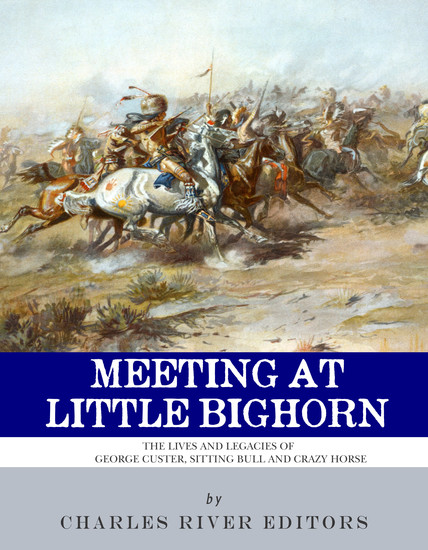
Meeting at Little Bighorn - The Lives and Legacies of George Custer Sitting Bull and Crazy Horse - cover

Meeting at Little Bighorn - The Lives and Legacies of George Custer Sitting Bull and Crazy Horse

Editors Charles River

Publisher: Charles River Editors

  • 0
  • 0
  • 0

Summary

In 1872, during a fight along the Yellowstone River between U.S. troops protecting railroad workers and Sioux warriors, one of the Sioux did something both unusual and inspiring. At the height of the battle, with bullets whizzing all around him, this warrior sat down, loaded his cannupa (sacred pipe), and began to smoke, partaking in his people’s religious sacrament. For the Sioux, smoking a pipe was akin to praying, and the smoke, wafting up through to the heavens, represented those prayers as they floated up to Wakan Tanka, the “god” of the Native Americans who occupied the North American Plains. Wakan Tanka is not the name of their god but rather a description, for the words literally mean “Great Mystery.” The Sioux warrior continued smoking until done with his pipe, and after carefully reaming and cleaning out the pipe, he rose to his feet, and rejoined the battle.
 
Of course, it was not that battle which made Sitting Bull one of the most famous Native Americans in American history. Like Geronimo in the Southwest during the same era, Sitting Bull was a warrior who fought in several skirmishes against settlers and U.S. forces across the Plains during the 1860s, and while it is still debated whether he was the "Supreme Chief of the whole Sioux Nation" by 1868, it’s clear that he was one of the influential leaders of the Lakota. And when The Great Sioux War of 1876 began, Sitting Bull was recognized as the most important leader among all Native American tribes on the Plains, and the one to turn to for those who intended to keep fighting whites. 
 
Sitting Bull ensured he would become a legend at the Battle of the Little Bighorn, during which an estimated 2,000 Lakota and Cheyenne warriors inspired by one of his visions routed and then annihilated the 7th U.S. Cavalry led by George Custer. That disaster led the American government to double down on its efforts to “pacify” the Sioux, and by the end of the decade many of them had surrendered and been moved onto a reservation. Sitting Bull defiantly refused to surrender, instead heading with a smaller band into Canada and remaining exiled.
 
Since the Battle of Little Bighorn, George Armstrong Custer (1839-1876) has possessed one of the most unique places in American history. Although he was a capable cavalry officer who served honorably during the Civil War, he remains one of the most instantly identifiable and famous military men in American history due to the fact he was killed during one of the country’s most well known and ignominious defeats, the Battle of Little Bighorn. And yet, this one relatively insignificant battle during America’s Indian Wars has become one of the country’s most mythologized events and continues to fascinate Americans nearly 140 years later.
 
Though he’s now best remembered for “Custer’s Last Stand”, George Armstrong Custer began June 25, 1876 as one of America’s better regarded cavalry officers, and a man whose ambitions might one day take him to higher office. In fact, decades before radio and television existed, Custer mastered the art of public relations, dressing impeccably and having newspaper correspondents accompany him on campaign, all in an effort to help cultivate and enhance his legacy. Custer’s efforts worked, with one biographer noting that Americans during the 19th century viewed him as “a cavalier without fear and beyond reproach."
Available since: 06/06/2025.
Print length: 103 pages.

Other books that might interest you

  • The Open Conspiracy - Blueprints for a World Revolution - cover

    The Open Conspiracy - Blueprints...

    H. G. Wells

    • 0
    • 0
    • 0
    This version of The Open Conspiracy: Blue Prints for a World Revolution was published in 1928. Apparently Wells knew this would be a temporary version and would stop printing after a year or so. It was rewritten a couple of times between then and 1933 under various other subtitles. 
    The book is, in Wells' words, a "scheme to thrust forward and establish a human control over the destinies of life and liberate it from its present dangers, uncertainties and miseries. It proposes that largely as the result of scientific progress, a common vision of a world 'politically, socially and economically unified' is emerging among educated and influential people, and that this can be the basis of 'a world revolution aiming at universal peace, welfare and happy activity' that can result in the establishment of a 'world commonwealth'." 
    Chapter index: 
    Preface 
    I. "Necessity of Religion to Human Life" 
    II. "Subordination of Self the Essence of Religion" 
    III. "Need for a Restatement of Religion" 
    IV. "Objective Expression of Modern Religion" 
    V. "The Frame of the Task Before Mankind, the World Commonweal" 
    VI. "Broad Characteristics of the World Commonweal" 
    VII. "No Stable Utopia Is Contemplated" 
    VIII. "The Open Conspiracy Must Be Heterogeneous" 
    IX. "Forces and Resistances in the Great Modern Communities Now Prevalent, Which Will Be Antagonistic to the Open Conspiracy" 
    X. "The Open Conspiracy and the Resistances of the Less Industrialised Peoples" 
    XI. "Resistances and Antagonistic Forces in Ourselves" 
    XII. "The Open Conspiracy Must Begin as a Movement of Explanation and Propaganda" 
    XIII. "Early Constructive Work of the Open Conspiracy" 
    XIV. "Existing and Developing Movements with Which the Open Conspiracy May Hope to Coalesce" 
    XV. "The Creative Home, Social Group and School: The Present Waste of Youthful Seriousness"
    Show book
  • 999 Inside Death Row in the United States - cover

    999 Inside Death Row in the...

    Arnaud Gaillard

    • 0
    • 0
    • 0
    On death row, the poorest and most numerous, with no family and no decent lawyer, are sometimes executed before all their appeals have been exhausted. Their fate consigned to modest prison cemeteries. In Texas, the number engraved on the cement stone begins with 999.
    Out of 50 American states, 34 still have the death penalty. Why and how? The author's investigation took him to California, Utah, Oklahoma, Texas, Louisiana, Tennessee, Mississippi and Pennsylvania. A human immersion into the heart of American society and its judicial system, through encounters with death row inmates, lawyers and victims' families.
    This fascinating book finely deconstructs the American myth of fair and infallible justice—from the deplorable conditions of confinement to daily abuse, from random legal recourse to political and judicial manipulation. More than just a sentence, the death penalty appears to be torture with many faces. And in an America on the move, there are signs that abolition is on the way. 
    999, is the fruit of a fact-finding mission carried out by the French association, Ensemble contre la peine de mort (ECPM), with financial support from the European Union.
    Show book
  • Fear Talking The - The True Story of a Young Man and Anxiety (Unabridged) - cover

    Fear Talking The - The True...

    Chris Westoby

    • 0
    • 0
    • 0
    Chris is sixteen. He wants to do well at college, have fun with his mates, be a good boyfriend and son. But anxiety takes its grip and won't shake loose. This is his true story.
    
    Chris Westoby takes us inside his past self, a teenager from a small English town. He's trying to be a good friend, student, son and boyfriend, but he struggles to be in company without wanting to hide. And things only get worse: it's nearly impossible to take the bus to college without catching the next bus home.
    
    His obsessive germaphobia begins to destroy his life. How can one boy overcome all this? Chris gives an unflinching, raw account of his troubles and presents what he's has learned. This book offers an outstretched hand to those fighting these same battles, or to anyone who's watching someone else go through the same.
    
    'The Fear Talking' does not promise to solve your problems, but it shows you that you're not alone. That's all Chris ever wanted, really; to unflinchingly capture the warmth and darkness of the teenage years.
    Show book
  • Flawed Predictions and Planning Errors - Why We Underestimate Time and Effort (2 in 1) - cover

    Flawed Predictions and Planning...

    William Rands

    • 0
    • 0
    • 0
    This book contains the following two titles: 
    - The Planning Fallacy: The allure of optimism has been a driving force behind humanity’s greatest achievements. It propels innovation, inspires ambition, and fosters resilience in the face of adversity. Yet, this same optimism can lead us astray, particularly when it comes to planning and executing tasks. The belief that everything will unfold as envisioned, without significant setbacks or challenges, is an enticing illusion. This overconfidence, while comforting, often masks the reality of time and resource constraints, resulting in a phenomenon known as the planning fallacy. 
      
    - The Representativeness Heuristic: The representativeness heuristic is one of the most influential concepts in cognitive psychology, profoundly shaping the way individuals make judgments and decisions. First introduced by psychologists Amos Tversky and Daniel Kahneman, this heuristic explains how people often assess probabilities and likelihoods based on how closely an event or object resembles a prototype or existing mental model. While this cognitive shortcut can be useful in navigating a complex world, it also introduces biases that distort reasoning and lead to systematic errors.
    Show book
  • The history of fashion - cover

    The history of fashion

    KidsChoice

    • 0
    • 0
    • 0
    KidsChoice: World knowledge for Children is an engaging audiobook series that takes young listeners on a fascinating journey to explore and understand the world around them. Aimed at curious children aged 7 to 99, this series dives into a variety of topics in science, society, and culture, making complex ideas accessible and exciting.  Each episode brings a unique theme to life—whether exploring the mysteries of space, uncovering the secrets of the human body, or discovering the diversity of cultures and traditions worldwide. With lively narration, interesting facts, and interactive elements, the series guides young listeners on an adventure full of discovery, encouraging them to ask questions and expand their understanding in a fun way.  In the scientific world of KidsChoice, children learn about the wonders of nature and the universe. Concepts like the solar system, animal behavior, the human body, and Earth's various ecosystems are explained in a way that is easy for kids to grasp and find fascinating. Exciting analogies and vivid examples help spark curiosity, turning learning into an adventure.  Societal topics also have a special place in the series. KidsChoice introduces young listeners to the basics of community, compassion, and making a positive impact. Children learn what it means to be a good citizen and how they can make small, meaningful contributions to their communities.  Additionally, KidsChoice opens a window to the vibrant world of global cultures. Through a virtual journey around the globe, children discover how people in other countries live, the customs and traditions they follow, the languages they speak, and the foods they enjoy. This fosters understanding and respect for diverse ways of life, celebrating the richness of human experience as a beautiful, valuable part of the world.  With its vivid language and captivating soundscapes, "KidsChoice: World knowledge for Children" turns learning into an exciting experience, sparking a lifelong curiosity and a deeper understanding of the world around them.
    Show book
  • His Finest Speeches - cover

    His Finest Speeches

    Winston Churchill

    • 0
    • 0
    • 0
    A collection of Winston Churchill's finest speeches between 1934-1946.
    Show book