

Join us on a literary world trip!
Add this book to bookshelf
Grey
Write a new comment Default profile 50px
Grey
Subscribe to read the full book or read the first pages for free!
All characters reduced
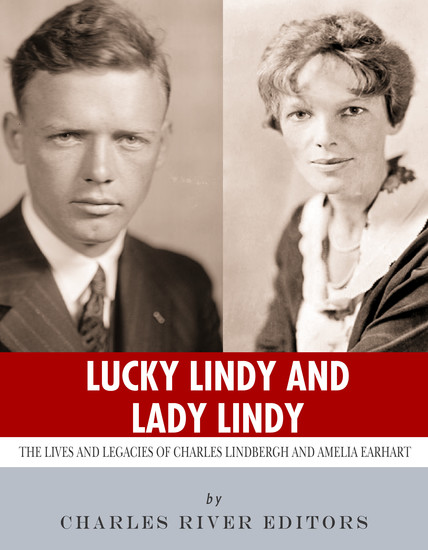
Lucky Lindy and Lady Lindy - The Lives and Legacies of Charles Lindbergh and Amelia Earhart - cover

Lucky Lindy and Lady Lindy - The Lives and Legacies of Charles Lindbergh and Amelia Earhart

Editors Charles River

Publisher: Charles River Editors

  • 0
  • 0
  • 0

Summary

Everyone has read about history’s most important people and events in dense textbooks and classrooms, but words can only say so much. In Charles River Editors’ Interactive Biography series, history comes to life in video and audio, allowing people to not only read history but truly experience it, through the eyes and ears of the people who were there.
 
In many ways, Charles Lindbergh represented the best and worst of America during the first half of the 20th century. Lindbergh became famous for being an aviation pioneer whose solo flight across the Atlantic captured the imagination of an entire world, yet he was an isolationist who wanted to keep American freedoms safe for Americans and no one else. Lindbergh was the quintessential family man, yet he fathered illegitimate children and suffered an unspeakable tragedy that became known as “The Crime of the Century.” Lindbergh embodied some of his era’s greatest virtues and harbored some of its worst prejudices.
 
Lindbergh was a 25 year old U.S. Air Mail pilot who was probably best known for two crashes before shooting to fame with his non-stop flight across the Atlantic from New York City to Paris on May 20-21, 1927. Lindbergh was Time Magazine’s first Man of the Year in 1927, and he used his newfound fame to promote the development of commercial flight and become a spokesman and symbol for advances in aviation.
 
Tragically, Lindbergh was the subject of front page headlines in 1932 when his infant son, Charles, Jr., was kidnapped and murdered in the "Crime of the Century". After going into voluntary exile in Europe, Lindbergh found himself embroiled in scandals as he toured German (and Luftwaffe) aviation systems and took isolationist stances, at times making comments that were tinged with anti-Semitism and in favor of eugenics.
 
During the early 20th century, groundbreaking technology revolutionized transportation both on the ground and in the sky, with new motors making automobiles and airplanes a reality in the 1910s. Around that same time, the feminist movement was underway in the United States, spearheaded by women seeking the right to vote, lobbying for the temperance movement, and trying to make their voices heard.
 
It was at that crossroads that flight pioneer Amelia Earhart found herself in 1919, the very year President Wilson and Congress were trying to shepherd through the 19th Amendment to the Constitution, giving women the right to vote. That year, Earhart was given a ride on a plane piloted by legendary air racer Frank Hawks, and as she recalled, "By the time I had got two or three hundred feet off the ground, I knew I had to fly."
 
Earhart’s unbridled joy for flying was only occasionally abated by a lack of finances, and a recurring sinus issue, but throughout the 1920s she was one of the few women licensed to fly, and she set an altitude record of 14,000 feet for women in 1922. In 1928, Earhart was the first woman to fly across the Atlantic Ocean, but she was disappointed that she had to do so as a passenger, complaining, “I was just baggage, like a sack of potatoes.”
 
Nevertheless, that trip made “Lady Lindy” the “Queen of the Air” in America, and Earhart was now the nation’s best known aviatrix. With her fresh face available for promoting everything from luggage to women’s clothing, Earhart was able to finance her own aviation and remain involved in promoting air travel and flying to skeptical Americans. In May 1932, Earhart finally made her solo flight across the Atlantic, for which she received the Distinguished Flying Cross from Congress, the Cross of Knight of the Legion of Honor from the French Government and the Gold Medal of the National Geographic Society from President Herbert Hoover.
Available since: 05/28/2025.
Print length: 68 pages.

Other books that might interest you

  • It's Too Late Now - The Autobiography of a Writer - cover

    It's Too Late Now - The...

    A. Milne

    • 0
    • 0
    • 0
    With characteristic self-deprecating humour, A.A. Milne recalls the formative events of his life: from a blissfully happy childhood to the writing of Winnie-the-Pooh and Christopher Robin. 
     
    ––––––––––––– 
     
    In his classic memoirs A. A. Milne, with his characteristic self-deprecating humour, recalls a blissfully happy childhood in the company of his brothers, and writes with touching affection about his father whom he adored. 
     
    From Westminster School he won a scholarship to Cambridge University where he edited the university magazine, Granta. He then went out into the world, determined to be a writer. He was assistant editor at Punch Magazine and enjoyed great success with his novels, plays and stories. And of course he is best remembered for his children's novels and verses featuring Winnie-the-Pooh and Christopher Robin. 
     
    This is both an account of how a writer was formed and a charming period piece on literary life – Milne met countless famous authors including H. G. Wells, J. M Barrie of Peter Pan fame and Rudyard Kipling. 
     
    ––––––––––––– 
     
    * Praise for It’s Too Late Now * 
     
    ‘A funny book, beautifully written’ NEIL GAIMAN 
     
    ‘A fascinating and insightful read into one of the greatest authors’ INDEPENDENT 
     
    ‘Warm and candid’ NEW YORK TIMES
    Show book
  • Book 'Em - Four Bibliomysteries by Edgar Award-Winning Authors - cover

    Book 'Em - Four Bibliomysteries...

    Thomas H. Cook, Carolyn Hart,...

    • 0
    • 0
    • 0
    The Little Men by Megan Abbott: Rumors and strange experiences lead a washed-up actress in 1950s Hollywood to question the suspicious circumstances surrounding the alleged suicide of a former occupant of her low-rent bungalow. 


    What's in a Name? by Thomas H. Cook: Rare books dealer and amateur historian Franklin Altman has always wondered how the world might have turned out if the First World War had ended differently. On the fiftieth anniversary of the Armistice Treaty, an ancient German mysteriously appears and presents him with a personal manuscript, the contents of which, he claims, have the power to change history. 


    The Book of the Lion by Thomas Perry: An anonymous phone call sends Professor Dominic Hallkyn on a mad dash through the streets of Boston in pursuit of a priceless Chaucerian manuscript. But the caller's demands will lead to a devilish plot twist. 


    From the Queen by Carolyn Hart: When a priceless, first edition of Agatha Christie's Poirot Investigates, autographed and inscribed to the Queen of England, disappears from her South Carolina thrift shop, Ellen Gallagher calls on her friend Annie Darling, owner of the mystery bookstore Death on Demand, to track it down.
    Show book
  • The Stories We Tell - Every Piece of Your Story Matters - cover

    The Stories We Tell - Every...

    Joanna Gaines

    • 0
    • 0
    • 0
    READ BY THE AUTHOR 
    AN INSTANT NEW YORK TIMES BESTSELLER 
    Imagine if all the worn-out, untrue, painful chapters of our lives started to quiet, and the beautiful, unique pieces of who we are were to rise. Imagine if the stories we tell brought us back to our true selves, back to one another. Imagine if they spoke of how we loved and lost and tried our best. How we saw it all, even the parts that hurt.Joanna Gaines' new book, The Stories We Tell, invites us on an authentic and deeply vulnerable journey into her story—and helps shine a light on the beauty of our own—guiding us to release the weights that hold us back so we may live and share our story in truth.We've all dropped anchor in places that suited us for a time: a city, a perspective, a lie we mistook as truth. This book is an invitation to a kind of life where you know how to hold what you believe—about yourself and the quiet worlds behind the people you pass—with gracious and open hands. To see your story as greater than any past or future thing, but for all the beauty and joy and hope it holds today.It’s an invitation to take stock of the chapters you’ve lived—the good and the bad, the beautiful and the ugly—glean what’s gold, and carry only that forward. Let it slow your feet and steady your life-in-motion so you can see where you stand today from a new point of view. No longer through weary or uncertain eyes, but a lens brimming with hope.—————"The only way to break free was to rewrite my story. Because something would happen every time my pen stopped: It was like my soul was coming back to my body. Like the deepest parts of me that got knocked around and drowned out by all the crap I let the world convince me about who I was came back to the surface. And what was left was only what was real and true. I was, finally, standing in the fullness of my story. I felt hopeful. I felt full. Our story may crack us open, but it also pieces us back together.We all have a story to tell. This happens to be mine—every chapter a window into who I am, the journey I’m on, and the season I’m in right now. Because this is my story, maybe you won’t always relate, or maybe it will feel like you’re looking in a mirror. Whatever we have in common and whatever differences lie between us, I only hope my story can help shine a light on the beauty of yours. That my own soul work will stir something of your own. And that by the time you get to the end of my story, you’re also holding the beautiful beginnings of your own.A story only you can tell. And I hope that you will."-Joanna
    Show book
  • Never Know Your Place - Memoir of a Rulebreaker - cover

    Never Know Your Place - Memoir...

    Martin Naughton

    • 0
    • 0
    • 0
    Every young person is looking for freedom,
    
    but some have to fight harder than others …
    In 1960s Ireland there was a special place for disabled children: behind the walls of an institution, cut off from the rest of society.
    At just nine years old, Martin Naughton was one of these children. Along with his younger sister Barbara he was sent to a Dublin institution, far away from his Irish-speaking home in Spiddal.
    But Martin wouldn't be sidelined. With the help of some unexpected characters – and an unlikely encounter with his Celtic Football heroes – he began to change the way a generation of young disabled people saw themselves.
    This is the story of a boy who not only won his own independence, but also led the fight for freedom for all disabled people.
    'Martin was a formidable and tireless campaigner for the right of people with disabilities to live in their own communities and homes.' President Michael D. Higgins
    'Martin Naughton was a protector, a leader, a gamechanger. In reading this narration of his life, tears filled my eyes.' Dr Rosaleen McDonagh, playwright, rights activist and author of Unsettled.
    Show book
  • The Ballad of Karla Faye Tucker - cover

    The Ballad of Karla Faye Tucker

    Mark Beaver

    • 0
    • 0
    • 0
    On a June night in 1983, twenty-three-year-old Karla Faye Tucker and her boyfriend, fueled by a sinister cocktail of illicit drugs, broke into a Houston apartment. "We were very wired," Tucker later testified, "and we was looking for something to do." Though they later claimed they entered the premises with no murderous intent, they ended up slaughtering two people—one a sworn enemy, the other an utter stranger. The weapon: a pickax they found in the apartment.
    
    Fourteen years later, in early 1998, Tucker was facing lethal injection. But after her religious conversion in prison, Texas would be executing a different woman than the one who'd committed the murders. Her change was so dramatic that the most powerful and influential voices in American televangelism—Pat Robertson and Jerry Falwell among them—were urging viewers to contact Texas's governor, George W. Bush, and plead for clemency. One follower was author Mark Beaver's father, a devout Southern Baptist deacon who asked Beaver to put his fledgling literary ambitions to work by composing a letter on his behalf to Governor Bush.
    
    Through a merger of true crime, social history, and memoir, The Ballad of Karla Faye Tucker illustrates how a seemingly distant news story triggers a national reckoning and exposes a growing divide in America's evangelical community. It's a tale of how one woman defies all conventions of death row inmates, and her saga serves as an unlikely but fascinating prism for exploring American culture and the limits of forgiveness and transformation. It's also a deeply personal reflection on how a father's request leads his son to struggle with who he was raised to be and who he imagines becoming.
    Show book
  • Nothing to Be Frightened Of - cover

    Nothing to Be Frightened Of

    Julian Barnes

    • 0
    • 0
    • 0
    A memoir on mortality as only Julian Barnes can write it, one that touches on faith and science and family as well as a rich array of exemplary figures who over the centuries have confronted the same questions he now poses about the most basic  
    fact of life: its inevitable extinction. If the fear of death is “the most rational thing in the world,” how does one contend with it? An atheist at twenty and an agnostic at sixty, Barnes looks into the various arguments for, against, and with God, and at  
    his own bloodline, which has become, following his parents’ death, another realm of mystery. 
     
    Deadly serious, masterfully playful, and surprisingly hilarious, Nothing to Be Frightened Of is a riveting display of how this supremely gifted writer goes about his business and a highly personal tour of the human condition and what might follow the final diagnosis.
    Show book
