Join us on a literary world trip!
Add this book to bookshelf
Grey
Write a new comment Default profile 50px
Grey
Subscribe to read the full book or read the first pages for free!
All characters reduced
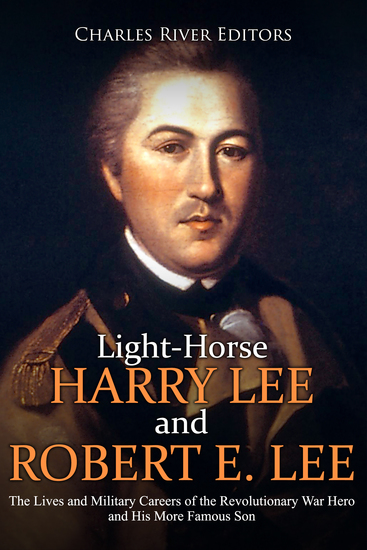
Light-Horse Harry Lee and Robert E Lee - The Lives and Military Careers of the Revolutionary War Hero and His More Famous Son - cover

Light-Horse Harry Lee and Robert E Lee - The Lives and Military Careers of the Revolutionary War Hero and His More Famous Son

Editors Charles River

Publisher: Charles River Editors

  • 0
  • 0
  • 0

Summary

nation demands his saving arm.” – Henry Lee III
 
The proud Virginian entered the war in uncertain times, and there were understandable doubts about how well he could lead soldiers, but through a combination of skill and luck, he became one of his country’s earliest and foremost military heroes. After the war, he would go on to a distinguished political career, and he would find himself caught up in civil unrest toward the end of his life.
 
Some of those details might bring to mind the life story of George Washington, and if those details included the name Lee, most of them would immediately sound like a description of Robert E. Lee’s life. In fact, they only begin to scratch the surface of the life and career of Robert E. Lee’s father, Henry Lee III, who is best known by the nickname “Light-Horse Harry” for the way he excelled as a cavalry officer during the Revolutionary War. 
 
When the Revolution began, the Continental Army sported numerous volunteers from Ireland, Scotland, virtually every European nation between France and Russia, and men from the northern and southern borders of the European continent. This is understandable, given that at the start of the war, military confrontations between the world powers had become so common that combat was raised to the status of a fine art, consuming a large portion of time for adolescent males in training and comprising a sizeable component of the economy. Weaponry was developed to a degree of quality not accessible to most North Americans, and European aristocrats were reared in the mastery of swordsmanship with an emphasis on the saber for military use. Likewise, the cavalry, buoyed by a tradition of expert horsemanship and saddle-based combat, was a fighting force largely beyond reach for colonists, which meant that fighting on horses was an undeveloped practice in the fledgling Continental Army, and the American military did not yet fully comprehend the value of cavalry units. Few sword masters were to find their way to North America in time for the war, and the typical American musket was a fair hunting weapon rather than a military one. Even the foot soldier knew little of European military discipline.
 
All of this helps explain why, aside from George Washington, many Americans are likely able to name just as many foreign generals on the rebel side as American generals. While names like Lafayette, Pulaski, Kościuszko, and Baron von Steuben are quickly associated with the Revolution, American officers like Nathanael Greene, Anthony Wayne, Horatio Gates, Henry Knox, and Light-Horse Harry Lee are often overlooked. Over 200 years later, Lee is best remembered not for his military or political service, but for being Robert E. Lee’s father, and all the attendant controversy that comes with his son’s legacy. This is unfortunate, given that he was one of the most distinguished individuals of the age.
 
With the exception of George Washington, perhaps the most famous general in American history is Light-Horse Harry’s son, despite the fact Robert E. Lee led the Confederate Army of Northern Virginia against the Union in the Civil War. Lee was imbued with a strong sense of honor and duty from the beginning, and as a top graduate of West Point, Lee had distinguished himself so well before the Civil War that President Lincoln asked him to command the entire Union Army. Lee famously declined, serving his home state of Virginia instead after it seceded.
 
Lee is remembered today for constantly defeating the Union’s Army of the Potomac in the Eastern theater from 1862-1865, considerably frustrating Lincoln and his generals. His leadership of his army led to him being deified after the war by some of his former subordinates, especially Virginians, and he came to personify the Lost Cause’s ideal Southern soldier. His reputation was secured in the decades after the war as a general who brilliantly led his men to amazing victories against all odds.
Available since: 05/01/2025.
Print length: 116 pages.

Other books that might interest you

  • The Bell Pepper - cover

    The Bell Pepper

    Sherman T. Hancock

    • 0
    • 0
    • 0
    All dick is not the same! Some are long, and some are short. Some are skinny, some are girthy, some curve, and some have extra skin covering the head. I can repeatedly list countless differences we hear about through comedians, influencers, personalities, and radio and talk show hosts. You see women discussing it on various platforms, laughing to their heart’s content with their fellow sisters, and we, as men, accept this fact and what it means when it comes to our sex, but what about the reverse?  
    It seems no one talks about the different things that make up “good poon.” I mean, yes, there is the “smelly poon” remark that gets thrown around, and now and again, you’ll hear things about a “deep, loose poon” or a “roast beef poon,” but is that all it comes down to? Are you suddenly in the top 1% if you do not subscribe to those phrases?  
    I’m here to tell you no. Just like women, men too have talked about the size, the shape, the inside, and many more aspects that all go into what we consider to be “good poom poom,” and we’ve discussed it at length, behind closed doors, details of the feminine parts that never make its way to the town square. No man is loud enough, bold enough, or cares enough to sing the song of the thing that eats the thong, but I, Sherman T. Hancock, have sung!  
    So, I present to you the Opera of the Bell. Pull the feet of this book close to the edge of the bed, open its legs, lick your fingers and turn the pages, move that leaf to the side, and stick your face in it. I promise you will not stop reading until you have entirely uncovered the secrets hidden deep within this paprika in a bottle, pimento in a bowl, cum inside this capsicum, and discover the Bell Pepper. 
    Show book
  • Black Chameleon - Memory Womanhood and Myth - cover

    Black Chameleon - Memory...

    Deborah D.E.E.P. Mouton

    • 0
    • 0
    • 0
    This program is read by the author.In the literary tradition of Carmen Maria Machado’s In the Dream House, Maxine Hong Kingston’s The Woman Warrior, and Jesmyn Ward’s Men We Reaped, this debut memoir confronts both the challenges and joys of growing up Black and making your own truth.Growing up as a Black girl in America, Deborah Mouton felt alienated from the stories she learned in class. She yearned for stories she felt connected to—true ones of course—but also fables and mythologies that could help explain both the world and her place in it. What she encountered was almost always written by white writers who prospered in a time when human beings were treated as chattel, such as the Greek and Roman myths, which felt as dusty and foreign as ancient ruins. When she sought myths written by Black authors, they were rooted too far in the past, a continent away.Mouton writes, “The phrases of my mother and grandmother began to seem less colloquial and more tied to stories that had been lost along the way. . . . Mythmaking isn’t a lie. It is our moment to take the privilege of our own creativity to fill in the gaps that colonization has stolen from us. It is us choosing to write the tales that our children pull strength from. It is hijacking history for the ignorance in its closets. This, a truth that must start with the women.”Mouton’s memoir Black Chameleon is a song of praise and an elegy for Black womanhood. With a poet’s gift for lyricism and poignancy, Mouton reflects on her childhood as the daughter of a preacher and a harsh but loving mother, living in the world as a Black woman whose love is all too often coupled with danger, and finally learning to be a mother to another Black girl in America. Of the moment yet timeless, playful but incendiary, Mouton has staked out new territory in the memoir form.A Macmillan Audio production from Henry Holt & Company.
    Show book
  • Takka Takka Bom Bom - An Intrepid War Correspondent's 50 Year Odyssey - cover

    Takka Takka Bom Bom - An...

    Al J. Venter

    • 0
    • 0
    • 0
    The world’s oldest still-active war correspondent shares the real stories behind half a century of headlines from the front lines.
    
    The world’s oldest still-active war correspondent, Al J. Venter, has reported from the front lines for well over half a century, witnessing the horrors humanity visits upon itself in twenty-five conflict zones across Africa, the Middle East, and Central Asia.
    
    In this memoir, Venter masterfully recounts his experiences, sharing the real stories behind the headlines and the sharp lessons he learned that enabled him to survive his countless exploits, ranging from exposing a major KGB operative in Rhodesia entirely by accident, and accompanying an Israeli force led by Ariel Sharon into Beirut, to gun-running into the United States.
    Show book
  • Daily History Facts - cover

    Daily History Facts

    Anonymous

    • 0
    • 0
    • 0
    Every day, a little bit of history disappears into time, then we create more new history that requires attention and study. This book aims to preserve pieces of our historical record for posterity.
    Show book
  • Embrace Your Cycle: Transformative Insights for Thriving Women - "Unlock your potential with empowering audio insights for women ready to thrive!" - cover

    Embrace Your Cycle:...

    Kieran Ashcroft

    • 0
    • 0
    • 0
    Embrace Your Cycle: Transformative Insights for Thriving Women   
    Are you ready to enhance your career and deepen your understanding of your own body by embracing your cycles? 
    Searching for a comprehensive guide that equips you with the essential knowledge to transform your life? 
    Your journey of self-discovery starts now! 
    This audiobook acts as your ultimate companion for gaining valuable insights, applying your newfound knowledge, and engaging in practical exercises. With this resource, you're on the path to thriving. 
    Updated for a transformative experience in understanding your body's rhythms. 
    Key features of this enriching guide: 
    - Deep insights into women's cycles and how they impact daily life 
    - Thorough explanations of the physiological changes that occur throughout your cycle 
    - Effective strategies for harnessing your cycle to enhance your personal and professional life 
    This guide stands out due to its in-depth coverage, crucial for your personal growth. Concepts are not just glossed over; they are explored with clarity and depth. 
    Please be advised that this guide is an independent resource and not associated with any official entity. 
    Crafted with a clear structure and accessible language, our guide ensures seamless transitions between topics. Say goodbye to overwhelming jargon and embrace straightforward, precise, and technically accurate content. 
    So, why hesitate? Click the BUY NOW button, secure your guide, and embark on your journey toward understanding and thriving with your body’s rhythms! 
    Embrace Your Cycle: Transformative Insights for Thriving Women
    Show book
  • Famous Men of Modern Times - cover

    Famous Men of Modern Times

    John Henry Haaren, A. B. Poland

    • 0
    • 0
    • 0
    “Famous Men of the Middle Ages” features attractive biographical sketches of thirty-five of the most prominent characters in the history of the Middle Ages, from the barbarian invasions to the invention of the printing press. Each story in this book by John Haaren is told in a clear, simple manner, and is well calculated to awaken and stimulate the youthful imagination. Notable characters featured in “Famous Men of the Middle Ages” include Attila the Hun, Charlemagne, William the Conqueror, Frederick Barbarossa, Marco Polo, and William Tell. This book also includes a chapter about one woman: Joan of Arc. This book provides a great introduction to the Middle Ages, not only for children, but for adults who missed out on studying some of the more fascinating figures during this time period. John Haaren, who also wrote Famous Men of Greece, Famous Men of Rome, and Famous Men of the Middle Ages, was an American educator and historian. Haaren's father was German and his mother Irish. He studied under Professor N. M. Butler at Columbia University, 1889-91, before becoming a teacher in New York. In 1907 he became Associate Superintendent of Schools in New York, increasing the number and efficiency of kindergartens and starting classes to teach English to foreigners. He was president of the department of pedagogy in the Brooklyn Institute. Haaren High School which was located in Manhattan named in his honor. The Charles B. J. Snyder-designed school, which was initially De Witt Clinton High School, is now Haaren Hall on the campus of the John Jay College of Criminal Justice.
    Show book