Join us on a literary world trip!
Add this book to bookshelf
Grey
Write a new comment Default profile 50px
Grey
Subscribe to read the full book or read the first pages for free!
All characters reduced
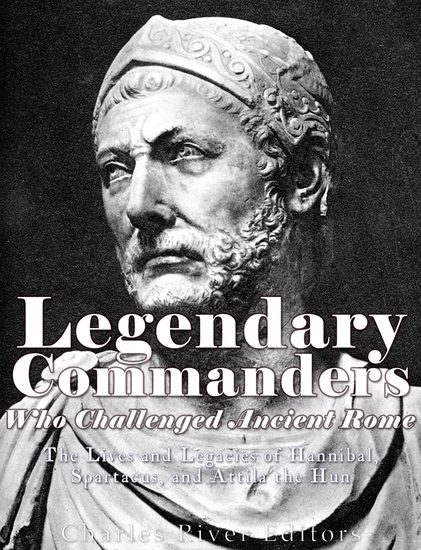
Legendary Commanders Who Challenged Ancient Rome - The Lives and Legacies of Hannibal Spartacus and Attila the Hun - cover

Legendary Commanders Who Challenged Ancient Rome - The Lives and Legacies of Hannibal Spartacus and Attila the Hun

Editors Charles River

Publisher: Charles River Editors

  • 0
  • 0
  • 0

Summary

In the history of war, only a select few men always make the list of greatest generals. Napoleon. Caesar. Alexander. They are always joined by Hannibal, who has the distinction of being the only man who nearly brought Rome to its knees before its decline almost 700 years later. Rome never suffered a more horrifying defeat in its history than at Cannae, and indeed, Hannibal nearly rewrote the course of Western history during the Second Punic War. Even today there remains great debate on just how he accomplished his masterful invasion of Italy across the Alps. Since his army included war elephants, historians still argue over exactly where and how he crossed over 2,000 years after he managed that incredible feat.
 
Hannibal will always be listed among history’s greatest generals, and his military campaign in Italy during the Second Punic War will always be studied, but part of the aura and mystique surrounding the Carthaginian legend is that there is still a lot of mystery. Since Carthage was destroyed by Rome a generation after Hannibal, most of what is known about Hannibal came from the very people he tormented in the late 2nd century B.C., and thus much of his background and life story is unknown. Moreover, while military historians are still amazed that he was able to maintain his army in Italy near Rome for nearly 15 years, scholars are still puzzled over some of his decisions, including why he never attempted to march on Rome in the first place.
 
Spartacus is the world’s most famous slave, and one of the most notorious figures of Ancient Rome. A slave enamored of freedom and willing to fight and die for it, he became especially popular in the years following the Enlightenment, after which he was widely viewed as a poignant champion of liberty in the 18th and 19th centuries. As a result, he became a symbol during struggles like the French Revolution, the American Revolution, the American Civil War and the struggle for emancipation.
 
Today, his dual life as a gladiator and a “freedom fighter” makes him fascinating to audiences around the world. His tale, a blend of violent spectacle and civil rights, has been adapted for film (Stanley Kubrick’s memorable Spartacus), television (Starz’s popular television series), and in literature (appearing in everything from historical novels to comics). To this day, Spartacus (Spartaco) is a popular first name in central and southern Italy, and his name has been adopted by sports teams like FC Spartak Moscow and FC Spartak Plovdiv. The Soviet Union’s internal version of the Olympics, the Spartakiad, also derived its name from Spartacus.
 
Attila, Emperor of the Hunnic Empire and thus most commonly known as Attila the Hun, is an idiosyncratic figure who has become more myth than man, not least because much of his life is shrouded in mystery. Perhaps the most famous “barbarian” in history, Attila was the lord of a vast empire spanning two continents, but he is best remembered for what he did not conquer. Though he seemingly had Rome at his mercy in 452, he ultimately decided not to sack the Eternal City, and a year later he had suffered a mysterious death.
 
What is known about Attila came mostly from Priscus, a guest of his court who wrote several books about Attila’s life in Greek. Unfortunately, much of that work was lost to history, but not before the ancient writer Jordanes relied on it to write his own overexaggerated account of Attila’s life. And like their leader, the Huns themselves are an instantly recognizable name with mysterious origins; most of what is known about the Huns came from Chinese sources thousands of miles and an entire continent away from Italy. Naturally, the dearth of information and the passage of time have allowed myths and legends to fill in the most important details of Attila’s life. 
Available since: 05/02/2025.
Print length: 110 pages.

Other books that might interest you

  • Spanish Phrasebook for Everyday Life and Travel - Your Practical Spanish Companion for Travel Everyday Life and Real Conversations - cover

    Spanish Phrasebook for Everyday...

    Lingosmith Lab

    • 0
    • 0
    • 0
    Your Practical Spanish Companion for Travel, Everyday Life, and Real Conversations 
    Traveling to a Spanish-speaking country? Meeting Spanish-speaking friends or coworkers? 
    This phrasebook is your easy, go-to guide to using real Spanish in real situations. 
    "Spanish Phrasebook for Everyday Life and Travel" is designed for beginners, tourists, and everyday learners who want to communicate without memorizing grammar rules. From ordering food to navigating transportation or conversing, you'll have the phrases you need when you need them. 
    Who This Book Is For: 
    First-time travelers to Spanish-speaking countries 
    Beginners who want quick wins 
    Students, digital nomads, or expats 
    Anyone who wants to feel more connected while abroad 
    What Makes This Phrasebook Different 
    Real-World Usefulness – No fluff. No grammar lessons. Just practical phrases for real situations. 
    Jump-In Navigation – Organized by topic for quick reference—no need to read cover-to-cover. 
    Easy Pronunciation Help – Includes bolded phonetic guides for every phrase to help you confidently speak. 
    Mini Conversations – End-of-chapter dialogues help you see phrases in action. 
    Cultural Confidence – Navigate local customs and speak respectfully. 
    Inside You’ll Find Phrases For: 
    Travel & Transportation – Airports • Checking In • Security & Boarding • On the Plane • Arrival & Immigration • Public Transit • Taxis • Renting Cars 
    Lodging – Hotels • Checking In & Out • Amenities & Issues During Stay 
    Dining & Food – Menus • Ordering at Restaurants • Dietary Needs & Allergies • At the Bar • Drinks 
    Shopping & Money – Souvenirs • Clothes • Grocery Stores • Bargaining • ATMs • Currency Exchange • Banking 
    Health & Emergencies – Medical Help • Pharmacies • Police Assistance • First Aid • Lost & Found 
    Leisure & Social Life – Romance • Going Out • Social Media • Making Friends • Events 
    Family & Kids – Family Terms • Traveling with Children • Introductions • Age & Profession.
    Show book
  • The Arabic Freud - Psychoanalysis and Islam in Modern Egypt - cover

    The Arabic Freud -...

    Omnia El Shakry

    • 0
    • 0
    • 0
    The first in-depth look at how postwar thinkers in Egypt mapped the intersections between Islamic discourses and psychoanalytic thoughtIn 1945, psychologist Yusuf Murad introduced an Arabic term borrowed from the medieval Sufi philosopher and mystic Ibn ‘Arabi—al-la-shu‘ur—as a translation for Sigmund Freud’s concept of the unconscious. By the late 1950s, Freud’s Interpretation of Dreams had been translated into Arabic for an eager Egyptian public. In The Arabic Freud, Omnia El Shakry challenges the notion of a strict divide between psychoanalysis and Islam by tracing how postwar thinkers in Egypt blended psychoanalytic theories with concepts from classical Islamic thought in a creative encounter of ethical engagement.Drawing on scholarly writings as well as popular literature on self-healing, El Shakry provides the first in-depth examination of psychoanalysis in Egypt and reveals how a new science of psychology—or “science of the soul,” as it came to be called—was inextricably linked to Islam and mysticism. She explores how Freudian ideas of the unconscious were crucial to the formation of modern discourses of subjectivity in areas as diverse as psychology, Islamic philosophy, and the law. Founding figures of Egyptian psychoanalysis, she shows, debated the temporality of the psyche, mystical states, the sexual drive, and the Oedipus complex, while offering startling insights into the nature of psychic life, ethics, and eros.This provocative and insightful book invites us to rethink the relationship between psychoanalysis and religion in the modern era. Mapping the points of intersection between Islamic discourses and psychoanalytic thought, it illustrates how the Arabic Freud, like psychoanalysis itself, was elaborated across the space of human difference.
    Show book
  • War of Art The: Book summary & analysis - cover

    War of Art The: Book summary &...

    Briefly Summaries

    • 0
    • 0
    • 0
    This is a concise summary and analysis of The War of Art, by Steven Pressfield. It is not the original book and is not affiliated with or endorsed by Steven Pressfield. Ideal for those seeking a quick and insightful overview.
     
    "The War of Art" delves into the struggle faced by artists in their creative endeavors, exploring resistance and the methods to overcome it. It offers insights into motivation, discipline, and the creative process, emphasizing perseverance and dedication. The authors examine psychological barriers that prevent artistic expression, advocating for a disciplined approach to creativity. This book is a guiding light for artists seeking to understand and conquer the internal battles that hinder their creative potential.
    Show book
  • Manipulation - A Complete Guide To Using Dark Psychology To Manipulate Influence Persuade And Control The Mind: NLP Body Language and How to Analyze People (Vol 2) - cover

    Manipulation - A Complete Guide...

    Adam Schultz

    • 0
    • 0
    • 0
    Highly Effective Techniques to Persuade and Influence Anyone! – Vol. 2 
      
    Manipulation can take many different forms. It can be used as a way of asking for a favor or manipulating others without being aware of it. Essentially, this is a tactic that is used to get someone to do something important. The following audiobook discusses 30 techniques that you can use to help you control somebody properly. While many people will see manipulation as a dishonest act, something that is evil and difficult to counter, manipulation is actually manipulating others to do what you want them to do. Whether you're trying to sell a product, a service, or just get someone to do you a favor, you're going to learn that coercion will help you get those kinds of results. 
    The fact is, we are imperfect human beings. We have some vulnerabilities. And if you research and get to know these vulnerabilities, you're going to have a huge power in your hands. Once you learn the right manipulation techniques, the real ones, it's entirely possible to manipulate other people's thoughts and make them do what you want. 
    Here's what you'll master with this bundle (Vol. 1 and Vol. 2):Using body language to become a fantastic communicatorInterpreting gestures, and subtle signs to analyze othersPersuading people with easeRecognizing when someone is manipulating youDefending yourself from every type of manipulatorDealing with an abusive or manipulative partnerUsing manipulation as a means of persuasionRaising your emotional intelligence and self-awarenessKnowing exactly how to act in any type of social or work situation 
      
    And much more! 
    So, What You're Waiting For, Get Started Today!
    Show book
  • The Planning Fallacy - Underestimating the Time and Costs Required for Tasks - cover

    The Planning Fallacy -...

    William Rands

    • 0
    • 0
    • 0
    The allure of optimism has been a driving force behind humanity’s greatest achievements. It propels innovation, inspires ambition, and fosters resilience in the face of adversity. Yet, this same optimism can lead us astray, particularly when it comes to planning and executing tasks. The belief that everything will unfold as envisioned, without significant setbacks or challenges, is an enticing illusion. This overconfidence, while comforting, often masks the reality of time and resource constraints, resulting in a phenomenon known as the planning fallacy. 
    At its core, the planning fallacy arises from our tendency to underestimate the time, effort, and costs required to complete tasks, regardless of past experiences. Even seasoned professionals and experienced teams are not immune to this bias, often succumbing to unrealistic timelines and budgets. The hidden costs of this fallacy ripple through personal lives, businesses, and large-scale projects, leaving behind missed deadlines, financial overruns, and unmet expectations. 
    On an individual level, the planning fallacy can manifest in simple daily scenarios. People frequently underestimate how long it will take to commute, complete errands, or prepare for events. This miscalculation leads to stress, frustration, and a constant feeling of being behind. In professional settings, it becomes even more pronounced, as teams juggle complex projects with high stakes. Unrealistic deadlines can push employees to their limits, fostering burnout and reducing overall productivity.
    Show book
  • The Communist Experiment - Historical Insights in Communist States and Their Legacy - cover

    The Communist Experiment -...

    Arlo Holders

    • 0
    • 0
    • 0
    Communism is one of the most influential and controversial ideologies in modern history. At its core, communism seeks to establish a classless society in which the means of production are collectively owned, and wealth is distributed according to need. This vision of equality and social justice has inspired revolutions, political movements, and significant social change across the globe. However, it has also sparked intense debate, criticism, and conflict, making it a complex and multifaceted subject. 
    The origins of communism trace back to the 19th century, with the works of German philosophers Karl Marx and Friedrich Engels laying its intellectual foundation. Their seminal text, The Communist Manifesto (1848), outlined the principles of communism and called for the working class, or proletariat, to rise against the bourgeoisie, the ruling capitalist class. Marx and Engels argued that capitalism inherently exploits workers, creating vast inequalities that would eventually lead to its collapse and the emergence of a socialist society as a transitional phase toward communism. 
    A key concept in Marxist theory is historical materialism, which posits that societal progress is driven by the struggle between opposing economic classes. According to this view, history has evolved through stages—such as feudalism and capitalism—each defined by its mode of production and class relations. Communism represents the final stage, where class distinctions disappear, and humanity achieves true freedom and equality.
    Show book