Join us on a literary world trip!
Add this book to bookshelf
Grey
Write a new comment Default profile 50px
Grey
Subscribe to read the full book or read the first pages for free!
All characters reduced
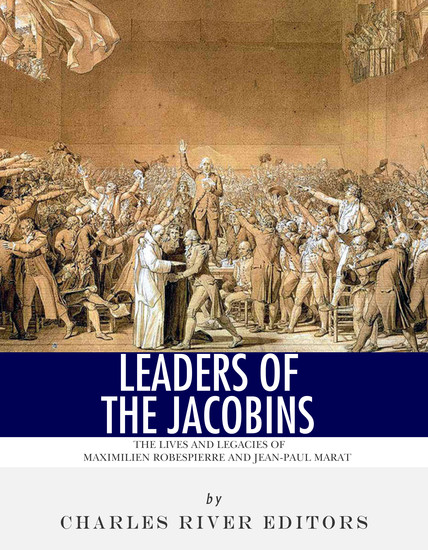
Leaders of the Jacobins - The Lives and Legacies of Maximilien Robespierre and Jean-Paul Marat - cover

Leaders of the Jacobins - The Lives and Legacies of Maximilien Robespierre and Jean-Paul Marat

Editors Charles River

Publisher: Charles River Editors

  • 0
  • 0
  • 0

Summary

“Citizens, did you want a revolution without a revolution?” – Maximilien Robespierre
 
In many ways it is fitting that Maximilien Robespierre (1758-1794) is one of the best known figures of the French Revolution, if not its most famous. The early years of the Revolution were fueled by Enlightenment ideals, seeking the social overthrow of the caste system that gave the royalty and aristocracy decisive advantages over the lower classes. Few were as vocal in their support of Enlightenment ideals as Robespierre, who was heavily versed in Rousseau and Montesquieu, a champion of the bourgeoise, and an advocate of human rights who opposed both slavery and the death penalty.    
 
But history remembers the French Revolution in a starkly different way, as the same leaders who sought a more democratic system while out of power devolved into establishing an incredibly repressive tyranny of their own once they acquired it. For that reason, the Reign of Terror became the most memorable aspect of the Revolution, and at the head of it all was Robespierre, whose position on the Committee of Public Safety made him the Reign of Terror’s instrumental figure, until he himself became a victim of the Revolution’s extremism.
 
Robespierre has remained one of the Revolution’s most controversial figures, an enigma in both life and death. Known as “The Incorruptible” to supporters and a bloodthirsty dictator to his opponents, what all could agree on was that he was a vital figure during one of history’s most momentous events.
 
Marat’s work during the French Revolution and his notorious death at the height of it remain the best known details of his life. Indeed, the image of the Death of Marat by Jacques-Louis David is one of the most commonly associated with the Revolution. But those facts have obscured what the man himself was really like. A trained scientist who served as a doctor before the Revolution, Marat counted among his acquaintances luminaries like Goethe and Benjamin Franklin. At the same time, Marat was an Enlightened political philosopher who advocated for basic human rights and reforms such as fair trials by jury.  
 
Of course, all of his work took a backseat to his writing as “Friend of the People” at the beginning of the Revolution, setting Marat down his fateful path. Perhaps no revolutionary has a more controversial legacy; Marat has long been praised by those who appreciate his work on behalf of the masses, and reviled by those who point out his violence and the course of the Jacobin-led Reign of Terror. Leaders of the Jacobins looks at the life and work of one of history’s most famous revolutionaries, explaining his role in the French Revolution and analyzing his legacy. Along with pictures of important people, places, and events, you will learn about Marat like you never have before, in no time at all.
Available since: 05/15/2025.
Print length: 95 pages.

Other books that might interest you

  • Kishore Rao: Care Starts With A 'K' - From The Mitra Tantra Archive Of Personal Narratives - cover

    Kishore Rao: Care Starts With A...

    Ranjan Kamath

    • 0
    • 0
    • 0
    To Kishore Rao, the words of Rabindranath Tagore enshrine the belief behind Karunashraya: "Death is not extinguishing the light It is putting out the light because the dawn has come."
    Show book
  • Chronicle The - Book Three - Full-cast dramatisation - cover

    Chronicle The - Book Three -...

    Mr Punch

    • 0
    • 0
    • 0
    The Chronicle – Book Three (July to September) 
      
    This is history... but not as you know it! At Waterloo, women are stripping the corpses of their valuable shoes and stockings yet the Highlanders are left in mass graves with their coarse tartan socks still on. Roy Strong attending a private dinner with the Prime Minister notes that Margaret Thatcher in floaty chiffon is "the apotheosis of the boss's wife, with the appeal of cosmeticised putty." Even at the  coronation of George IV, Queen Caroline, who is denied entry to the Abbey, is observed looking like "a blowsy landlady". As for the nude revue 'Oh Calcutta', it is noted that "there are some parts of the anatomy over whose movements the choreographer has no control”.  Join Fanny Kemble as she travels at break-neck speed aboard Stephenson's Rocket and Joyce Grenfell as she washes her tennis balls and bakes them in the oven while Lord Byron conducts a fiery seaside funeral of his close friend Shelley. 
     
    “It’s WONDERFUL.  In fact, I would describe it as one of the all-time audio greats... an unmissable five-star production.”  (The Guardian) 
    “I recommend the reader to hunt down and buy this series wherever it may be found.”  (The Spectator) 
     
    Dramatised and performed by a distinguished cast of over 30 actors, including Charles Dance, Harriet Walter, David Suchet, Timothy West, James Bolam, Maureen Lipman, Robert Powell, Jenny Agutter, Joss Ackland, Eleanor Bron, John Sessions, Imogen Stubbs. 
     
    Also available as part of the CHRONICLE BOX SET, over 11 hours of audio bliss.
    Show book
  • Pickles and Milhous Fly Again - Yet Another Pocketful of Funny Life Stories - cover

    Pickles and Milhous Fly Again -...

    Eric Litsky

    • 0
    • 0
    • 0
    “What do you say to a guy in his underwear? Outside of his apartment. Holding an oversized bird cage with two chirping parakeets? 
    That guy was me. Here’s what happened…” 
    So begins the third installment of true life short stories from master comedic storyteller,  Eric Litsky.   
    From rollicking good times, to the shenanigans of a young boy, to poignant moments that stay with you for life, you’ll laugh out loud and feel like you’re right there - in equal trouble or trepidation, laughter or love, all depending on the captured moment. 
    Most of us go through life with our little mishaps and anecdotes. Few of us can recall and captivate an audience with their re-tell like Litsky can.  
    Pick up this book today and read something that will make you smile. 
    Litsky is also the author of Harry Would be So Proud and Frying Pork Chops Naked.
    Show book
  • The Turpentine Tree - cover

    The Turpentine Tree

    Lynne Hjelmgaard

    • 0
    • 0
    • 0
    The Turpentine Tree is an enduring symbol of memory, fragile but enduring the passage of time and still persisting: in the title poem, Lynne Hjelmgaard describes it 'a coppery faux god / with wildly twisted branches'. It might slip into the void, but here it is for now 'flying into the eye of the storm.' Hjelmgaard employs strong, sensuous imagery to capture moments from across her remarkable life.
    These are portraits of family, friends and relationships – of Hjelmgaard's uprooted life, including a life at sea, the subsequent displacement, widowhood and search for connections. Often the remembrances in poems are sweet-bitter, recalling friends and lovers lost, including the writer's late partner Dannie Abse. These explorations of loss are extremely moving, but the poems also communicate the value of a rich bank of memories which range around from spectating on a girl being punished at camp ('Summer Camp'), a Florida roadtrip with friends ('1969'), or an 'Evening Flight from Copenhagen.' Very often the speakers are in transit, travelling through, and so the poems hold onto intense, lucid or epiphanic moments.
    There's an honesty, easiness and at times humour about the language. Vulnerability and strength walk side by side to give an extraordinary depth of experience for the reader. There's a visitation from her dead lover; her husband's spirit is safe in her wardrobe in a plastic bag; her father's ghost is on a WWII battleship in Norfolk Harbour and later waits for her in a crowd of strangers at Miami airport.
    These snapshots are sometimes based on real photographs, or at other times are imaginary photographs; Hjelmgaard questions 'Did we really exist? Yes – / the photograph answers' ('The Photograph Answers'). Threaded throughout all these memories is the gorgeous vividness of nature – the sea, animals, and creatures – which take speakers out of human concerns to a more connected relation with the world. The Turpentine Tree is about intangible presences which open up memory and move beyond it, towards a universal interconnectedness.
    How far back does grief go? What is lost, what can be found? Is memory transferred between us without words, years later, is the unsayable felt? 
    (from 'On the Atlantic Coast of Spain')
    'Lynne Hjelmgaard is truthful yet unrepentant. An American poet, determined to be alive.' - Robert Minhinnick, author of Diary of the Last Man
    'These poems keep a distinctive balance between distance and closeness – a  wide span across decades, between continents, hand in hand with crisp small moments that encapsulate a life. Closeness, too, in the intimacies at the heart of this collection, held with a lucid sensitivity that's never sentimental, staying true to individual relationships while melting into universal themes of love, loss, letting go and celebration.' -   Philip Gross, author of The Thirteenth Angel
    'Who is this person from so many places? Lynne Hjelmgaard grew up in Stuyvesant Town NYC, lived in Denmark, in Paris, in England, in the Caribbean -- did she really sail on a boat? What is she telling us? Everything she carries within, at any time. A unique, unusual life reflected on in poems of intimate address to the reader/companion. Delicate, beautiful, detailed from an amazing memory. Childhood, womanhood, children, aging, loves, mixed as everything is in the one body/mind. Tender and magical.' - Alice Notley, author of For the Ride
    Show book
  • The Good Fight - cover

    The Good Fight

    Shirley Chisholm

    • 0
    • 0
    • 0
    The revered civil rights activist and pioneering member of Congress chronicles her groundbreaking 1972 run for President as the first woman and person of color—a work of immense historical importance that both captures and transcends its times, newly reissued to commemorate the fiftieth anniversary of her campaign. 
    “Shirley Chisholm created a path for me and for so many others. Today, I'm thinking about her inspirational words: 'I am, and always will be a catalyst for change.'” —Kamala Harris 
    Before Kamala Harris, before Hillary Rodham Clinton there was Shirley Chisholm. In 1972, the Congresswoman from New York—the first Black woman elected to Congress—made history again when she announced her candidacy for President of the United States. Though she understood victory was a longshot, Chisholm chose to run “because someone had to do it first. . . . I ran because most people think the country is not ready for a black candidate, not ready for a woman candidate.”  
    In this invaluable political memoir, Chisholm reflects on her unique campaign and a nation at the crossroads of change. With the striking candor and straightforward style for which she was famous, Chisholm reveals the essential wheeling and dealing inherent to campaigning, castigates the innate conservatism and piety of the Black majority of the period, decries identity politics that lead to destructive power struggles within a fractious Democratic Party, and offers prescient advice on the direction of Black politics. From the whirlwind of the primaries to the final dramatic maneuvering at the tumultuous 1972 Democratic National Convention, The Good Fight is an invaluable portrait of twentieth-century politics and a Democratic Party in flux. 
    Most importantly, The Good Fight is the portrait of a reformer who dedicated her life to making politics work for all Americans. Chisholm saw her campaign as an extension of her political commitment; she ran as an idealist grounded in reality who used her opportunity and position to give voice to all the forgotten. This book bears the stamp of her remarkable personality and her commitment to speaking truth no matter the consequences. 
    “Shirley Chisholm's fearless determination has been an inspiration to so many of us.” —Regina King
    Show book
  • Growing Old Growing Cold - Notes on Swimming Aging and Finishing Last - cover

    Growing Old Growing Cold - Notes...

    Kathleen McDonnell

    • 0
    • 0
    • 0
    What is it about freezing cold water that draws people in? Throughout history, humans have gravitated to cold water swimming and celebrated its healing properties, calling it the secret to good health and serenity. Today, cold water swimmers gather in groups from Galway to Georgian Bay to jump into frigid waters for fun, competition, and even as a form of activism and protest.
    		 
    Kathleen McDonnell started swimming in Lake Ontario, infamous for its chilly depths, because it was close to home. As time went on she began to rely on a daily dip, even breaking through winter ice to raise her spirits and refresh her body. In this wide-ranging memoir, McDonnell shares her love of cold water swimming and the lessons she has learned from a slow and steady commitment to the waves.
    Show book