Join us on a literary world trip!
Add this book to bookshelf
Grey
Write a new comment Default profile 50px
Grey
Subscribe to read the full book or read the first pages for free!
All characters reduced
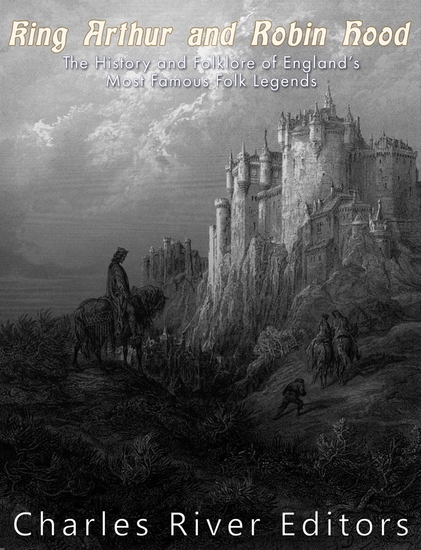
King Arthur and Robin Hood - The History and Folklore of England’s Most Famous Folk Legends - cover

King Arthur and Robin Hood - The History and Folklore of England’s Most Famous Folk Legends

Editors Charles River

Publisher: Charles River Editors

  • 0
  • 0
  • 0

Summary

King Arthur is one of the most famous names in history, and his name still evokes visions of fantasy, chivalry, bravery, and more even today. Arthur remains a pop culture fixture around the globe, made famous in various Arthurian tales written by writers like Chretien de Troyes. Arthur came to embody the ideals of the Middle Ages: strength, chivalry, bravery, and more. Along the way, his Excalibur sword, the Holy Grail, his queen, and more have all become household words.
 
Arthur has long been identified as a folk hero, and there are countless tales that comprise the Arthurian legend, but was there an actual person that the original stories were based on? People still search for the seeds of truth in the Knights of the Round Table, and the historical figure that inspired the Arthurian tales.
 
Of course, as with all great myths, and even those with a kernel of truth behind them, there is no "real" Arthur. Arthur is now comprised of the works written by diverse storytellers, most of which have built upon the ancient stories and possibly history. It is from there that a primordial seed of myth remains at the heart of all the retellings. At the same time, Arthur’s story is one of transformation, as he is brought from the Middle Ages into the Renaissance and more modern times. And that story also includes the famous contemporaries in his stories and other important historical figures, like Geoffrey of Monmouth, the imprisoned Sir Thomas Mallory and Walt Disney.
 
When looking for the historical and mythical Arthur, scholars try to understand how the Arthur of these tales and of others like Disney's Sword in the Stone and Monty Python and the Holy Grail came to be.  What are the origins of the Arthur legend and what can they tell people about the past?  What is the historical basis for King Arthur, if any?
 
There are few characters in the English language more iconic than Robin Hood.  Emerging out of the ballads of the High Middle Ages and surviving through numerous permutations to the present day, the green-clad archer has become an icon.  Today he represents a playful, irreverent and cunning resistance to corruption and injustice, associated primarily with stealing from the rich and giving to the poor. Robin Hood’s selfless acts of helping the masses at the expense of himself (by not keeping his treasure) have led to contemporary figures like Bill Gates being called “Modern Day Robin Hoods”, and when a British man robbed a bank in 2013 and handed out the money to homeless people before he was arrested and imprisoned, the name Robin Hood was naturally in the news once more.
 
Robin Hood is a celebrated folk hero and a kind of good thief, but the earliest stories about Robin Hood depict a far different character. The first Robin Hood was often a brutal and selfish yet also honorable figure, an anti-hero loved (perhaps paradoxically) by many social classes and loathed by authorities. When the notorious Gunpowder Plot was discovered at the beginning of the 17th century, the Earl of Salisbury condemned Guy Fawkes and the conspirators for being “Robin Hoods”. 
 
The transformation of Robin Hood over the centuries has left many scholars attempting to find the origins behind the original story. Like King Arthur, some have even sought a historical figure that might serve as the basis for Robin Hood, while others have sought out mythological origins to see if Robin Hood’s character evolved out of a mythological figure. When looking for the historical and mythical figure, scholars try to understand how the Robin Hood of these tales and came to be.  What are the origins of Robin Hood and what can they tell people about the past?  What is the historical basis for Robin Hood, if any?
Available since: 05/01/2025.
Print length: 73 pages.

Other books that might interest you

  • The Weimar Republic - Inflation Degeneration and Historicity - cover

    The Weimar Republic - Inflation...

    Kelly Mass

    • 0
    • 0
    • 0
    To summarize everything about this topic, the Weimar Republic was a disaster. Perhaps the setup of the republic wasn’t as much as fault as just the world events that led to the Great Depression, the eventual surrender of Germany to France, Russia, and England in World War I before that, and other significant changes in the economy at the time. 
    The Weimar Republic was a federal constitutional republic that lasted in Germany from 1918 to 1933. The German Reich (Deutsches Reich) was the main name of the state, which was also referred to as the German Republic (Deutsche Republik). The first word associates with the city of Weimar, which hosted the republic's first constituent assembly. The nation was typically described as "Germany" in English; the title "Weimar Republic" didn't become well-known till the 1930s. 
    Do you want to buy a few eggs with thousands of marks? How about a loaf of bread for ten thousand dollars? The inflation in the Weimar Republic led to a severe economic downturn, one that had probably never been there ever before. This led to other problems, which also explained the rise of Nazi Germany somewhat later. 
    If you want to understand all these things, then go ahead and get started.
    Show book
  • The Sociology of Religion - How Faith and Belief Systems Shape Social Life - cover

    The Sociology of Religion - How...

    Fred Grandsen

    • 0
    • 0
    • 0
    Religion has long been a fundamental aspect of human society, influencing cultures, shaping social norms, and providing meaning to people’s lives. The sociology of religion examines how faith and belief systems function within society, analyzing their impact on individuals, communities, and institutions. Unlike theological approaches that focus on the truth or divinity of religious doctrines, sociologists study religion as a social phenomenon, investigating its role in maintaining social order, fostering group identity, and driving social change. 
    One of the key concerns in the sociology of religion is understanding how religious beliefs and practices are shaped by broader social structures. Religious traditions do not exist in isolation; they are influenced by historical contexts, political systems, and economic conditions. For example, the rise of industrialization and urbanization has been linked to shifts in religious affiliation, with some societies experiencing a decline in traditional religious practices while others see the emergence of new forms of spirituality. 
    Sociologists also explore the role of religion in social cohesion and conflict. Many theorists, including Émile Durkheim, argue that religion serves as a unifying force, bringing people together through shared rituals, moral values, and collective worship. In this sense, religion helps to reinforce social bonds and provide a sense of belonging. However, religion can also be a source of division, contributing to sectarian conflicts, discrimination, and political struggles. The study of religious pluralism and interfaith relations highlights both the possibilities for coexistence and the challenges posed by religious diversity.
    Show book
  • Overcoming Stress-Induced Brain Fog - 10 Simple Ways to Find Focus Improve Memory and Feel Grounded - cover

    Overcoming Stress-Induced Brain...

    PhD Jill Weber

    • 0
    • 0
    • 0
    Do you ever feel spaced out or stuck in a rut, like you just can't think, or you're moving in slow motion? Perhaps you feel detached or disengaged, defeated and hopeless, or just not fully yourself. If you're struggling with a lack of mental clarity, energy, and belief in yourself and your capabilities, you may be experiencing the dreaded brain fog—a very real issue that can result from the exhaustion, overstimulation, and the stress of modern life. 


    All of us struggle to find the get-up-and-go we need sometimes, but when prolonged stress and anxiety begin to affect your ability to focus, concentrate, remember, solve problems, or communicate effectively on a regular basis, these symptoms may point to something more than just a stressful week. It's time to clear away the fog and reclaim your motivation, passion, self-worth, zest, and meaning in life. 


    Based on cutting-edge research, Overcoming Stress-Induced Brain Fog offers quick solutions you can put to work right away, including exercises based in awareness, mindfulness and acceptance, and self-compassion. With these ten easily accessible tools, you'll find your way out of the haze toward clarity, improved memory, and a greater presence to enjoy life.
    Show book
  • The Prophet - cover

    The Prophet

    Kahlil Gibran

    • 0
    • 0
    • 0
    The Prophet is a book beloved by millions for 100 years. The Prophet is a book of 26 prose poetry fables written in English by the Lebanese-American poet and writer Kahlil Gibran. It is Gibran's best-known work. 
    The prophet Al Mustafa has lived in the city of Orphalese for 12 years and is about to board a ship that will carry him home. He is stopped by a group of people with whom he discusses topics such as life and the human condition. The book is divided into chapters dealing with love, marriage, children, giving, eating and drinking, work, joy and sorrow, houses, clothes, buying and selling, crime and punishment, laws, freedom, reason and passion, pain, self-knowledge, teaching, friendship, talking, time, good and evil, prayer, pleasure, beauty, religion, and death. 
    Although published in 1923, the book contains universal wisdom that still rings true to this day and makes an excellent audiobook.
    Show book
  • Brave New World by Aldous Huxley (Book Analysis) - Detailed Summary Analysis and Reading Guide - cover

    Brave New World by Aldous Huxley...

    Bright Summaries

    • 0
    • 0
    • 0
    Unlock the more straightforward side of Brave New World with this concise and insightful summary and analysis!This engaging summary presents an analysis of Brave New World by Aldous Huxley, a pioneering science fiction novel which is generally considered one of the most significant English novels of the 20th century and remains a classic today. Its harrowing depiction of a totalitarian society built on a class system which is strictly enforced through the use of social conditioning and eugenics provides readers with a frightening glimpse of the future that could potentially await humanity, in which all emotions are suppressed and freedom is nothing more than an illusion. Aldous Huxley was a prolific English author who wrote nearly 50 novels, essays and other works of nonfiction. His writing often reflected his political beliefs, and he was a frequent nominee for the Nobel Prize in Literature. He died in 1963. Find out everything you need to know about Brave New World in a fraction of the time!This in-depth and informative reading guide brings you: • A complete plot summary • Character studies • Key themes and symbols • Questions for further reflectionWhy choose BrightSummaries.com?Available in print and digital format, our publications are designed to accompany you in your reading journey. The clear and concise style makes for easy understanding, providing the perfect opportunity to improve your literary knowledge in no time.See the very best of literature in a whole new light with BrightSummaries.com!
    Show book
  • Treasure Island: CEFR level A2 (ELT Graded Reader) - cover

    Treasure Island: CEFR level A2...

    Karen Kovacs

    • 0
    • 0
    • 0
    Improve your English in a fun way, without any extra studying, with books by Read Stories - Learn English. This book is adapted for learners at CEFR level A2 (pre-intermediate). 
    The men were quiet for a minute, then Squire Trelawney smiled and said, “We’re going to Bristol tomorrow!” 
    “Why?” I asked. 
    “I’m going to buy a ship there,” he explained, “then we’ll sail it to the island and find the treasure!" 
    Join Jim Hawkins on his exciting journey to Treasure Island. With scary pirates, dangerous battles and hidden gold, it's an adventure you won't forget!
    Show book