Join us on a literary world trip!
Add this book to bookshelf
Grey
Write a new comment Default profile 50px
Grey
Subscribe to read the full book or read the first pages for free!
All characters reduced
Karl Marx & The Communist Manifesto - The Life and Legacy of the Author and Book - cover

Karl Marx & The Communist Manifesto - The Life and Legacy of the Author and Book

Editors Charles River

Publisher: Charles River Editors

  • 0
  • 0
  • 0

Summary

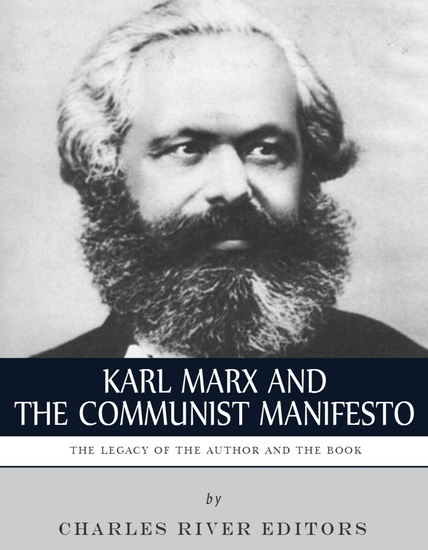
It would be almost impossible to exaggerate the influence Karl Marx has had upon the world in the last 150 years. Marx was an influential historian, journalist and economist who is widely considered one of the first social scientists, but he is best remembered for advocating socialism, particularly the brand that would take his name. As the father of Marxism, Marx predicted that capitalistic societies, ruled by a “dictatorship of the bourgeoise”, would eventually give way via class struggles to a “dictatorship of the proletariat”, and eventually to a more stateless form of communism.


Marx certainly wasn’t the first to espouse these kinds of political views, but nobody before or since had as much influence in actually bringing about the implementation of their ideas. Working with Friedrich Engels and others, Marx went about authoring a series of works, most notably The Communist Manifesto (1848) and Capital (1867-1894), championing his ideas.


The Communist Manifesto is in several respects a paradoxical document.  A product of the Western European political struggles that culminated in the pan-European Revolutions of 1848, its greatest historical impact was nevertheless not felt until the following century, in countries far from Western Europe (Russia and China) that Marx and Engels would never have viewed as ripe for revolutionary activity.  The Manifesto was written as a diagnosis of the ills of what is often called high industrial capitalism, yet in many ways the world it describes, in which “all that is solid melts into air,” sounds more like a prediction of a globalized capitalist world of political flux, virtual life, and accelerated time than a description of Marx’s era, in which monarchies and established churches still wielded immense power across Europe.  Moreover, although the best-known attempts to put Marx’s and Engels’s program into practice failed and are now in almost universal disrepute, the fundamental contradictions and deadlocks of capitalist society they present so vividly are still awaiting adequate remedies. 


While Marx laid out the ideological groundwork, many put it into action, leading to the formation of socialist powers in the Soviet Union and China during the first half of the 20th century. Marx’s writings and philosophy had an impact on the social sciences and economic theories, but one of his biographers could comfortably and accurately assert that the political history of the 20th century was “Marx’s legacy”. Whether fairly or not, in the West Marx has become inextricably linked with some of the totalitarian excesses of the regimes that claimed to espouse his ideology, and for that reason Marx is often associated with some of the negative connotations that come with the Soviets. Nevertheless, few would deny the very decisive impact Marxism had on the global landscape, and the ramifications continue to have a political influence today.


Karl Marx and The Communist Manifesto chronicles the life of the revolutionary socialist and his seminal work, analyzing its ideological themes and its influential and enduring legacy. Along with pictures of important people, places and events, you will learn about Marx and the Manifesto like you never have before, in no time at all.
Available since: 05/28/2025.
Print length: 85 pages.
Other books that might interest you

  • Pisits Sophia - The Mystical Teachings of Light and Redemption - cover

    Pisits Sophia - The Mystical...

    Anonymous (Gnostic Tradition),...

    • 0
    • 0
    • 0
    What is the path to spiritual redemption? How can divine wisdom illuminate the soul’s journey to the Light? 
    Pistis Sophia is one of the most profound and mystical texts of the early Gnostic tradition.  
    Attributed to the teachings of Jesus after his resurrection, this sacred work reveals esoteric dialogues with his disciples—exploring the soul’s ascent, the cosmic battle between Light and darkness, and the mysteries of divine knowledge and redemption. 
    Now available in a clear, modern translation, this edition brings the deep spiritual insights of Pistis Sophia to today’s listener, preserving its mysticism while offering clarity and inspiration. 
    What you'll discover inside: 
    •	The Journey of the Soul – Follow Pistis Sophia’s ascent from the lower realms of darkness to the Light above 
    •	The Mysteries of the Higher Realms – Jesus’ teachings on divine hierarchies, cosmic structure, and spiritual awakening 
    •	Redemption and Divine Wisdom – Lessons on faith, knowledge, and the transformative power of spiritual perseverance 
    •	A Window into Gnostic Thought – Insight into early Christian mysticism, theology, and the soul’s divine purpose 
    Whether you’re a spiritual seeker, a student of ancient texts, or exploring Gnostic wisdom for the first time, Pistis Sophia offers timeless guidance for the soul’s journey toward redemption and enlightenment. 
    Begin your journey today—and uncover the mystical path to divine Light.
    Show book
  • Islands - Searching for truth on the shoreline - cover

    Islands - Searching for truth on...

    Mark Aston

    • 0
    • 0
    • 0
    "A spellbinding serial voyage in which encounters with islands across time are gathered, displayed and reburnished. Memoir becomes morality, as the oldest human myths challenge present neglect and political malfunction." – Iain Sinclair
    "Illuminating, incisive and beautifully written." – Kirsty Young
    "From ancient Crete to modern Canvey, this is a fascinating voyage around island identity, exploring isolation and imagination through a wealth of stories from around the world." – Martha Kearney
    "A timely and original exploration of the liminalities of islands and the waters that envelop them: by turns beguiling, enchanting and ultimately affirming." – Sir Anthony Seldon
    "This is a huge theme which Mark Easton pursues with vigorous and beautifully clear prose. His archipelagic fascination is contagious. Read this and the maps in your mind will never be quite the same again." – Peter Hennessy
    ***
    No man is an island, wrote John Donne. BBC Home Editor Mark Easton argues the opposite: that we are all islands, and it is upon the contradictory shoreline where isolation meets connectedness, where 'us' meets 'them', that we find out who we truly are.
    Suggesting that a continental bias has blinded us, Easton chronicles a sweep of 250 million years of island history: from Pangaea (the supercontinent mother of all islands) to the first intrepid islanders pointing their canoes over the horizon, from exploration to occupation, exploitation to liberation, a hopeful journey to paradise and a chastening reminder of our planet's fragility.
    But that is only half of this mesmerising book: aided by the muse he names Pangaea, Easton also interweaves reflections on what he calls 'the psychological islands that form the great archipelago of humankind'. Taking readers on an enchanting adventure, he illustrates how understanding islands and island syndrome might help humanity get closer to the truth about itself.
    Brave, intelligent and haunting, Islands is a deep dive into geography, myth, literature, politics and philosophy that reveals nothing less than a map of the human heart.
    Show book
  • How the Paranormal Affects Mental Illness - And What Additional Therapies Apply - cover

    How the Paranormal Affects...

    Martin K. Ettington

    • 0
    • 0
    • 0
    My career was being trained as and working as an Engineer mostly for Fortune 100 companies. 
    In parallel with that I’ve also been working on spiritual enlightenment and developing my paranormal abilities for the last fifty years. 
    This unusual combination of skills has led me to my passion of writing about the paranormal and many “out of the box” concepts and topics. I’ve actually written twelve books about the paranormal based on my experiences and research into these topics. 
    One topic which has always fascinated me has been how many paranormal experiences are usually interpreted by mental health professionals as delusional and mentally ill behaviors. 
    My thinking is that most people have spiritual and paranormal abilities and these cause experiences which can overwhelm some people to make them fit the diagnosis of them having mental illnesses. 
    Certainly there are a lot of legitimate mental illnesses which cause the need for treatments by mental health professionals. 
    But what happens when persons having these experiences may be normal and stable in their other behaviors but these experiences are so far beyond the norms of society that others think they are “crazy” and therefore treat them as such? 
    I’ve heard and read a number of stories over the years where I wonder if they were real experiences which might have just caused the person who lived them to have a nervous breakdown. 
    This book is my effort to help people understand the interfaces of real paranormal experiences and mental illness and how to tell which is which. 
    Also, what additional therapies can be used to help people who may be overwhelmed by these experiences?
    Show book
  • History of Colombia - An Overview of Its Politics Corruption and Culture - cover

    History of Colombia - An...

    Kelly Mass

    • 0
    • 0
    • 0
    Colombia’s history is marked by a rich tapestry of indigenous cultures and societies, which laid the foundations for the diverse nation that exists today. Long before the Spanish arrived in 1492, the region was home to advanced civilizations such as the Muisca Confederation, the Quimbaya Civilization, and the Tairona Chiefdoms. These indigenous groups thrived in Colombia's varied geography, establishing complex societies with sophisticated agricultural practices, intricate trade networks, and elaborate spiritual beliefs. 
    The Spanish conquest of the Americas brought significant change to the region. Following Christopher Columbus's arrival in the Caribbean, Spanish explorers began their colonization efforts. In 1538, the Spanish established Bogotá, which became the capital of the Viceroyalty of New Granada. This vast colonial territory included what is now Colombia, Ecuador, Panama, and Venezuela. The Spanish imposed their rule over the indigenous peoples, exploiting both the land and the labor of native communities, which would profoundly shape the future of the region.
    Show book
  • Speaking Out - Lectures and Speeches 1937-1958 - cover

    Speaking Out - Lectures and...

    Albert Camus

    • 0
    • 0
    • 0
    The Nobel Prize winner’s most influential and enduring lectures and speeches, newly translated by Quintin Hoare, in what is the first English-language publication of this complete collection. 
     
    Albert Camus (1913–1960) is unsurpassed among writers for a body of work that animates the wonder and absurdity of existence. Speaking Out: Lectures and Speeches, 1937–1958 brings together, for the first time, thirty-four public  
    statements from across Camus’s career that reveal his radical commitment to justice around the world and his role as a public intellectual. 
     
    From his 1946 lecture at Columbia University about humanity’s moral decline to his 1951 BBC broadcast commenting on Britain’s general election; and from his strident appeal during the Algerian conflict for a civilian truce between Algeria and  
    France to his speeches on Dostoevsky and Don Quixote, this essential collection reflects the scope of Camus’s political and cultural influence.
    Show book
  • Fifth Crusade The: The History of the Christian Campaign to Retake Jerusalem - cover

    Fifth Crusade The: The History...

    Charles River Editors

    • 0
    • 0
    • 0
    In the 50 years following the First Crusade, the Latin states in the East were consolidated, but there were also growing tensions and new challenges. Against this backdrop, the fall of the County of Edessa in December 1144 at the hands of Zengi, the atabeg of Aleppo and Mosul, was a catastrophic event. Founded in 1098 by the future King Baldwin of Boulogne, Edessa was the first Crusader state, as well as the northernmost, weakest, and least populated. It was constantly exposed to Muslim attacks, and news of its fall reached Europe at the beginning of 1145, and the fall was the catalyst for the Second Crusade. Furthermore, the Crusader States were also concerned about their relationship with the Byzantine Empire, as relations with the Byzantines were often tense. Indeed, efforts to strengthen and then retake parts of the collapsing Crusader States would fuel subsequent Crusades, and the Fourth Crusade notoriously ended with the Crusaders sacking Constantinople instead of proceeding to Jerusalem.  
    	Naturally, the Fifth Crusade was launched as a result of the Fourth Crusade’s failure to retake Jerusalem, and Pope Innocent III’s goal of reclaiming Jerusalem, which had been lost in 1187, remained unchanged.[1] At the same time, there was a truce between the Kingdom of Jerusalem and the Ayyubid Sultan al-‘Adil I, which was due to expire in 1217. The timing seemed favorable for a new initiative, particularly given the strengthening of Christendom in other regions such as Spain, where the victory at Las Navas de Tolosa in 1212 had secured much of the Iberian Peninsula against the Moors. The turning point for the proclamation of the Fifth Crusade was the Fourth Lateran Council in 1215, where Innocent III established a model for future Crusades, providing the enterprise with consistent legal, liturgical, and fiscal provisions.
    Show book