Join us on a literary world trip!
Add this book to bookshelf
Grey
Write a new comment Default profile 50px
Grey
Subscribe to read the full book or read the first pages for free!
All characters reduced
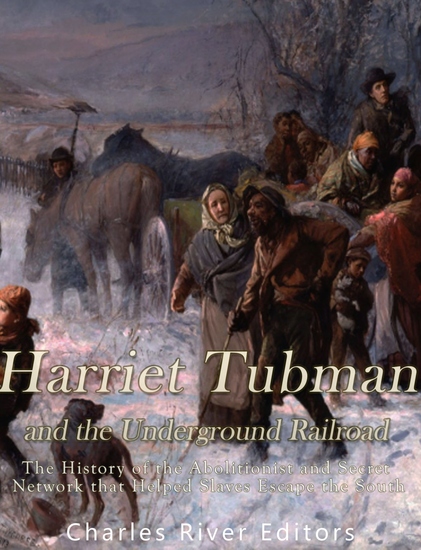
Harriet Tubman and the Underground Railroad - The History of the Abolitionist and Secret Network that Helped Slaves Escape the South - cover

Harriet Tubman and the Underground Railroad - The History of the Abolitionist and Secret Network that Helped Slaves Escape the South

Editors Charles River

Publisher: Charles River Editors

  • 0
  • 0
  • 0

Summary

The Underground Railroad is one of the most taught topics to young schoolchildren, and every American is familiar with the idea of fugitive slaves escaping to Canada and the North with the help of determined abolitionists and even former escaped slaves like Harriet Tubman. The secrecy involved in the Underground Railroad made it one of the most mysterious aspects of the mid-19th century in America, to the extent that claims spread that 100,000 slaves had escaped via the Underground Railroad. Of course, from a practical standpoint, the Underground Railroad had to remain covert not only for the sake of thousands of slaves, but for a small army of men and women of every race, religion and economic class who put themselves in peril on an ongoing basis throughout the first half of the 19th century, and in the years leading up to the war.
 
Over 150 years later, that same secrecy has helped the Underground Railroad become so romanticized and mythologized that people often visualize it in ways that were far different from reality. Before the American Civil War eliminated slavery, it was a fixture in North America for over 200 years, and by 1850 a trained slave was worth approximately $2,500, around 10 times the sum of a typical annual salary in that day. As a result, the economic dependence on slavery in the South was an extreme one, and in the wake of the Fugitive Slave Act, black people in the North were under constant pressure to defend their “credentials” to bounty hunters and owners. Between the value of slaves in America, rising abolitionist sentiment at home and overseas, and political debates promoting or hindering the movement toward equality, the era in which the Underground Railroad operated cannot be easily fit into a concise body of principles, actions or geography.
 
Hilary Russell may have put it best in saying of the Underground Railroad that while “a powerful and centralized system may not have existed but in legend, localized networks did.”[1] Communication standards over long distances being what they were in that century, she is most likely correct. The Underground Railroad was neither a true railroad nor underground, and it was not a route but a network comprised of a widespread conspiracy and social rebellion against present law. For the most part, people working on the Underground Railroad tried to protect themselves by not knowing the full details of the routes they were working on; instead, many people just played individual parts for the greater good.
 
Harriet Tubman is one of the most famous women in American history, and from an early age every American learns of her contributions to abolition and the Underground Railroad. The woman who became known as the Moses of her people personally led more than 13 expeditions to free slaves in the South, and she was so integral in helping escaped slaves achieve freedom that her name is practically synonymous with the Underground Railroad today.
 
If anything, the central role she played in the Underground Railroad has become so ingrained among subsequent generations that Tubman’s life has been shrouded in legend, and other important aspects have been overlooked. In order to fully appreciate and understand both Harriet Tubman’s life and the important role she played in the abolitionist movement, it is necessary to examine the circumstances in which she was raised and what events drove her to the path she chose. Anthropologist Douglas Armstrong notes “[s]o little information about Tubman has been based on fact and so much based on myth and created history” that it has only been recently that historians have “come to the point where we can recognize her true contributions.”
Available since: 05/01/2025.
Print length: 86 pages.

Other books that might interest you

  • EVERY DAY IS SATURDAY - Recognizing dementia symptoms and how to deal with them - cover

    EVERY DAY IS SATURDAY -...

    ROD MCCOMBIE

    • 0
    • 0
    • 0
    Discover a heartwarming and insightful journey through the challenges and unexpected moments of living with dementia in Every Day is Saturday. Rod McCombie shares his personal experience following his wife Jeannine's diagnosis in June 2022. This book offers a unique perspective, embracing the humour and finding positivity in the face of a condition that defies logic. Inspired by Jeannine's consistent belief that every day is Saturday, Rod illustrates how adapting and understanding the perspective of a loved one with dementia can minimize stress and enhance quality of life. Learn from their experiences, from navigating a confusing world to cherishing simple joys. Rod, a Chartered Certified accountant, provides practical insights and a compassionate approach, aiming to offer comfort and a different view on dementia for fellow caregivers and anyone seeking to understand this challenging condition.
    Show book
  • Book summary & analysis of Braiding Sweetgrass by Robin Wall Kimmerer - cover

    Book summary & analysis of...

    Briefly Summaries

    • 0
    • 0
    • 0
    This is a concise summary and analysis of Braiding Sweetgrass, by Robin Wall Kimmerer. It is not the original book and is not affiliated with or endorsed by Robin Wall Kimmerer. Ideal for those seeking a quick and insightful overview.
     
    Braiding Sweetgrass is a meditative exploration of the intersection between science, culture, and the natural world. Blending Indigenous wisdom with ecological knowledge, the book invites readers to reimagine their relationship with nature through stories, reflections, and lessons grounded in reciprocity and respect. Through the lens of botany and personal experience, it portrays plants not just as resources, but as teachers and relatives—offering a poetic call to heal the human connection with the Earth.
    Show book
  • The Funny Stuff - The Official P J O’Rourke Quotationary and Riffapedia - cover

    The Funny Stuff - The Official P...

    P. J. O'Rourke

    • 0
    • 0
    • 0
    A compendium of quotes and riffs by P.J. O'Rourke on subjects ranging from government to fishing to apps, to be published on what would have been his seventy-fifth birthday. 


    When The Penguin Dictionary of Modern Humorous Quotations was published in 1994, P. J. O'Rourke had more entries than any living writer. And he kept writing funny stuff for another twenty-eight years. Now, for the first time, the best material is collected in  one volume. Edited by Terry McDonell, The Funny Stuff is arranged in six sections, organized by subject in alphabetical order from Agriculture to Xenophobia. From his earliest days at the National Lampoon in the 1970s, through his classic reporting for Rolling Stone in the '80s and '90s to his post-Trump, pandemic, new media observations of recent years, P. J. produced incisive, amusing copy. Not only did P. J. write memorable one-liners, he also meticulously constructed riffs that are still being quoted years later. His prose has the electric verbal energy of Tom Wolfe or Hunter Thompson, but P. J. is more flat out funny. And through it all comes his clear-eyed take on politics, economics, human nature—and fun. The Funny Stuff is a book for P. J. fans to devour but also a book that will bring new audiences and stand as testament to one of the truly original American writers of the last fifty years.
    Show book
  • Early Greek Philosophy & Other Essays - cover

    Early Greek Philosophy & Other...

    Friedrich Nietzsche

    • 0
    • 0
    • 0
    "The essays contained in this volume treat of various subjects. With the exception of perhaps one we must consider all these papers as fragments. Written during the early Seventies, and intended mostly as prefaces, they are extremely interesting, since traces of Nietzsche's later tenets—like Slave and Master morality, the Superman—can be found everywhere. But they are also very valuable on account of the young philosopher's daring and able handling of difficult and abstruse subjects. "Truth and Falsity," and "The Greek Woman" are probably the two essays which will prove most attractive to the average reader."
    Show book
  • Nobel Prize The: Ten Winners - A Short Story Collection - Stories from authors that won the legendary Nobel prize for their writing - cover

    Nobel Prize The: Ten Winners - A...

    W B Yeats

    • 0
    • 0
    • 0
    Being acknowledged for what you do is always very welcome.   When it comes to Oscar’s, Emmy’s, Pulitzer’s and Nobel’s it’s also international news and for many, the pinnacle of their career. 
     
    The Nobel Prize is much lauded and very difficult to secure.  In this volume we list ten of its winners over the decades who were famed for their literature.  The prize is given with an emphasis on its contribution to literature and its influence in the world and for the individual, more usually, for the body of work created. 
     
    So, whilst none of the stories in this volume were winners in their own right, their authors most certainly were.  They perfectly illustrate both the nature and mastery of the writing and the power and the purpose set within its storied prose. 
     
    1 - The Nobel Prize - Ten Winners - An Introduction 
    2 - The Father by Bjornstjerne Bjornson 
    3 - The Phantom Rickshaw by Rudyard Kipling 
    4 - The Victory by Rabindranath Tagore 
    5 - An Arch Rascal by Knut Hamsun 
    6 - The Daughter of Lilith by Anatole France 
    7 - Dhoya by W B Yeats 
    8 - Speed by Sinclair Lewis 
    9 - The Salvation of a Forsythe - Part 1 by John Galsworthy 
    10 - The Salvation of a Forsythe - Part 2 by John Galsworthy 
    11 - Son by Ivan Bunin 
    12 - Sicilian Limes by Luigi Pirandello
    Show book
  • Jaanbaaz Rakha - Sant Jarnail Singh Da Ubhar - cover

    Jaanbaaz Rakha - Sant Jarnail...

    A.R.Darshi

    • 0
    • 0
    • 0
    "Jaanbaaz Rakha" by A.R.Darshi 
    The author of the book is a retired officer from the Punjab Civil Services, who has had firsthand experience with government policies. In this book, he shares an honest account of important historical events related to Punjab and Sikh history, particularly focusing on the life of Sant Jarnail Singh Bhindranwale. The author aims to present a clear and truthful story of the key events that shaped the political and social history of Punjab and Sikhism. 
    You can order it from Sikh Siyasat and get it delivered anywhere in the world.
    Show book